Bot, Bot-fly, Gad-fly, and Warble-fly, names common to many insects of the family Cestrææ, the genus Cestrus of Linnaeus. The name bot is sometimes restricted to the parasitic and destructive larvæ, which appears to have been its original use, the other names being given to the perfect adults, and the name gad-fly often to blood-sucking insects of the very different genus Tabanus (q.v.), to which some try to restrict it. The insects of this family are now supposed not to be those which were called Estrus by the ancients, although, like them, extremely troublesome to cattle. They are Dipterous (two-winged) (q.v.) insects, nearly allied to the Muscides (House-fly, Flesh-fly, Blow-fly, &c.).
The head is large, and as if blown out; the antennæ are short and spring from deep pits; the proboscis and palps are degenerate; the eyes are small, and there are three eye-spots; the posterior part of the body is rounded; the hindmost legs are often very long. The larvæ have toothed body-rings, and are parasitic in the nose, throat, stomach, or under the skin of mammals, and are unfortunately more familiar than the bee-like adults.
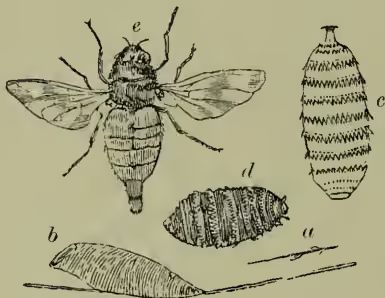
(1) The Horse-bot, or Gad-fly of the Horse (Gasterophilus, or Gastrus or Estrus equi), sometimes also called the Breeze and Horse-bee, is much less common in Britain than in some parts of the continent of Europe, and occurs chiefly in elevated heathy districts. It is not quite half an inch in length, woolly, with yellowish-gray head, rusty thorax and abdomen, and whitish wings, with brownish-gray spots. The abdomen of the female ends in a black horny egg-laying tube. In the later part of summer, the female hovers about horses, and deposits her eggs on their hairs, where they remain attached by a glutinous substance, until they, or the larvæ just emerging from them, are licked off by the tongue of the horse, their destined place being its stomach. It is believed that the fly deposits her eggs only on those parts which are accessible to the horse's tongue, seeming to prefer the back of the knee-joint, where they may sometimes be found in hundreds. The larva is yellowish, without feet, short, thick, soft, composed of rings which have a double row of short teeth surrounding them; it is somewhat sharply pointed at one end—the head; and the mouth is furnished with two hooks, one on each side, for taking hold of the inner coat of the horse's stomach, to which the bot attaches itself, and from which it derives its subsistence, hanging in clusters sometimes of three or four, sometimes of more than one hundred. Here it spends the winter, and in the following summer, when it is about an inch long, it disengages itself, and being carried through the horse's intestines, burrows in the ground, and changes into an oval black pupa with spiny rings, from which, in a few weeks, the perfect insect comes forth. Multitudes, of course, become the prey of birds before they can accomplish their burrowing. It has been disputed whether or not bots are very injurious to horses; and some have with apparent improbability main- tained that, when not excessively numerous, their presence is rather beneficial.—The Red-tailed Horse-bot (G. hæmorrhoidalis), also a British species, deposits its eggs upon the lips of the horse, distressing it very much by the annoyance which it gives in so doing. The larvæ attach themselves chiefly to the surface of the intestine and about the anus of the horse, and sometimes cause an annoying irritation. Linseed-oil is used for their removal. G. nasalis also finds its way into the stomach, more frequently the small intestine, of the horse.
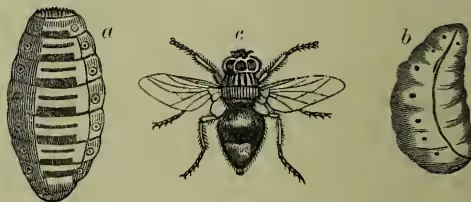
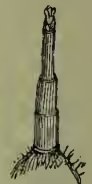
(2) The Ox-bot, Ox Gad-fly, or Warble-fly (Hypoderma or Estrus bovis), is more troublesome than any species of horse-bot. It is a beautiful insect, not unlike a humble-bee, not quite half an inch long, and thicker in proportion than the horse-bots; it has brown unspotted wings; the face whitish, the crown of the head brown, the thorax black, the abdomen whitish, with a broad black band around the middle, and yellow hairs at the extremity, where also the female has an ovipositor, a remarkable organ, formed of a horny substance, and consisting of four tubes retractile within one another, like the pieces of a telescope; and the last of them terminating in five points, three of which are longer than the others, and hooked. By means of this organ, a small round hole is pierced in the hide of an ox's back, in which an egg is deposited. Egg-laying takes place during summer, especially in heat and sunshine; hence the importance of cattle having shade, and when possible water shelter. The fly is very quick in depositing her egg, not remaining upon the back of the animal more than a few seconds. Cattle exhibit great alarm and excitement at the presence of the warble-fly, and rush wildly about, with head stretched forward, and tail stuck out, to escape from their tormentor. The further injury done by this insect is often, however, very great; the larva—a little pearl-white maggot (warble or wormal)—feeding upon the juices beneath the skin, causes a swelling, called a warble, forming a sort of sac, within which it lives and grows, amidst a kind of purulent matter suited to its appetite; and from which it finally emerges, leaving a small sore, and like the horse-bot, undergoes its further transformations in the ground. The warbles open in January or February, and a breathing chimney communicates with the surface; the larvæ should then be squeezed out, and smothered with any thick greasy matter, such as McDougall's dip, cart-grease and sulphur, &c. To prevent the panic and often fatal galloping, train-oil, preferably with some flowers of sulphur and spirits of tar, should be rubbed on spine, loins, and ribs. Warbles also occur, usually singly, under the skin of horses.
(3) The Sheep-bot (Estrus or Cephalomyia ovis) is a much more serious pest than any other British species, and is not unfrequently very destructive to flocks. The insect is smaller than either the ox-bot or horse-bot, is of a yellowish-gray colour, with a large head and yellow face, and is most abundant in damp situations and woody districts. It is to be seen chiefly in the months of June and
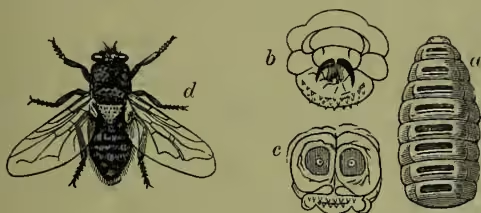
July. Sheep exhibit great alarm when it approaches them, and seem to seek, by keeping their noses close to the ground, and by incessant motion of their feet, to keep it from entering their nostrils. It is in the nostrils of the sheep that this fly deposits its eggs, and the larvæ, when hatched, make their way into the maxillary and frontal sinuses, feeding upon the juices there, until they are ready to change into the pupa state, in April or May of the following year, when they find their way again through the nostrils to the ground. They seem to cause great irritation in their progress up the nostrils of the sheep, and the poor animals run hither and thither, snorting and in great excitement. 'The common saying, that a whimsical person is maggoty, or has got maggots in his head, perhaps arose from the freaks the sheep have been observed to exhibit when infested by their bots.' The bots cause considerable irritation in the cavities, where they usually fix themselves, and sometimes getting into the brain cause death.—These larvæ move with considerable quickness, holding on by the hooks with which their mouth is furnished, and contracting and elongating the body. It is said that flocks fed where broom is in flower are never infested with them; and when many cases arise in a flock, removal to a dry soil is found particularly advantageous.
These three genera, with their three modes of parasitism, do not complete the list of bot-flies; Cephonomyia and Pharyngomyia are two others with several species infesting, in their larval state, deer, goats, and other hoofed mammals. Elephants are also afflicted; and Cuterebra deposits its eggs under the skin of haies and the like. The eggs of one of the species which attacks the fallow-deer are deposited in the nostrils, and the larvæ make their way in large numbers to a cavity near the pharynx. Reindeer are excessively tormented by these insects, one kind depositing its eggs in their nostrils, and another in their skin; and it is no unfrequent thing for a large part of a flock to be destroyed by them. When feeding where bot-flies are numerous, they are said to keep such watch against them, that they neglect to eat, become emaciated, and often actually perish in consequence. Even human beings are said to be sometimes afflicted by insects of this family. Humboldt saw Indians in South America having the abdomen covered with tumours produced by their larvæ. They touch human life more certainly and disastrously in an indirect way by the injuries they inflict upon stock. Dairy and sheep farmers, and stock-keepers generally, not to speak of leather manufacturers, know well the disastrous work of these bot larvæ. 'The attack of warbles (alone) is now grown to be one causing enormous annual national loss, estimated by practical men at sums from two million to seven million pounds sterling per annum, at the least, and there is no reason why we should suffer it to go on' (Miss Ormerod, 1887). Those practically interested should consult Miss Ormerod's reports on the Warble-fly and other insect pests.