Bothriocephalus (Gr. bothrion, 'a little pit,' and cephalē, 'the head'), a flat parasitic worm allied to the tapeworm (Tænia), in the class Cestoda. In its adult stage it is chiefly found in man and dogs, and is common in some parts of Europe, such as Western Switzerland, Northern and North-western Russia, Sweden, &c. The adult form consists of a small 'head' without hooks, but with two spindle-shaped lateral suckers, and of a long chain of joints budded off from the attached region. The joints are at first very slender, but gradually increase in length and breadth (the latter always the greater), and become at a certain distance from the head sexually mature 'individuals.' The joints differ conspicuously from those of the common tapeworm in the position of the genital apertures on the flat surface, and also in this, that they are not liberated from the host individually, but in stretches of a few at a time. The total chain may attain the prodigious length of 5 to 10 yards.
Bothriocephalus.
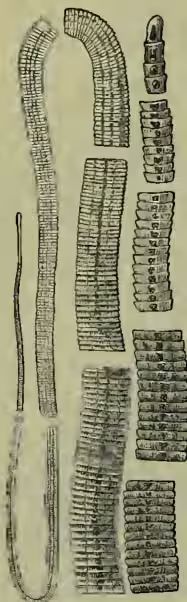
The life-history of the common Bothriocephalus of man (B. latus) cannot yet be said to be fully known with certainty. The embryo which escapes from the eggs of the ripe expelled joints (proglottides) differs from that of the Tænia in being ciliated and devoid of hooks. It is free-swimming, and passes, according to Braun, into a fresh-water fish—Pike (Esox) or Burbot (Lota vulgaris). There it becomes the usual asexual bladder-worm, after it has passed from the gut into the muscle of the fish. When the fish is eaten raw or half-cooked by dog or man, the bladder-worm becomes the 'head' of the Bothriocephalus, and attaching itself to the intestine, buds off the long chain of sexual individuals or joints. These are liberated as they ripen, and so the vicious circle is complete. B. cordatus is another not uncommon species found in fish-eating animals and occasionally in man. There are numerous species, some of which occur, as we would expect, in birds. Bothriocephalus is not so firmly attached to its host as the Tænia usually is, and thus admits more readily of expulsion by purgatives and similar expedients. An obvious preventive precaution for man is to see that the fish (Esox and Lota) be well cooked. See CESTODES, PARASITISM, TAPEWORM; and Leuckart's Parasitics of Man.