Boulders. ERRATIC, are large masses of rock found at a distance from the formations to which they belong. The term is generally applied when they are found lying detached on the surface.
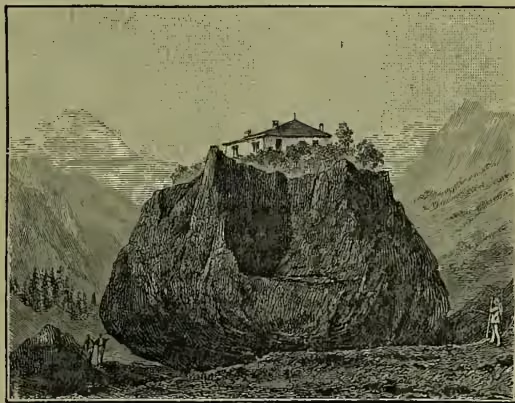
Large blocks of Scandinavian rocks are scattered over the plains of Denmark, Prussia, and Northern Germany. From their magnitude and number they frequently form a striking feature in the landscape. Some of these have been washed out of the Boulder-clay (q.v.), but the larger number are dotted over the surface of the terminal moraines of the great northern ice-sheet (see GLACIAL PERIOD). They abound on the shores of the Firth of Forth. Such boulders are simply the residue of the boulder-clay which has been denuded and washed away by the action of the sea. The pedestal of the statue of Peter the Great, in St Petersburg, was hewn out of a large erratic boulder, 1500 tons in weight, that lay on a marshy plain near that city. The boulder called Pierre de Marmettes at Monthey, in the canton of Valais, contains 70,630 cubic feet, and is large enough to have a chalet built on it. From the nature of the stone, it is believed to have been carried by glacier action a distance of 35 miles down the valley. On the other hand, the well-known 'Boulder Stone' of Borrowdale (q.v.) is simply a detached block, which has fallen from the adjacent crags.