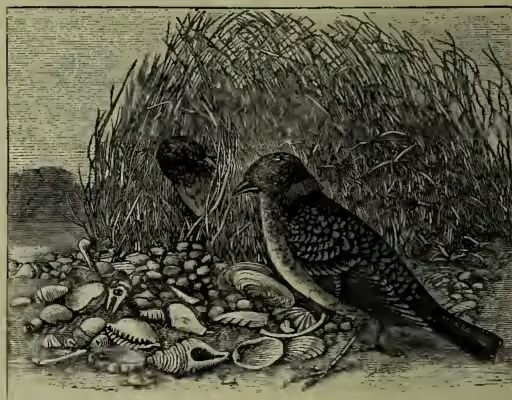
Bower-bird, a name given to certain Australian birds, probably in the great family of Timeliæ, or babbling thrushes, remarkable for their habit of making bower-like erections, called runs by the colonists of New South Wales, and for adorning them with gay feathers, rags, bones, shells, and such other white or brightly coloured objects as they can pick up. These bowers are not used as nests, but they appear to be places of much resort at the breeding-season in particular. Their structure has been carefully examined, and fine specimens of them, transported with no little difficulty, were deposited in the British Museum by Mr Gould, in whose magnificent work on the Birds of Australia (1848) a full account of them was first given to the world. The bowers of the Satin Bower-bird (Ptilonorhynchus holosericeus) are built among the low branches of some tree, and appear to be repaired and frequented from year to year. The base consists of an extensive and rather convex platform of sticks, firmly interwoven, on the centre of which the bower itself is built of more flexible twigs. It is chiefly at and near the entrance that the shells, feathers, &c. employed for decoration are placed. The bowers of the Spotted Bower-bird (Chlamydodera maculata) are longer and more avenue-like than those of the satin bower-bird; they are placed upon the ground, are outwardly built of twigs, and beautifully lined with tall grasses so disposed that their heads nearly meet. The decorative propensity appears in the highest degree in this species. 'In some of the larger bowers, which had evidently been resorted to for many years,' Mr Gould says, 'I have seen nearly half a bushel of bones, shells, &c. at each of the entrances.' These are arranged in much the same way at both entrances. Small pebbles are often transported by the birds from considerable distances.
The satin bower-bird is particularly abundant in the mountainous districts of the west of New South Wales, and is found in all the 'brushes' from the mountains to the coast. The adult male has the whole plumage of a deep, shining black. The colours of the female are grayish green and brown, curiously mingled.—The Spotted Bower-bird, which is rather smaller than the satin bower-bird, or about the size of a starling, has a general colour of rich brown, beautifully marked with black and buff; a band of elongated feathers of light rose-pink crosses the back of the neck, and forms a broad, fan-like, occipital crest. It is restricted exclusively to the interior of Australia.—The Regent-bird (Sericulus melinus) has also been shown to form bowers. Mr Coxen, an Australian ornithologist, to whom many interesting observations on bower-birds are due, has described the love-tent of the regent-bird. It is less dome-shaped and smaller than that of the satin bower-bird, and appears to be wholly adorned with snail-shells. The use of such elaborate contrivances in the process of courtship, and the possession of such obvious æsthetic tastes, are circumstances of great interest in estimating the height of development reached by birds.