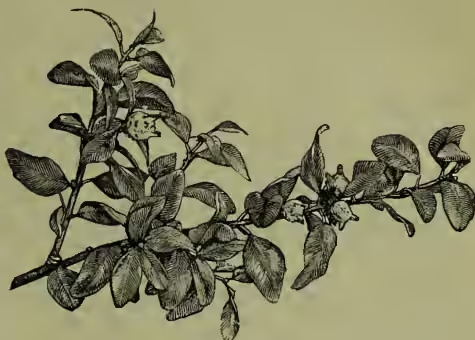
Box (Buxus), a genus usually reckoned to belong to the Euphorbiaceæ; evergreen shrubs or small trees, with greenish inconspicuous monocious flowers in little axillary spikes or fascicles. The Common Box (B. sempervirens) grows wild through South Europe, North Africa, North Asia to Japan, West Asia to West Himalaya. It is generally regarded as a true native of Surrey and the south of England, where it grows on dry chalky hills. In Britain, it seldom attains a height of more than 12 or 14 feet, though in warmer countries it is often twice that height, and though the three classic box-trees in Queen Mary's 'child-garden' at Inchmahome, in the Lake of Menteith, are 20½ feet high. The box is remarkable for its compact habit of growth and densely crowded branches and leaves, presenting a very solid mass of foliage, hence it bears clipping remarkably well; and in the old 'topiary' style of ornamental gardening it occupied an important place, being cut into architectural and fantastic figures. A dwarf variety is used for edging garden-plots, and different kinds are grown in our shrubberies. The bitter and purgative leaves are no longer officinal. The wood of the box is heavier than that of any other European tree, and is the only European wood that sinks in water. It is of a beautiful pale-yellow colour, remarkably hard and strong, of a fine regular and compact texture, capable of a beautiful polish, and not liable to be worm-eaten. It is much valued for the purposes of the turner and the wood-carver; is preferred to every other kind of wood for the manufacture of flutes, flageolets, and other wind-instruments, as well as of mathematical instruments; and is unrivalled for wood-engraving, admitting of a finish as sharp and fine as metal, whilst it takes the ink much better (see ENGRAVING). The box of commerce comes mainly from Caucasias, parts of Turkey in Asia, and Persia; but the reckless destruction of the box-trees has rendered the supplies scarce and dear. In 1815 as many box-trees were cut down at Box Hill, in Surrey, as brought upwards of £10,000; but the tree is of so very slow growth that it is seldom planted in Britain except for ornament.—The Minorca Box, or Balearic Box (B. balearica), a native of the Mediterranean countries, &c., is a larger tree than the common box. The wood is of a bright yellow, and inferior to the true box-wood, but is brought in large quantities from Constantinople under that name.