Bracken, or BRAKE, a large genus of Ferns of the division Polypodea, distinguished by spore-cases in marginal lines covered by the reflexed margin of the frond. It is very widely distributed from arctic and temperate to tropical countries. The Common Bracken (Pteris aquilina) is the largest, commonest, and handsomest of European ferns, often covering considerable tracts in woods and parks, or on heaths and hills. It has a long, creeping, black rhizome, or root-stock, behind the apex of which a new frond arises annually. The fronds are bipinnate, but the first two pinnae are as large as the remainder of the frond, which is moreover bent into the same horizontal plane, so producing a three-branched appearance, which is very characteristic.
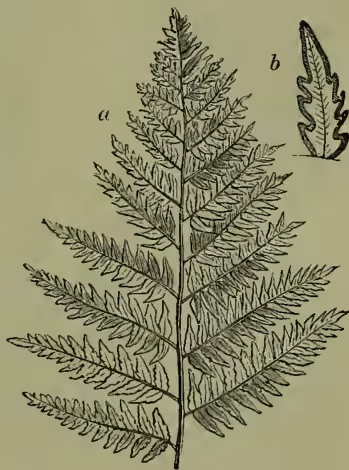
The fibro-vascular bundles of the stalk of the frond, when cut across, exhibit an appearance slightly resembling a spread eagle, whence the specific name aquilina (Lat. aquila, 'an eagle'); while the two dark strands of sclerenchyma in the root-stock suggest the letters J C, whence the medieval name of Christ-root, and a character of sanctity confirmed by the crozier-like unrolling of the fronds in spring. The root-stock is bitter, and has been used as a substitute for hops; it has also been ground, mixed with barley, and made into a wretched bread in times of distress. It was of importance as a food-supply in Teneriffe, furnishing the so-called Helecho-bread. The plant is astringent and anthelmintic; and as such, it had at one time a high reputation in medicine, and was also employed in dressing kid and chamois leather. The ashes were formerly used in the manufacture of soap and glass. Bracken is also employed for thatching, for littering cattle, for manure, &c., and has been chopped up with straw or hay for feeding cattle. It is a favourite covert of deer and of other game. The abundance of this plant is sometimes regarded as a sign of poor land, although, probably, its absence from the richer soils is very much a result of cultivation. To extirpate it, nothing more is necessary than a few successive mowings of the young shoots as they appear. The annual growth of brake is killed by the first frosts of autumn, but remains rigid and brown, still affording shelter to game, and almost as characteristic a feature in the landscape of winter as in that of summer.—Pteris caudata, a large species of brake very similar to that of Europe, is one of the worst pests which the farmer has to contend with in the south of Brazil.—Pteris esculenta, a native of New Zealand, Tasmania, &c., has a more nutritious rhizome than the common brake (see TARA FERN).—Pteris serrulata of India, China, and Japan is largely used as a table decoration on account of its grace and hardness.