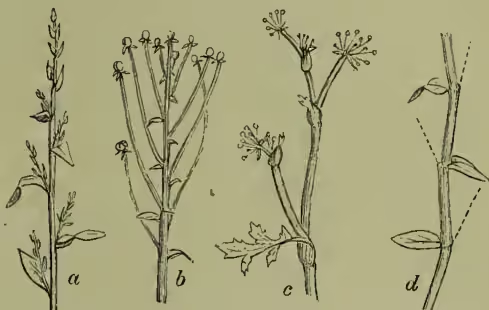
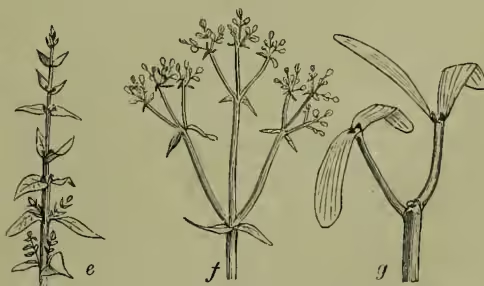
Branch, Branching. In the widest sense we may speak of branching whenever one part gives rise to another similar one, be it the thallus of the lowest plants, or the root or stem of higher ones; more strictly, however, the term is restrained to the ramification of stems. Branches then 'are secondary stems developed from a primary one, or tertiary from these, and so on.' The growing point in many cryptogams forks constantly, while in the higher plants we have a potential branch in every vegetative bud except the terminal one which continues the main axis (see BUD). The number and position of the branches is thus in the first place determined by those of the leaves, but in the vast majority of cases such exuberant ramification is impossible, and many or most of such buds perish early or never even develop. This arrest depends largely on individual circumstances, and the branches may thus come to have a quite irregular or at anyrate undefinable position; yet this is by no means always the case, even in our trees. The general aspect of trees depends more upon their mode of branching than the form or exuberance of their foliage; notably that broadest of all arboreal contrasts, between the spire-like growth of the coniferous trees and the more spreading deciduous ones. In the conifers the lateral branches often perish and are thrown off from below upwards, and the adult stem thus appears branchless to a great height; yet even here sooner or later a branchy head is formed, as in the familiar Scotch fir or the Italian pine. The predominance of the main axis over the branches may long persist in many deciduous trees, and especially in their fastigate varieties, like the Lombardy poplar; frequently, however, as in the elm, the main axis soon becomes altogether lost, or apparently continued by several main branches. The angle at which branches come off also largely varies; usually ascending and acute, they may be at a right angle—e.g. cedar—or even droop, as in 'weeping' trees. With regard to the conifers, it may be noticed that the shortened branchlet of the larch, with its tuft of needle-like leaves, is represented in the pines by a still more reduced form, which has only two leaves, surrounded at the base by a number of bud-scales. When the vegetative life of these ceases, the branchlet is disarticulated as a whole—a fact the more curious in relation to the separation of the large lower branches of the stem, which also snap off, leaving a clean cicatrix. That more or less distinct tendency to the development of the lateral buds, and the consequent subordination of the apical one, which all branching implies, may be traced from the general aspect of the tree into the details of its growth, and yet more fully into its inflorescence. Thus, while in the simplest case, the secondary axes are all subordinate to the primary one, as in a pine-tree or a raceme, the growth of the branches tends continuously to predominate. The shorter, more rounded, and long-branched conifers and other trees, or the 'corymb' variety of the raceme, are the simplest cases of this; but more definite forms also arise. Thus, when the leaves are opposite, the large development of the lateral branches to an equality with the main stem may give a three-branched appearance, which is well exhibited by valerian (fig. 2). More frequently, however, the development of the lateral branches exceeds that of the apical one altogether, which may be reduced to flower-bearing or totally arrested, and false dichotomy is the result; the autumnal arrest of the apical bud of the lilac, with development of its two lateral ones in spring, the apparent forking of the mistletoe, and the 'dichotomous cyme' of the pinks or chickweeds, are all familiar instances of this. Where the leaves are alternate we may also have an apparent forking, due to the equal development of the axillary branch, as often happens in Umbellifera; or the main axis may be reduced to terminate in a flower, as in the scorpioid and helicoid cyme, or may be checked altogether, as in the shoot of the lime.
Where, as in most of these cases, the primary axis is not only checked by its secondary axis, but this bears a bud or tertiary axis, which again overpowers it, and so on, a false axis or sympode is formed. Physiologically indistinguishable from an ordinary main axis, examination shows that the leaves are not borne in the ordinary way, but have developed the successive segments of stem in their respective axils.
The underground branches of a rhizome are often thickened as tubers; or they may send up tertiary branches to become new ascending axes—the suckers of the raspberry or rose. A stolon is a prostrate branch which roots at the tips and then develops an ascending branch; it may often be long and thread-like, and is then called a runner (strawberry). Branches may also undergo modifications from vegetative forms to new purposes—they may become sensitive and supporting as tendrils, their vegetative life may be diminished and their growing points hardened off as spines or thorns; the flower too is of course a reproductively shortened axis with modified appendages. See INFLORESCENCE.