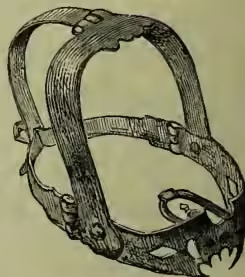
Brank, or BRANKS, an instrument formerly used for the punishment of scolds in England and Scotland, and often in the former country called 'the scold's bridle,' or 'gossip's bridle.' It seems in England to have come in place of the ducking-stool or Cucking-stool (q.v.), and is said to be of Scotch origin; but according to Mr Llewellyn Jewitt it was never a legalised instrument of punishment, although corporations and lords of the manor in England, and town-councils, kirk-sessions, and barony courts in Scotland, exercised the right of inflicting such punishment. Men were put in the stocks or pillory, women in the branks, for such petty misdemeanours as are now described as breaches of the peace, using abusive, insulting, or threatening language, cursing and swearing, and contumacy. The brank in its simplest form is a hoop of iron, opening by hinges at the sides, so as to inclose the head, and fastened by a staple with a padlock at the back; a plate within the front of the hoop projecting inwards, so as to fit into the mouth of the culprit, and by pressing upon the tongue, be an effectual gag. In some instances this mouth-plate was armed with a knife or point which cut the tongue if moved. In its last most complicated shape, the brank, by the multiplication of its hoops and bands, took the form of a conical cage or lantern, the front taking the shape of a rude mask, with holes for mouth, nose, and eyes; in one instance, the mask quite covers the face. With this cage upon her head the unfortunate woman was paraded through the streets by the bellman, beadle, or constable, or was chained to the market cross, a target for ridicule and insult. When the brank first came into use is unknown. It is found at Edinburgh in 1567, at Glasgow in 1574 and 1596, at Stirling in 1600, at Macclesfield in Cheshire in 1623, at Newcastle-on-Tyne in 1655, Worcester in 1658, Congleton in 1662, at Chesterfield, the only instance in Derbyshire, in 1688. Cheshire had thirteen examples extant in 1660. An old description of the Isle of Man mentions the tongue of a scandalous person being tied with a noose of leather called a bridle. One brank in the church of Walton-on-Thames, in Surrey, has the date of 1633. In another, called 'the witches' bridle of Forfar,' dated 1661, the gag for the mouth is not a flat plate, but a long piece of iron with three sharp spikes. A brank at Stockport was somewhat of the same description. Of examples in private custody in England, one had the date of 1688, the other the crowned cipher of King William III., and another had a mask with apertures for the eyes, a prominence to fit the nose, and a long funnel-shaped peak projecting from the mouth. The brank was used at Langholm, in Dumfries-shire, in 1772; at Morpeth in 1741; it was used at a later date at Manchester and at Macclesfield; and at Bolton-le-Moors, in Lancashire, the iron bridle was in use up to 1856 for the correction of immorality. Examples of the brank may be seen in the Ashmolean Museum at Oxford, in the National Museum of the Antiquaries of Scotland at Edinburgh, at Abbotsford, in the county-hall at Forfar, in the Guildhall at Lichfield, at Leicester, Newcastle-on-Tyne, Shrewsbury, in the town-hall at Macclesfield, in the parish church of Walton in Surrey, and in St Mary's Church at St Andrews in Fife; Chester has four examples. Brank was at one time a common name in Scotland for any sort of bridle, and the word is so used by Burns. The word is derived from the Gaelic brangus, an instrument for punishing petty offences, brang, a halter, words cognate with the Dutch pranger, pincers, and the German pranger, a pillory. See the paper by Llewellyn Jewitt, F.S.A., 'Scolds; and How they Cured them in the "Good Old Times,"' in Reliquary, vol. i. (1860-61); also notes in vol. xiii. (1872-73); and Andrews, Punishments in the Olden Times. See JOUGS.—The affection called Mumps (q.v.), causing a swelling about the jaws or neck, is in Scotland vulgarly known as the branks.