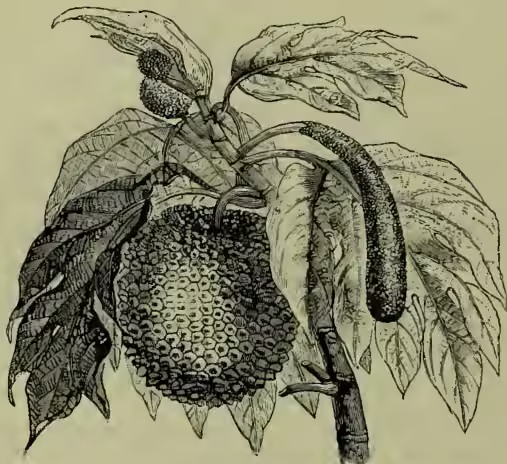
Bread-fruit Tree (Artocarpus incisa), a tree of the sub-order Artocarpaceæ of Urticaceæ (q.v.), a native of the islands of the Pacific Ocean and of the Indian Archipelago, is one of the most important gifts of nature to the inhabitants of these regions, its fruit supplying the principal part of their food, and its inner bark a considerable part of their clothing, whilst its timber and its milky juice are also employed for economical purposes. The genus to which it belongs (Gr. Artocarpus, 'bread-fruit') is distinguished by having the male flowers in catkins, with a two-leaved perianth and one stamen; the female flowers naked; the fruit roundish, fleshy, and tuberculated. The bread-fruit tree is a rather slender tree, 40 to 50 feet high, and often rises almost half its height without a branch. It has large pinnatifid leaves, frequently 12 to 18 inches long, dark-green, and glossy. The fruit is generally oval, or nearly spherical, and about the size of a child's head, and 3 or 4 lb. in weight. It is a sorosis, a compound or aggregate fruit formed from numerous flowers on a common axis, and is covered with a roughish rind, which is marked with small square or lozenge-shaped divisions, corresponding to the separate fruitlets; it is at first green; when imperfectly ripened, brown; and when fully ripe, assumes a rich yellow hue. It is attached to the small branches of the tree by a short thick stalk, and hangs either singly or in clusters of two or three together. It contains a somewhat fibrous pulp, which, when ripe, becomes juicy and yellow, but has then a rotten taste. At an earlier stage, when the fruit is gathered for use, the pulp is white and mealy, and of a consistence resembling that of new bread. In a still less mature state, the fruit contains a tenacious white milk. The seedless variety is of course especially fleshy, but the seeds of the normal form are sometimes roasted like chestnuts or used as sources of starch. The common practice in the South Sea Islands is to cut each fruit into three or four pieces, and take out the core; then to place heated stones in the bottom of a hole dug in the earth; to cover them with green leaves, and upon this to place a layer of the fruit, then stones, leaves, and fruit alternately, till the hole is nearly filled, when leaves and earth to the depth of several inches are spread over all. In rather more than half an hour, the bread-fruit is ready; 'the outsides are, in general, nicely browned, and the inner part presents a white or yellowish cellular pulpy substance, in appearance slightly resembling the crumb of a wheaten loaf.' It has little taste, but is frequently sweetish, and more resembles the plantain than bread made of wheat-flour. It is slightly astringent, and highly nutritious. Sometimes the inhabitants of a district join to make a prodigious oven—a pit 20 or 30 feet in circumference, the stones in which are heated by wood burned in it, and many hundred bread-fruits are thrown in, and cooked at once. Baked in this manner, bread-fruit will keep good for several weeks. Another mode of preserving it is by subjecting it in heaps to a slight degree of fermentation, and beating it into a kind of paste, which although rather sour, is much used when fresh bread-fruit cannot be obtained. There are numerous varieties of the bread-fruit tree in the South Sea Islands, and they ripen at different seasons. The tree produces two and sometimes three crops a year, in fact is bearing during eight or nine months of the year. In the West Indies and South America, into which it has also been introduced, the bread-fruit is valued as an ornamental tree, but has not come much into use as an ordinary article of food; various preparations of it, however, are reckoned delicacies.—The fibrous inner bark of young bread-fruit trees, beaten and prepared, is used for making a kind of cloth, which is much worn by the common people in the South Sea Islands, though inferior in softness and whiteness to that made from the paper mulberry (see MULBERRY, PAPER).—There exudes from the bark of the bread-fruit tree, when punctured, a thick mucilaginous fluid (latex), which hardens by exposure to the air, and is used, when boiled with cocoa-nut oil, for making the seams of canoes, pails, &c. water-tight, and as birdlime.—The timber is soft and light, of a rich yellow colour, and assumes, when exposed to air, the appearance of mahogany. It is used for canoes, housebuilding, furniture, and many other purposes. It is durable when not exposed to the weather. The leaves serve for wrapping articles of food, and the fallen male catkins furnish a convenient source of tinder.—The Jack Tree or Jaca (A. integrifolia) is a large and very thick tree, a native of the East Indies, but cultivated also in the Antilles, with large entire leaves and much larger fruits (up to 25 lb.), of which some varieties are as eatable as those of the commoner species. The mahogany-like timber is known as jacqueira-wood, and is used both in building and furniture. The sap yields a kind of dammar, and is also a source of caoutchouc. A. hirsuta (Malabar) yields paper from its bast.