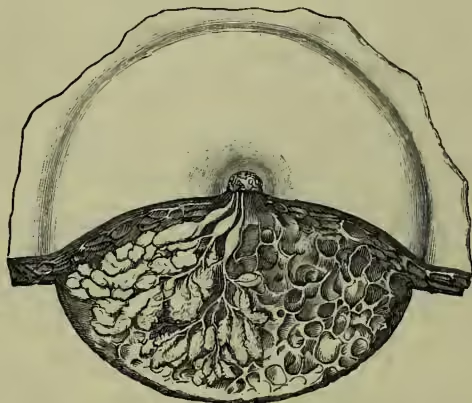
Breasts, or mammary glands, are the organs which secrete milk for the nourishment of the young in the Mammalia, and from the presence of which that class of animals takes its name. In the human subject they are two in number, situated on the front of the chest. In very exceptional cases additional glands are found, sometimes in remote situations. In children they are small and rud- mentary, but about the age of puberty they enlarge. In boys this enlargement, if it occurs, passes off after a few days, and the breasts remain rudimentary during the rest of life; but in girls it leads to the full development of the organ. Over the centre of the gland there is a circular patch of skin, thinner and darker than the rest (the areola); and from it rises a small conical projection (the nipple). On the apex of the nipple the milk-ducts (15 to 20 in number) open by separate orifices. Each of these ducts passes outwards to one division or lobe of the breast, dilating beyond the nipple into a sinus, and then branching repeatedly to terminate in the lobules, or clusters of small rounded vesicles in which the milk is secreted. The lobules and lobes are bound together by connective tissue, and well packed in fat, which increases sometimes to an enormous extent the apparent size of the organ.
In the adult female the breasts swell a little at each monthly period. During pregnancy considerable enlargement takes place, and shortly after the birth of the child the milk begins to be freely secreted.
DISEASES OF THE BREAST are of frequent occurrence in women, probably on account of the great changes in activity and blood-supply to which the organ is subject.
Fissures of Nipple.—During suckling the delicate skin of the nipple often becomes abraded. The ulcers or fissures thus formed are usually very painful, so much so it may be as to render nursing impossible, and frequently lead to abscess of the breast. Their formation may usually be prevented by applying to the nipple several times daily a spirit lotion—e.g. diluted eau-de-Cologne or brandy—or an astringent—e.g. glycerine of tannic acid—both before and after nursing is begun, and by scrupulous attention to cleanliness. When they have formed, similar measures may be used; or oxide of zinc, starch, or some other drying powder, frequently applied. If severe or persistent, the use of lunar caustic may be necessary.
Acute Inflammation and Abscess.—Acute inflammation of a part of the breast or of the adjacent tissues frequently occurs during nursing, rarely at other times. In its treatment, besides measures generally useful in inflammation, the free application of belladonna in the form of ointment or liniment is of special value; and care must be taken that the milk is not allowed unduly to accumulate in the organ. When abscesses result, they should be opened with antiseptic precautions; but they are often very tedious and intractable.