Breech-loading is the method of introducing the charge into a firearm at the breech instead of the muzzle. The breech is then closed by a block of metal which is held in its place by a hinge and lever, or by a bolt with a bayonet joint, in the case of small-arms, and in that of heavy guns by a screw or a wedge.
Military Small-arms.—The advantages of the breech-loading military rifle are very manifest. It enables a recruit to fire four times as fast as the best-drilled soldier armed with a muzzle-loader, and a cavalryman to load his carbine even at a gallop. The absence of Windage (q.v.) renders the action of the powder stronger and more uniform, thus increasing the range and accuracy of the weapon. The rapidity of fire can be still further increased by the addition of a magazine, as described under RIFLES.
The Prussian needle-gun (1841) was the first breech-loading rifle carried by European troops. Its breech is closed by a bolt carrying a long needle. This is driven by the hammer completely through the powder, and ignites it in front by striking a patch of fulminate placed at the base of the sabot which carries the bullet. The latter is oval, and fits the bore loosely, the sabot taking the grooves and causing it to rotate. The cartridge is of thin paper, and intended to be consumed on discharge, thus avoiding the necessity of extracting the empty case. The French Chassepôt (1866) is also a bolt-action breech-loader firing a paper cartridge ignited at the base.
The Sharp breech-loading carbine, long used by the cavalry in British India, has a similar consumable cartridge. The breech of each of these rifles is ineffectually closed, and the 'spitting' inconveniently great, in spite of an attempt, in the case of the Chassepôt, to prevent it by an india-rubber washer or ring; nor is the cartridge paper always consumed. The metallic cartridge (called by the French cartouche obturatrice), which 'obturates' and seals the breech at the moment of explosion, has now been universally adopted to remedy this defect.
The first re-armament (1866) of the British infantry with breech-loading weapons was effected by converting the Enfield rifle on the Snider principle; the result of experiments carried on with fifty different systems in 1864. The breech-action of this rifle is well described by its French name, fusil à tabatière. The breech-block is hinged on to the side of the barrel, and contains a piston or striker, by means of which a blow is communicated from the hammer to the cap at the base of the cartridge. After firing, the hammer is raised, and the breech- block opened like a snuff-box. The block also slides upon its hinge, and when pulled towards the butt, catches the empty cartridge-case and loosens it, so that it can be thrown out.
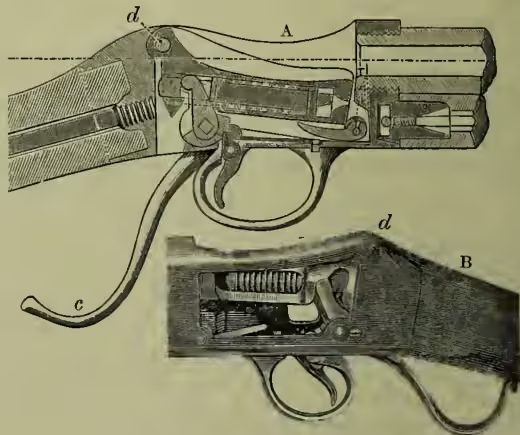
A, in section ; B, with part of side plate removed.
The Martini breech-action, which superseded the Enfield in 1871-74, and which was retained in the Enfield-Martini rifle issued in 1888 to the British army, is a block and lever system. The lever, c, in fig. 1 is hinged behind the trigger-guard, and free at the end next the stock. On being pulled down, away from the stock, this lever depresses the front end of the breech-block, hinged at d, which contains the striker, opens the breech, and compresses the spring, thus bringing the trigger to full-cock, and extracts the empty cartridge-case. A fresh cartridge being introduced, the block is returned to its place by the return movement of the lever, and the rifle is ready for firing. The Lee-Enfield rifle at present in use has the Enfield barrel in connection with the Lee breech-action.
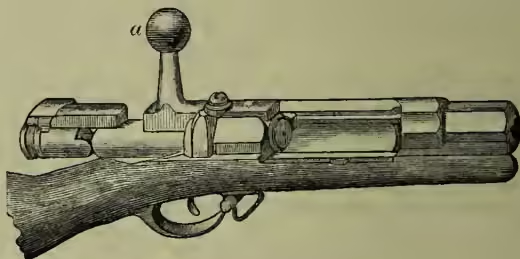
As an example of the bolt-action, fig. 2 shows the German Mauser rifle. This action has been adopted by all European nations, except Great Britain, as being simpler and more direct. To close the breech, the bolt, a, carrying a striker and extractor, is pushed forward and turned down to the right. After firing, the reverse process opens the breech and extracts the cartridge.
The Lee-Metford rifle, introduced into the British army in 1890, will be found fully described, with diagrams, under RIFLE. See also BULLET, CARTRIDGE. Revolvers (q.v.) usually have a breech-action similar to that of sporting guns (see p. 420).
Artillery.—The difficulty of closing the breech in a simple and effectual manner, especially with heavy guns, the structural complications involved, the impossibility of using a simple time Fuse (q.v.), owing to absence of Windage (q.v.), and the greater cost, were long the chief objections to breech-loading artillery. Krupp (1812-87), in Germany, always advocated this construction, and in 1859 the Armstrong breech-loading system was introduced into the British service, only, however, to be abandoned in favour of muzzle-loading some six years later. Other nations gradually re-armed their artillery with breech-loaders, and in 1880 breech-loading field-guns began again to be made at Woolwich Arsenal; in 1888 the heaviest guns were being so constructed. The reasons given are chiefly due to fortress and naval requirements. The immense power necessary to pierce modern ships' armour is obtained by using a slow-burning powder, requiring the projectile to be held fast until a pressure of from 1 to 2 tons per square inch is set up in the powder chamber, which can only be done in a breech-loader. The power of the gun is increased by making it longer, and many such guns are placed in turrets, or other confined spaces, where their length prevents their being loaded at the muzzle. The use of the so-called obturator has met the difficulty of satisfactorily closing the breech. The advantages include better cover for the gunners, reduced size of the embrasure, less smoke in the turret or casemate, easier examination of bore, enlarged powder chamber, economy in relining, &c., as against greater first cost, expense of renewing breech-fittings, and their greater liability to injury on service.
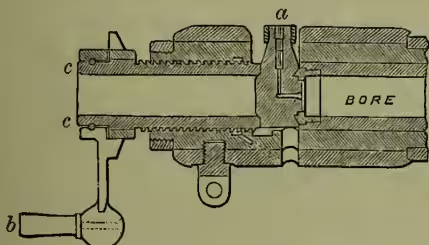
There are practically only three methods of closing the breech of a gun—viz. the screw, the wedge, and the interrupted screw. In the Armstrong screw-gun, shown in fig. 5, the breech is closed by a 'vent-piece,' a, held in its place by a hollow 'breech-screw,' c, through which the gun is loaded; the lever, b, being used to screw it up firmly. A copper face to the edge of the vent-piece, or a tin cup in front of it, more completely closes the breech, and is the earliest form of 'obturator.' The wedge breech-action invented by Lord Armstrong con- sisted of two wedges sliding on their sides in a slot, and also a heavy sliding handle arranged to act as a hammer, and so tighten the wedges, which, when loose, could be drawn out sufficiently to admit the charge. Very few guns were made with this action.
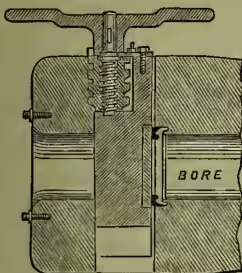
The Krupp breech system, shown in fig. 3, has a round-backed wedge pushed in from the side, and forced firmly home by a screw and lever handle. Its face carries a removable flat plate, which presses against a Broadwell ring let into the end of the bore. It is axial vented, like all modern heavy breech-loading guns.
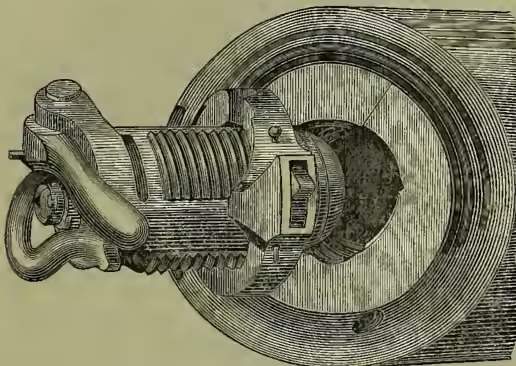
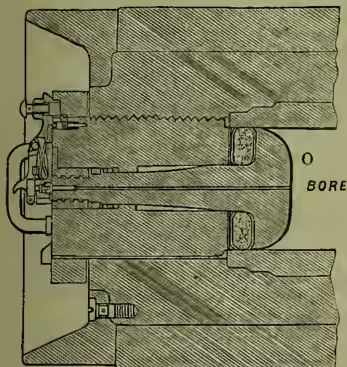
The interrupted screw system (fig. 6) has been adopted by the French, by the Royal Gun Factories at Woolwich, and the Elswick Ordnance Company (Armstrong, Mitchell, & Co.). It consists of a solid steel breech-block furnished with a screw-thread of the requisite pitch and strength fitting into a similar female screw in the gun. The surface of the block is divided longitudinally into six or eight equal parts, and the screw-thread planed away from alternate portions. In the gun the parts corresponding to the smooth portions are left, and those between them slotted away. A turn of one-sixth or one-eighth of a circle enables the block to be drawn out, and a carrier, hinged to the side, swings it clear of the bore. The bearing surface, and consequent strength of the screw, is reduced one-half by this method, but this can be compensated for by increasing its length, which would not appreciably affect the time occupied in opening or closing the breech, or by making it conical, and forming the screw-threads in steps, with the blank spaces on one opposite the screw-threads on the other. Additional mechanism and extra leverage are supplied when the size of the gun requires it.
The obturator, O in fig. 4, the invention of De Bange, of the French artillery, is similar in the French, Woolwich, and Elswick guns, but the latter sometimes have a different pattern, called the 'Elswick-cup.' Some safety arrangements, making it impossible to fire the gun until the breech-block is screwed home, are common to all three. See CANNON, FIREARMS, GUN, REVOLVER, and RIFLE.
Breech-loading Sporting Guns are made on a totally different principle, called the drop-down action. Nearly every maker has a patent for different details, but almost all are founded on the Lefauchex action, invented in 1825. This consists of a piece of steel called the 'lump,' securely fastened to the under-side of the breech end of the barrels, and about 2 or 2½ inches long; the fore end of this lump is hinged by means of a pin to the corresponding part of the breech-piece (d, e, f, fig. 7) at d, and on this hinge the barrels are moved in opening and shutting the breech. The lump is, in most guns, cut into two divisions, e, which fit into slots in the breech-piece, and both parts have notches, into which an ingenious arrangement called, from the inventor, a 'Purdey' bolt, snaps when shut. An additional grip to add solidity is also generally provided in various forms of an extension of the top rib, b. The modern breech-loading sporting gun is generally made hammerless—i.e. without outside hammers, but the locks, which are let into slots in the breech-piece, are usually made, more or less, on the old principle. A main-spring, on the pull of the trigger, explodes the cap in the rear end of the cartridge by means of a hammer, either acting directly through a hole in the breech (as in the Anson and Deeley lock), or by means of a detached rod inserted in the hole.
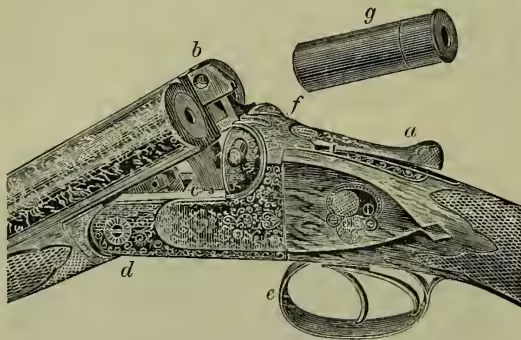
Fig. 7 represents one of the many first-class breech-actions, Greener's self-acting ejector gun. A movement of the top lever, a, to the right, simultaneously slides the cross bolt from the hole in the extension top rib, b, withdraws the double Purdey bolt from the lump, and the barrels tilt over. Swivels attached to either side of the rear end of the lump cock the hammers ready for firing again; a lever at the same time ejects the used cartridge-case. The figure shows the gun as opened after firing the right barrel, from which the cartridge-case, g, is being ejected. When the breech is closed, all the bolts snap into their places. There is a safety arrangement on the side of the gun, acting on the trigger, and another automatically obstructing the fall of the hammer, which prevent the gun being accidentally discharged. See Gun; also J. H. Walsh's ('Stonehenge') Modern Sportsmen's Gun and Rifle (1882-84); W. W. Greener's Gun and its Development (1881), and his Modern Shot Guns (1888).