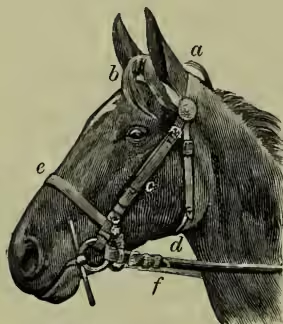
Bridle and Bit, that part of a horse's harness which is attached to the head and mouth, by means of which he is governed and restrained. The proper bitting of horses has been a matter of much study in England, and innumerable kinds of bits have been introduced for the purpose. It will be sufficient for our purpose, however, to describe only a few of those most generally used. The ordinary single riding-bridle, with a snaffle-bit, is shown in fig. 1. The driving-bridle is similar in principle, with, generally, the addition of blinkers—i.e. pieces of leather fastened to the cheek-pieces of the headstall to prevent the horse seeing in any direction except straight forward; the theory being that he would be startled by anything catching his eye from behind.
There are several forms of the snaffle-bit. The common riding form (fig. 2, a) is a round smooth bit, jointed in the middle, attached at either side to straight bars or cheeks, which prevent the bit being pulled through the horse's mouth, and with rings to which the reins and cheek-pieces of the headstall are fixed. The twisted snaffle has the mouthpiece twisted or fluted, increasing its severity on the horse's mouth. The ring snaffle is made without cheeks; and the rings for headstall and reins are not fixed, but work loose in holes at the ends of the mouthpiece. Another form which is very generally used, especially in driving, is the double-ring snaffle (fig. 2, b), having two rings at either end, one working within the other, to one of which the reins are fastened, and to the other the headstall. The snaffle being jointed, its action is to press on the sides or bars of the lower jaw, and not on the tongue, while its shape prevents anything like severity.
The double or Weymouth bridle is generally used in the hunting-field and often for ordinary purposes.
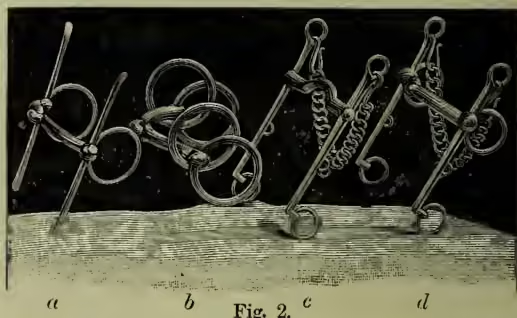
It has two separate bits, the snaffle and curb, or bridoon and bit, each having separate headstalls and reins. The snaffle or bridoon is like the plain ring snaffle already described. The bit or curb (fig. 2, c) has a fixed unjointed mouthpiece having an upward curve, or port, of varying size, in the centre, which answers the same purpose as the joint in the snaffle of confining the pressure of the bit to the bars, where it is most effective. Hooks are fixed to the upper end of the cheeks, on which the curb-chain is hung, and which is passed round the chin-groove under the horse's under-jaw. To the lower end the curb-reins are attached; the other reins are fastened to the bridoon-rings. One advantage of the double bridle is that its action can be varied according as the curb or snaffle rein is tightened or relaxed. Military bridles are double, and generally similar to that just described, except that the cheeks are made in the form of the letter S, and other ornamentation added.
The Pelham is an extensively used modification of the double bridle. It consists of a single bit (fig. 2, d) similar in form to the curb-bit of the double bridle, but with the addition of rings fixed to the cheeks at either end of the mouthpiece to which reins are attached, in addition to those fixed to the lower end. The curb-chain is adjusted as in the double bridle. The running martingale is an arrangement applicable to any bridle, by which a pair of reins run through rings at the ends of two straps attached to the horse's girth to prevent him throwing his head up.
In connection with driving-bridles, two questions have in recent years caused considerable discussion—viz. bearing-reins and blinkers. The bearing-rein, in its simple form, is intended as a support to the horse's head, and consists of a strap buckled to the ring of the bridoon-bit of a double bridle, passed through a swivel on the throat-band, and fastened to a ring on the saddle-pad. In its severe form, known as the 'gag,' it is attached to the headpiece, passes through the bridoon-ring, through a swivel on the throat-band, and then to the saddle. The effect is to cramp the horse's neck, and prevent him throwing his nose forward, but it is supposed to improve his appearance in a carriage. The opponents of the bearing-rein complain of the torture unnecessarily inflicted on the horse, and hold that nature supplies all the support necessary for the head. The blinker question is not so important, and consists of a difference of opinion as to whether a horse would or would not be more easily startled with his eyes uncovered.
In European nations and in North America, the bridles used are generally similar to those described; but among the Arabs and in South America and some parts of Mexico and Texas, a heavy, old-fashioned, and terribly cruel curb-bit is used. On the other hand, the stockmen of the Australian bush employ the plain snaffle-bridle alone, with which they manage their powerful and usually half-broken horses easily, an equal tribute to the sufficiency of the snaffle and their own horsemanship.
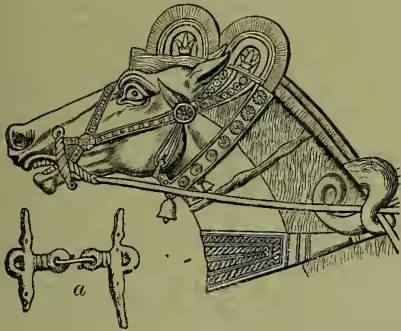
It is interesting to know that in the representations of harnessed horses in the Assyrian sculptures the bridle generally shown is apparently almost identical with the modern snaffle. Fig. 3 represents a chariot horse with bridle (Koyunjik); a, a bronze bit from Nimroud. See Major Dwyer's Seats and Saddles, Bits and Biting; Stonehenge's Horse in the Stable and Field. See also HORSE, RIDING AND DRIVING.