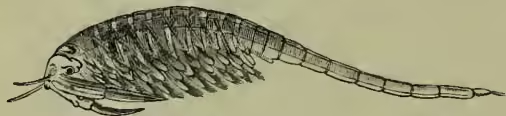
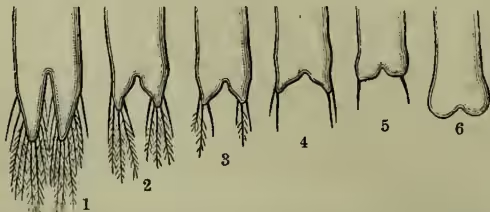
Brine-shrimp (Artemia), a genus of small animals belonging to the Branchiopod (gill-footed) division of Crustacea. They have leaf-like swimming and respiratory appendages; the last eight rings bear no legs. They are hatched at the lowest level of crustacean life as Nauplii (q.v.). The full-grown animal is about half an inch long, and having no shell, is transparent. The male has a strong embracing organ, the female a pouch-like brood-sac. The multiplication is very rapid. They swim actively and gracefully on their backs. There are five species of Artemia, all found in salt-lakes or in brine-pools where salt is manufactured. Of these species the most unlike are A. salina and A. milhauseni. Schmankewitsch has made the exceedingly interesting experiment of manufacturing one species of brine-shrimp into another. By increasing the salinity of the water, in the course of several generations, A. salina became A. milhauseni, and vice versa, by decreasing the salinity of the water in which the latter normally lives. Not only so, but by decreasing the salinity of the medium natural to A. salina, he was able to make it assume at least some of the characters of a quite different fresh-water genus—Branchipus. In the course of generations the Artemia acquired nine instead of eight rings in the tail region, and a partial transformation was thus effected. This is one of the most striking instances of the effect of the environment on the organism (see ENVIRON-
MENT). In respect of habitat, the brine-shrimp is indeed remarkable, occurring, as it does, in myriads, in the concentrated brine of salt-pans. The workers at salt-pans so confidently ascribe to it the rapid clearing of the brine in which it occurs, that when it does not appear in their salterns, they transport a few from other pools.