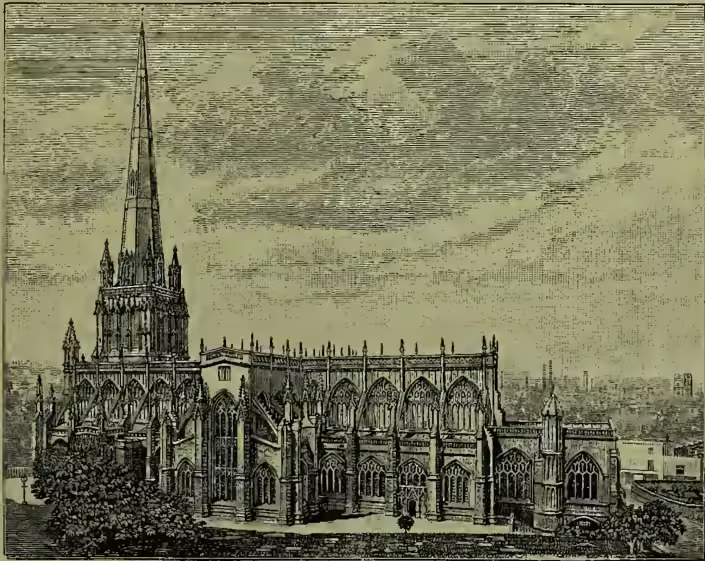
Bristol, a mercantile city 6 miles from the mouth of the Avon, and at its junction with the Frome, is locally partly in Gloucestershire and partly in Somerset, but since 1373 has been itself a county. The ancient town stood wholly on the north of the Avon, on a peninsula formed by that river and the Frome, which then flowed across the bottom of Corn Street; a new course was dug for the Frome in 1248, and this added a large area; and soon afterwards a stone bridge was built across the Avon, connecting the town with Temple-fee, and with Redcliff, which belonged to the lords of Berkeley. After a violent struggle with the House of Berkeley, these districts were included in the town and county by the charter of 1373. The castle, first built probably by Geoffrey, Bishop of Coutances, and rebuilt with a vast keep by Robert, Earl of Gloucester (died 1147), fell into decay, and was demolished in 1654; some remains may be seen in Castle and Tower streets. The cathedral was formerly a church of Augustinian canons (1148); the nave and aisles, pulled down for rebuilding in 15th century, were rebuilt in 1877; the choir is good 14th-century work; fine Norman chapter-house and gateway remain. Bristol, originally in the diocese of Worcester, was created a see and a city in 1540, with the abbey-church of St Augustine's as cathedral, and was united to the see of Gloucester in 1836; its re-erection as a separate see is now contemplated. Other noteworthy churches north of the old course of the Avon are St James' (Benedictine), with fine Norman work, and showing the division of the building into parochial and monastic churches; St Philip's and St Jacob's, St Stephen's, All Saints, and the Mayor's Chapel. South of the river is St Mary Redcliff, justly declared by Queen Elizabeth to be the 'fairest and most famous parish church in England.' Of the church rebuilt, 'from the cross aisles downwards,' by William Canynges, sen., merchant (circa 1376), only the south transept and south wall of nave remain; the rest was wrecked by the fall of the spire, and was built by Canynges' grandson and namesake (circa 1470); it is vaulted throughout, and is a magnificent specimen of Perpendicular architecture. The truncated spire was completed, 280 feet from ground, and 170 feet from top of tower, in 1872. In the muniment-room is the chest in which Chatterton (1752-70) pretended to have found the Rowley poems. The present Temple Church, on the site of an oval church of the Templars, was built in the 14th century; the tower leans about 5 feet, through a defect in the foundations; attached to the church is the Weavers' Chapel of St Katharine. Among the ancient houses of the town are Canynges' house, Redcliff Street, Spicer's (or Back) Hall, and St Peter's Hospital. The principal educational institutions are University College (1876), Clifton College (1862), and the grammar-school (1531); and the charitable foundations, Queen Elizabeth's
Hospital (1586), the Red Maids' School (1621), and Colston's School (1704), now removed to Stapleton, Gloucestershire. A technical school has lately been opened by the Merchant Venturers. The City Library (free) dates from 1613. Bristol first appears in history on a coin circa 1000. The town, which derived its early wealth from exporting slaves to Ireland, took a large part in the war of Stephen's reign, and was besieged by the king. The first charter was granted by Henry II., who also (1171) gave Dublin to the men of Bristol. By 1217 the town had a mayor. In the reign of Edward II. the burghers made an insurrection, stood a siege, and were not brought to obedience for nearly four years. The town did a large trade in wool, leather, wine, and salt, was famous for its clothes, and was one of the 'staple' towns (1353). In the next century its trade was in the hands of great merchants, many of them, like Canynges, men of princely liberality, and generally on the Yorkist side. Bristol took a prominent part in discovery and colonisation. In 1497 John Cabot sailed from the port, and was the first to discover North America; his son Sebastian declared that he was born in Bristol, and sailed thence on his voyage of 1498. Bristol men colonised Newfoundland, engaged in several early attempts to colonise Maine, and established a large trade with the
West Indies and American colonies. The city was taken by Prince Rupert in 1643, and by Fairfax in 1645. Colston the philanthropist (1636-1721) founded many charities, and his 'day' is annually kept in Bristol. In the 18th century privateering was largely carried on, and was encouraged by the success of Captain Woodes Rogers in 1708-10. Other famous names connected with Bristol and Clifton by birth and residence are those of Grocyn, Wraxall, Cottle, Sir T. Lawrence, T. L. Beddoes. Southey (1774-1843) was a native of Bristol, and he and Coleridge were much there in their younger days. Burke was returned for the city in 1774, and declined the poll in 1780. One of his chief supporters was Champion (1743-1791), maker of the famous Bristol china; true Bristol china is the product of 1773-81 only. The Reform riots of 1831 occasioned great loss of life and property. The first steam-ship for the transatlantic voyage, the Great Western, was built in the port in 1838. Strenuous efforts have been made to improve the dock accommodation; in 1809 the Avon for about 3 miles was turned into a floating harbour, and it has been proposed to extend the endockment of the river to its mouth, so as to make the town accessible to large ships. In 1883 the corporation purchased large docks at Avonmouth and Portishead. The principal imports are grain, provisions, oils, hides, tallow, sugar, and petroleum; the exports coal, salt, tin-plates, cotton piece-goods, chemical products, oils, and sundries. Vessels of about 1,500,000 tons enter the port annually. In 1885 the number of its members of parliament was raised from two to four. The town was made a county borough in 1888. A statue of Burke was unveiled in 1894. Pop. (1801) 61,153; (1841) 125,148; (1871) 182,552; (1881) 206,503; (1891) 221,578, and of parl. borough, 234,815. The Hotwell, noticed by the Bristol chronicler, William Worcester (died circa 1491), was a fashionable resort during the later half of the 18th century (see Humphry Clinker and Evelina); it is now deserted and decayed. Clifton, however, the parish to which it belongs, has thriven. It is mentioned in Domesday, but has little history till it appears as a 'beautiful village' in 1760; it is now a large and handsome suburb of Bristol, of which it forms part for municipal and parliamentary purposes. It stands above St
Vincent's Rocks, which rise majestically from the Avon. The river is spanned 245 feet above high-water by a suspension bridge (1864, see BRIDGE). Clifton is well furnished with places of worship of different denominations, and has a zoological garden (1836), fine arts academy (1858), museum and library, and other public buildings. In the neighbourhood are the remains of some Roman camps.
See Barrett's History and Antiquities of Bristol (1789); Seyer's Bristol Charters (1812), and Memoirs of Bristol (2 vols. 1823); Nicholl's and Taylor's Bristol, Past and Present (3 vols. 1881); Hunt's Bristol, Historic Towns Series (1887); Latimer's Annals of Bristol in Nineteenth Century (1887).