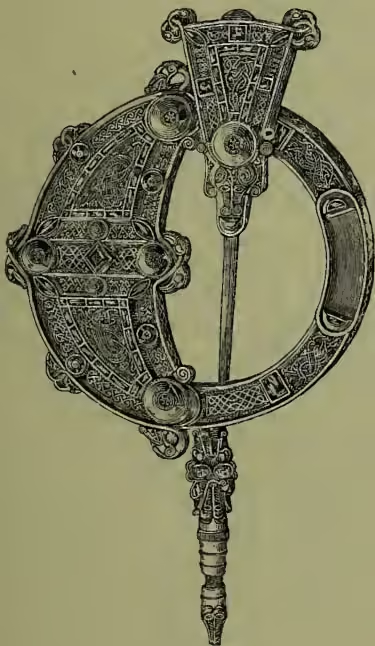
Brooch (from a root signifying to pierce; comp. Eng. to broach; Fr. brocher, 'to spit,' or 'to stitch'; Wel. proc, 'to stab'), an ornamental pin or instrument for fastening the dress, consisting for the most part either of a ring or disc, or of a semicircle, there being a pin in either case passing across it, fastened at one end with a joint or loop, and at the other with a hook. The oldest known brooches are those found in graves assigned to the early iron age of Southern Europe. They are made of bronze, and consist of a bent or bow-shaped body, with a spring pin coming from a spiral twist at one end, and its point fitting into a loop of the bow at the other end, like the modern 'safety' shawl-pin. They are exceedingly varied in form, often presenting grotesque imitations of the shapes of animals. The form which prevailed in Northern Europe was more massive, having a cross-bar at one end, and covered with chased ornamentation inlaid with gold. In Scandinavia a peculiar form of brooch of brass of oval bowl-shape, covered with dragonesque ornamentation, plated with gold and studded with bosses and coloured pastes, was characteristic of the Viking period. The early Celtic brooches of Scotland and Ireland were penannular, the ring being incomplete, with expanded ends, while the pin, which was loosely looped upon the ring, was greatly longer than the diameter of the brooch. They were made of bronze or silver plated with gold; the flat ring, divided into panels, was richly ornamented with interlaced or spiral patterns, or dragonesque filigree work, peculiar to Celtic art, and studded with settings of amber or coloured glass. The most elaborate work of art of this description is the Tara Brooch, preserved in the museum of the Royal Irish Academy at Dublin, of which a woodcut is subjoined. The finest in
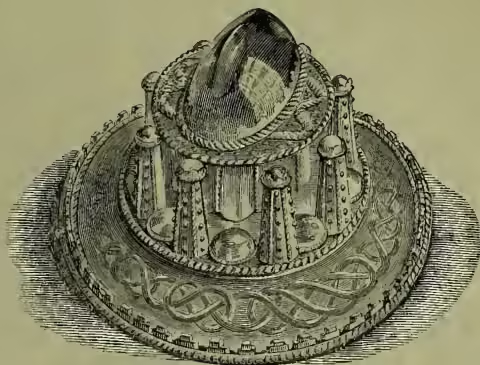
Scotland is the so-called Hunterston Brooch, which was found in 1830, on the estate of Hunterston, in the parish of West Killbride, Ayrshire. It is of silver, richly ornamented with gold filigree, elaborately worked into lacerine and ribbon patterns, and set with ornaments of amber; diameter, inches. On the reverse is an inscription scratched in runes: 'Maelbritha owns this brooch.' The later form of the Highland brooch of brass or silver is annular, having a pin of the length of the diameter of the ring. Those of brass are decorated with chased patterns of interlaced work, scrolls of foliage, and grotesque animals. Those of silver have their decoration often inlaid with niello, and sometimes enriched with settings. The Ugadale Brooch, in the possession of Hector Macneal of Ugadale, in Kintyre, which is here figured, is a characteristic example of a form of reliquary brooch of West Highland origin. The Brooch of Lorn, in the possession of Macdougall of Dunolly, near Oban, has the reputation of being identical with one torn from the breast of Robert Bruce by Alexander of Lorn, the ancestor of Macdougall, in a personal contest with the king, but it is also identical in form and character with the Lochbuy Brooch, now in the British Museum, and classed as a work of the 16th century. They are all about inches in diameter, having a circle of jewelled obelisks rising round a central capsule, crowned by a large rock-crystal. The capsule is removable, and discloses a cavity, designed, doubtless, for the purpose of a reliquary.