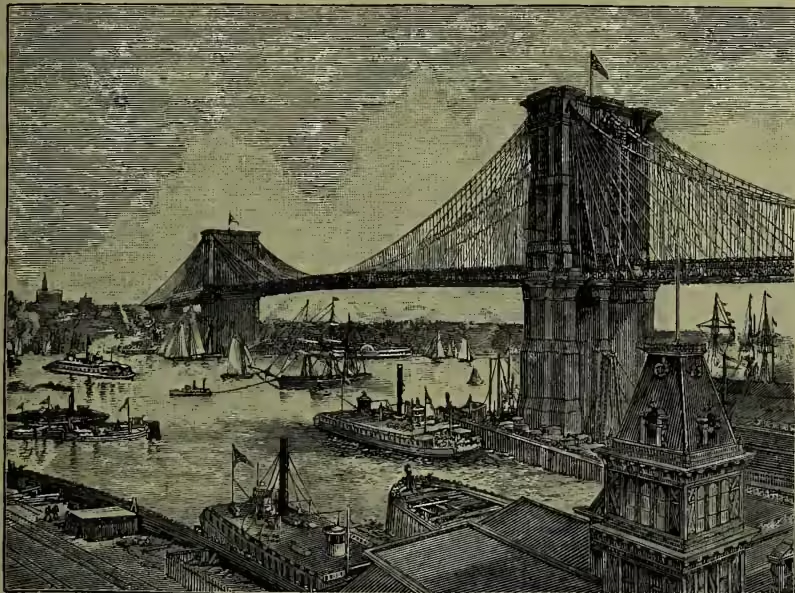
Brooklyn, the fourth city of the United States, and capital of King's county, New York, is situated on the west end of Long Island, opposite New York City, from which it is separated by a strait called East River, nearly a mile in width, running from Long Island Sound to New York Bay. Twelve or more lines of steam-ferries ply between the different points of Brooklyn and New York, and a magnificent suspension bridge (finished 1883), 5989 feet in length by 85 in breadth, and with a river span of 1595½ feet, intended for foot-passage, carriages, and railways, extends from one city to the other (see BRIDGE). Branches of the Long Island system of railways have their west termini in Brooklyn, running thence to Greenport and Sag Harbour near the east end of the island, and five or more lines connect this city with Coney Island, a famous bathing-place 10 miles distant. Two lines of steam elevated railways and numerous lines of horse-cars traverse the streets of Brooklyn, making easy communication between the suburban sections and the ferries. Although not a port of entry, the amount of foreign and domestic freight that comes to its warehouses is enormous. Freight-cars are brought to its docks on floats, and great numbers of canal-boats from the interior discharge their cargoes here. Some of these docks are among the most extensive works of the kind in the United States, covering from 40 to 60 acres each, and are lined with immense storehouses for grain and other freight.
At the south-east extremity of the city, upon a high ridge overlooking New York Bay and its environs, is the beautiful Greenwood Cemetery, covering about 400 acres, and containing many fine monuments; and near at hand are the Ridgewood reservoir and Prospect Park, a public pleasure-ground of 540 acres, which has cost, including two noble boulevards connected with it, extending
Copyright 1889 in U.S.
by J. B. Lippincott
Company. respectively 3 and 2½ miles to Coney Island and East New York, nearly $12,000,000. The city proper has a water front of 10 miles, and within its
It is divided into 26 wards, and according to the census of 1890 was the fourth city in population in the United States. The population in 1810 was 4402; in 1830, 15,396; in 1850, 96,838; in 1870, 396,099; in 1880, 566,603; and in 1890, 806,343. area of 25 sq. m. are carried on large and varied industries, among which are embraced the refining of sugar and petroleum, the manufacture of glass, chandlery, clothing, carpets, chemicals, paints, oil-cloth, metallic wares, tobacco, steam-boilers, lace, hats, buttons, paper, felt goods, &c., and the building and repairing of ships.
Brooklyn has 13 national banks, 14 savings-banks (2 of which have deposits of 22,000,000 each), 8 daily, 2 weekly, and many monthly periodicals. Its school system embraces a high school, a training school for the public school teachers, 70 grammar and primary schools (employing 1817 teachers, and costing 1,800,000 annually), 2 medical colleges, a Roman Catholic college, and numerous convents, academies, and seminaries, attended by about 60,000 pupils. An average of 75,000 children attend the public schools daily. Brooklyn is 'the City of Churches:' of such edifices there are 58 Methodist, 54 Roman Catholic, 39 Protestant Episcopal, 32 Baptist, 25 Congregational, 24 Presbyterian, 21 Lutheran, 16 Dutch Reformed, 9 Jewish, &c. The public buildings are not generally imposing; among the most notable are the court-house, erected at a cost of 543,000; the hall of records, costing 328,000; the municipal building, costing 200,000; an academy of music, with a seating capacity of 2400, &c. Its charitable institutions comprise lunatic and deaf-mute asylums, homes for destitute children, for the aged, the idiotic, and the deformed, and numerous pharmacies, dispensaries, infirmaries, hospitals, &c. There is a fine government post-office, and a United States navy yard, which occupies about 40 acres of ground, with extensive ship-houses, workshops, and military stores, and a dry-dock which cost about 1,000,000.
First settled in 1636, the town was organised by the Dutch governor of New Amsterdam in 1646, and named Breukelen from a place of the same name in the Netherlands, 8 miles NW. of Utrecht. It was incorporated as a city in 1834, to which Williamsburg (now 'Brooklyn E.D.,' or Eastern District) and Bushwick were added in 1855, and in 1886 the town of New Lots (East New York) was annexed.