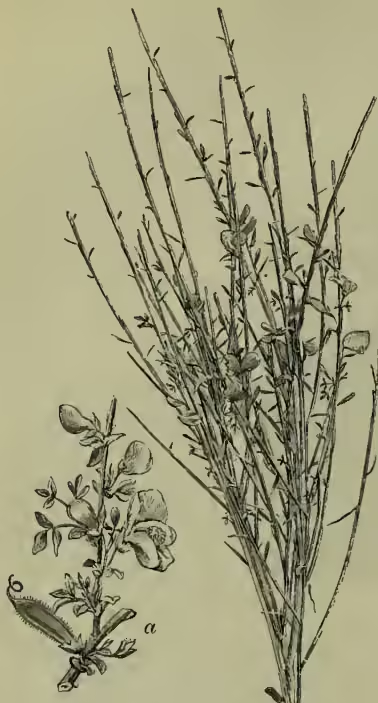
a, flowering branch.
Broom, a name given to a number of species of shrubs of the closely allied genera Cytisus, Genista, and Spartina, of the natural order Leguminosae, sub-order Papilionaceæ—all of them having long slender branches, along which are produced axillary flowers.—Common Broom, Cytisus (Sarithamnus) scoparius, the trivial name being from the Lat. scopæ, 'long twigs,' or 'a besom'), is a well-known native of Britain, Europe, and Northern Asia, ranging also as far as the Canaries and the Azores, growing in dry soils, and ornamenting hedge-banks, hills, and bushy places, in May and June, with its large yellow flowers, which are on short stalks, drooping, solitary, but produced in considerable number along the straight slender branchlets. The lower leaves have three oblong leaflets, the upper ones are simple; the branches are angular and of a very dark green, very tough, and much in use for making besoms, as also in Belgium, &c., for baskets. They have also been used for tanning and dyeing; and their fibre has been woven into a coarse strong cloth, and even made into paper. In South Germany it is sometimes planted on sandy wastes for the sake of its fibres; while its ashes are also valuable additions to the soil on account of their high percentage of potash. The whole plant is very bitter, and the young tops and seeds are diuretic, hence the plant is a very unsuitable ingredient of fodder. The flowers were formerly employed in medicine (flores spartii), and as a yellow dye; they are much visited by bees for cross-fertilisation, for which they are very beautifully adapted (see fig.). The mode of diffusion of the seed by the explosive rupture of the dry pod-valves in hot weather is also worthy of notice. Broom inhabits colder climates than furze, reaching to a greater elevation on mountains, and being found beyond the northern limit of furze. It usually varies in size from 2 to 6 feet, but in some localities grows much larger, the wood then being of great value to cabinet-makers and turners. Although sometimes annoying to the forester, it is also capable of rendering him service as a quick-growing shelter to young trees, especially on wind-swept and sandy soils.—Irish Broom (Cytisus or Sarothamnus patens), not unfrequent as an ornamental plant in British shrubberies, is not at all a native of Ireland, but of Spain and Portugal.—Portugal Broom or White Broom (C. albus), a native of the countries bordering on the Mediterranean, is very often planted in Britain as an ornamental shrub, and is much admired for the beauty of its fascicled white flowers, which are produced upon long filiform branches. Its leaves have three leaflets. It sometimes attains a height of 15 or 20 feet.—Spanish Broom (Spartium junceum) is a native of the south of Europe, generally growing in dry soils and rocky situations, and attaining a height of 8 feet or upwards. Its branches are upright, round, and rush-like, a characteristic of this genus. They are smooth, and bear only a few small simple leaves, which soon drop off. It is the Spartium of the ancients, and the fibre of the branchlets has been used from time immemorial in some parts of Italy, France, and Spain, for making canvas, nets, ropes, &c., and even for the preparation of a kind of linen. Its twigs also are employed for basket-making, and the finer ones for tying up the grapes. In the south of France, the plant is cultivated on dry unproductive soils. The branchlets are made into bundles, dried, beaten, steeped, and washed, in order to the separation of the fibre. It possesses medical properties similar to those of the common broom.—A white-flowered species (S. monospermum), occasionally to be seen in British shrubberies, grows abundantly on the loose sands of the coasts of Spain, and produces a similar fibre. It is mentioned by Barth as growing in great abundance in Africa to the south of the Great Desert. Many species somewhat resembling these are occasionally to be seen in Britain among ornamental plants, some of them often in greenhouses. The Canary Isles produce some remarkable for the fragrance of their flowers.—Dyer's Broom (Genista tinctoria) is, with other members of the same genus, a well-known source of yellow colouring matter. This European shrubby plant is thoroughly naturalised in some parts of North America. The name broom is not given to those species of Cytisus and Genista (q.v.) which do not display in a marked degree the character of having long slender twigs.—Butcher's Broom (q.v.) is a plant of an entirely different family.