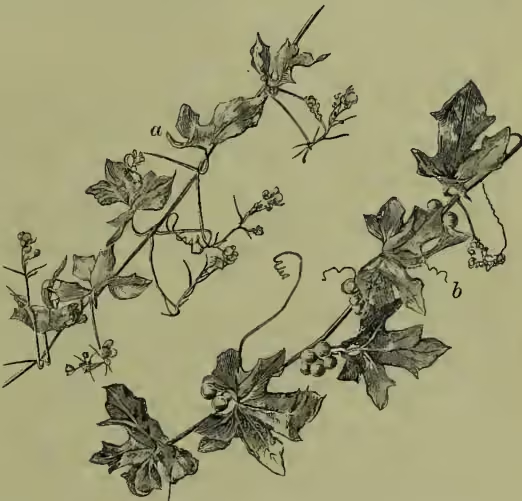
a, flowering, and b, fruiting branch.
Bryony (Bryonia), a genus of Cucurbitaceæ (q.v.), of which the Common Bryony (B. dioica) is the only British species. It is frequent in hedges, in England, but becomes rarer in the north, and is not indigenous to Scotland. It has cordate palmate leaves, axillary bunches of flowers, and red berries about the size of a pea. It abounds in a fetid and acrid juice. The root-stock is perennial, very large, white and branched, has a repulsive smell, and is acrid, purgative, and emetic, owing to the presence of a bitter and poisonous alkaloid, bryonin. B. alba, which is monœcious, with black berries, is common in Central Europe, and possesses similar properties. The root of both is applied to bruises, was formerly in use as a purgative, and its tincture is still employed in homœopathic and veterinary practice. The young shoots of both species are free from acrid and dangerous qualities, and are sometimes used as pot-herbs, especially in Eastern Europe.—The roots of other species of the genus are also acrid and purgative; and are used medicinally in India; but it is said that the root of B. abyssinica, when cooked, is eaten without danger.—B. boykinii is a species found native in the southern United States.—Black Bryony (Tamus communis) is a plant of a different natural order (Dioscoreæ, q.v.). Its habit and distribution is similar to that of Bryony proper, but it may be readily distinguished by its simple entire heart-shaped leaves, which are smooth and somewhat glossy. The flowers are small and greenish, and the berries red, the root-stock very large and fleshy, black externally. The berries are unwholesome, and the whole plant is acrid, the roots so much so as to have been formerly employed for stimulating plasters. But the young suckers, in which the acrid principle is not much developed, may be eaten like asparagus, after careful boiling with change of water.