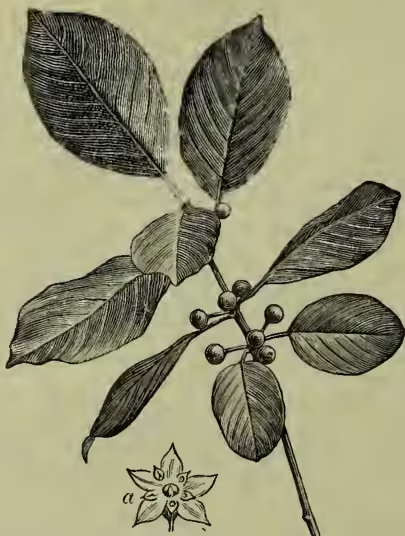
a, a flower.
Buckthorn (Rhamnus), a genus of Rhamnaceæ (q.v.), including sixty species, all shrubs or trees, widely distributed through temperate and tropical regions, but absent from Australia.—The Common Buckthorn (R. catharticus) is characterised by its spinous and cross-like branchlets, serrate leaves, and yellow-green dioecious flowers. The berries, which are about the size of peas, globular, bluish-black, nauseous, and violently purgative, were formerly much used in medicine, but now more rarely, and only in the form of a sirup prepared from their juice. They supply the Sap Green (q.v.) or Bladder Green of painters. The bark affords a beautiful yellow dye. The buckthorn is sometimes planted for hedges, but is of too straggling a habit.—The Alder Buckthorn, or Breaking Buckthorn (R. frangula), also (wrongly) called Black Alder, or Berry-bearing Alder, is spineless, with oval entire leaves, and small, whitish, axillary flowers. The berries are small and black, and also violently purgative, yet are freely eaten by birds. The charcoal of the wood is light, and is used by gunpowder-makers and called dogwood. The bark, leaves, and berries are used for dyeing. The flowers are peculiarly grateful to bees.—Dyer's Buckthorn (R. infectorius) is a low shrub, abundant in the south of Europe, whose unripe fruit yields a brilliant yellow dye. The French Berries, Avignon Berries, or Yellow Berries of dyers, are the fruit of this and other species.—Of North American buckthorns there are, besides the Com- mon one, six or more peculiar species. The most important is the R. purshiana of the north-west Pacific slope (especially south-west Oregon), the cathartic bark of which is used in medicine under the name of Cascara Sagrada.—The Sea Buckthorn (q.v.; Hippophaë rhamnoides) is a shrub of a different genus and order (Elcagnææ). It is occasionally planted as an ornamental shrub.