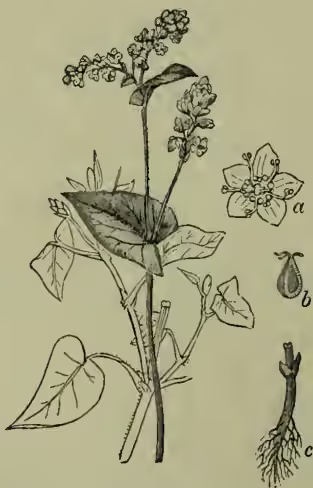
a, a flower; b, a seed; c, root.
Buckwheat (Fagopyrum esculentum, or Polygonum Fagopyrum) is a native of the basin of the Volga, the shores of the Caspian Sea, and many parts of Central Asia. A recent German authority affirms that there is no authentic mention of it until 1436 at Mecklenburg, whence it spread over Europe in the following century. It is also said to have been introduced by the Moors into Spain, and thence to have extended over Europe, or, again, to have been brought to Europe by the Crusaders. The French name Sarrasin seems to support these latter traditions. It is cultivated on account of the farinaceous albumen of its seeds, which are used, as grain, for food of man and cattle. It is upright, branched, 1 to 3 feet in height; the leaves are between heart-shaped and arrow-shaped, the flowers pale red, the seed (nut) black and triangular, its angles entire. The resemblance of this seed in form to the beech-nut is supposed to be the reason of the German name Buchweizen (lit. 'beech-wheat'), from which the English name is derived. Buckwheat is a very common crop in some parts of Europe and of the United States of North America, but is seldom sown in Britain, except as food for pheasants, as it requires continued dry weather in autumn for profitable harvesting. In north-east Germany, and also in Brittany, buckwheat is valued as a crop, particularly for sandy heaths, moorlands, and other poor soils. It yields abundantly, and requires little manure or attention. Forty bushels or more per acre may be expected, weighing 46 or 48 lb. per bushel; and notwithstanding the resemblance of the seed to grain in its qualities and uses, wheat or any other cereal crop generally succeeds well after buckwheat. The seed is most frequently used in the shape of groats, or made into pottage; in the United States, thin cakes of the flour are a standard food. It is very nutritious, containing about 10 per cent. of gluten and 52 per cent. of starch, besides about 6 per cent. of gum and sugar. It is said to be as good as barley for fattening cattle, and better for horses than oats. But as the seed is covered with a very hard rind or thin shell, it must always be shelled before being given to cattle. Poultry are very fond of it. Beer is sometimes brewed from it, and it yields a spirituous liquor of good quality; indeed, it is frequently used in gin-distilleries. As green fodder, the herb-age of the plant is said to be more nutritious than clover; but it is said to act as a narcotic on sheep. Bees delight in its flowers, and in some parts of the United States it is sown on this account. In America the seed is usually sown broadcast over the land, which has been ploughed in autumn or early spring, and well scarified or harrowed. About a bushel and a half of seed per acre is required when sown broadcast, but a bushel is sufficient if drilled with a machine. In the latter case it should not be sown in narrower drills than one foot apart, but two feet is recommended as being better for the succeeding crop, as the wider intervals can be properly cultivated. It should not be sown in England before the middle of May, as the least frost is injurious. When the lower seeds are ripe it should be mown, as they are easily shed out if allowed to stand too long.—Tartarian Buckwheat (F. tataricum) is distinguished by the toothed edges of the seeds and its more vigorous growth. It is hardy, and adapted for cold situations, but yields inferior meal, and is reckoned a mere weed in Germany. In Canada, on the other hand, it is much grown; but its use, as well as that of common buckwheat, is thought by many to induce skin disease. F. emarginatum is cultivated in China.—Dyer's Buckwheat is Polygonum tinctorium. See POLYGONÆ.