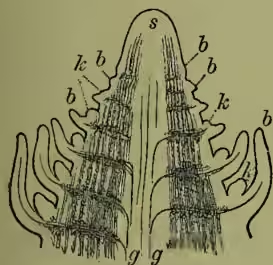
Bud. The bud is the rudiment of an axis with its appendages. Starting with the seed, we may trace the continued upgrowth of the primeval bud or plumule in germination. Again, by examination of the growing point at any age, we may observe the progressive development of new appendages with crowded nodes but lengthening inter-nodes of stem from the undifferentiated embryonic tissue (see MERISTEM) of its apex (fig. 1). In monocotyledons especially, an axis may have only a single apical bud; and of this mode of growth the palms furnish the most salient example; in the majority of dicotyledons, on the other hand, every vegetative leaf may be regarded as having, if not an actual, at any rate a potential or latent bud in its axil, which may, at least under exceptional circumstances, vegetate as a new axis or Branch (q.v.), or become developed for reproduction as a flower.
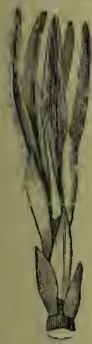
Bud Scales of
Rhododendron.
In some hardy shrubs and trees the buds are quite inconspicuous in winter, being so minute as to be hidden under an apical coating of bark (e.g. Taxodium, Philadelphus); generally, however, the buds are well formed before autumn, and are thus fully exposed to the severity of winter. In a few cases (e.g. species of Viburnum, although not the common Guelder Rose) the outer leaves still retain sufficient vitality to expand as the first foliage of spring. In the vast majority of plants, however, the leaves are not so hardy, and the outer ones have thus to be sacrificed for the protection of the rest. Since in any upward-growing axis, the lower and earlier formed appendages tend to grow beyond the embryonic apex with its short inter-nodes, and thus cover it up more or less entirely with its developing higher and younger appendages, the normal form of every bud is thus, as it were, a kind of incipient cabbage; and this overlapping mode of growth comes to be of the greatest protective usefulness. For the changes of day and night, of weather, and most of all, of the seasons, render the process of growth not continuous but rhythmic; and a growing point has thus latent as well as active periods. During the former, however, the outer appendages are exposed to the climate, and usually present adaptive modifications of great variety and interest, which are known as the bud-scales. These are often waterproofed with an exudation of resinous varnish, or warmly lined with an epidermic down.
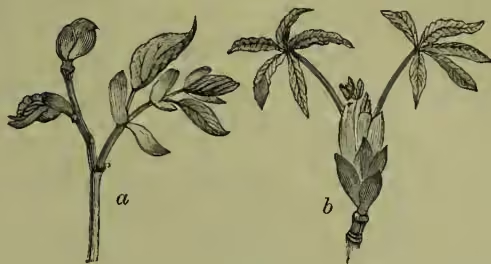
While, in what may be safely taken as the simplest cases, the bud-scales are modifications of entire leaves (e.g. lilac or rhododendron, fig. 2), in many plants the bud-scale is reduced to the petiole only. This is beautifully shown where a series of gradations survives, as is very often the case in the horse-chestnut; in opening buds of which it is often possible to trace every step of the reduction of the complete foliage-leaf to the petiolar bud-scale (fig. 3, b). Finally, bud-scales may be derived from stipules, as in the magnolia or the beech (fig. 3, a). In all these cases alike, the scales are thrown off by the opening buds in spring, and often carpet the ground like a foreshadowing of autumn.
Buds, as has been said, when other than terminal, are usually axillary to the leaves, and their origin may be traced almost as far back as that of the leaves themselves; this may be conveniently seen in a section of the growing point of the mare's-tail (Hippuris, fig. 1). Occasionally, too, the bud forms quite under the base of the leaf-stalk, and is concealed by it until this falls off in autumn (Platanus). There is usually only one bud in each axil, yet in many plants 'accessory buds' occur. These may be collateral in position, the middle one being largest, as in some hawthorns, willows, and maples; in other cases, however, they form a vertical series, of which either the lowest, and alone strictly axillary bud, may be largest and strongest, as in some honeysuckles, or the uppermost, as in the Aristolochia or the butternut, where, indeed, the main branches are thus extra-axillary.
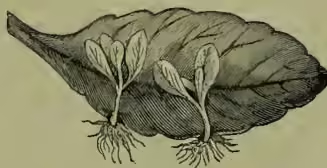
In many cases buds are also of adventitious origin—i.e. may arise quite independently of leaves, from any part of the stem—as is well seen on the trunk of the elm-tree, in pollarded willows, in fact in any tree deprived of its branches, or often even after being felled. This is intelligible when we reflect that at all such points there lies the Cambium (q.v.) or embryonic layer of cells; in the rarer case of origin of adventitious buds from roots, as in the bramble, we have similarly a perieambium (see ROOT): the most curious and exceptional (yet in a deeper view of cellular physiology the most natural) mode of origin is when the leaf-parenchyma itself retains a sufficiently embryonic character to give rise to new buds without the presence of any specially reproductive cells. This is well seen on the surface of the fronds of certain ferns, and is also experimentally reproduced by gardeners, who often raise young plants from the edges of a Bryophyllum leaf (fig. 4), or from the petiole or wounded surface of a leaf of Begonia, by simply placing it on sand in a warm and moist atmosphere.
This passage from ordinary vegetative growth to that discontinuous growth which we call asexual reproduction, and also that further transition to sexual reproduction (see REPRODUCTION, SEX), is admirably illustrated by the interesting reversions to ordinary bud-growth which these more specialised processes often exhibit in unusually favourable vegetative conditions, or even as a permanent habit. Thus in Ferns (q.v.) we may have the budding of prothallia directly upon the frond in the place of spore-cases, or that of the fern plant directly upon the prothallium in place of archegonia. Again, the reversion of floral to leafy buds occurs more or less completely in many garden-flowers, while in many wild species of Allium the flowers become largely replaced by vegetative buds capable of independent growth. This tendency to bud-independence is also well shown in the bulbils and bulbs of many other allied Liliaceæ; while the multiplication of plants by cuttings of course takes advantage of the same widespread latent possibility of separate bud-life. In the old disputes about the individuality of plants and animals, the bud was in fact often defined as a separate individual, and the tree thus viewed as a mere colony of buds. For the growth of buds, see BRANCH; and for arrangement of leaves in buds, see VERNATION, ÆSTIVATION, FLOWER.
Budding or gemmation is also a frequent mode of growth in animals. See REPRODUCTION.