Buffalo, a name often applied to two distinct bovine genera or sub-genera—viz. the Asiatic Buffalo (Bubalus) with the Cape Buffalo; and the American Buffalo, better called Bison, and discussed under that head. The genus or sub-genus Bubalus has the usual bovine characteristics, and whatever be its exact limits in strict zoological classification, remains for practical purposes a large, clumsy ox. The horns rise from the posterior side corners of the skull, are usually thickened out of proportion at the base, and irregularly ridged, though smooth towards the points; the forehead is short and arched; the covering of hair is comparatively sparse. The common or Asiatic Buffalo (B. buffelus) has beautifully twisted horns, thick and broad at the base, rough on to the middle, somewhat triangular in section. The horns lie back on the shoulders when the animal walks or runs, with its muzzle projecting characteristically forwards. The hair is short and scanty, almost bristly, slightly longer on head, shoulders, and front of neck, and all but black in colour. The bare brown polished hide is, however, the more striking feature.
The animal measures about 7 feet in length, and stands about 4 feet high at the shoulder. It is a native of the East Indies, has been domesticated in India, and thence introduced into Egypt, Greece, Italy, Hungary, &c. It is said to have reached Italy towards the end of the 6th century A.D., and there it has been its fate, as elsewhere, to become a beast of burden. The animal is adapted for marshy situations, which it naturally affects; preferring for its food the rank coarse herbage which they afford, delighting to immerse itself in water till only its head appears above the surface, in which condition it will remain for hours. It often envelops itself in mud as a protection against insects. On account of these propensities, the buffaloes used as beasts of burden in India are seldom laden with any goods liable to be spoiled by water, as the animal is always ready to take an opportunity of lying down with his load in any river or pond which presents itself. In Italy the buffalo seems nowhere more at home than in the Pontine Marshes and the pestilential Maremma.
The buffalo is a very powerful animal, much more powerful than the ox, and capable of dragging or carrying a far heavier load. The female yields a much greater quantity of milk than a cow, and of excellent quality. It is from buffalo milk that the ghee or semi-fluid butter of India is made. The hide is greatly valued for its strength and durability, but the flesh is decidedly inferior to that of the ox.
The buffalo exhibits a considerable amount of intelligence. In a state of domestication, it is capable of becoming very docile. In a wild state the buffalo is savage and dangerous, and even in domestication it is apt to resent injury. Alone, perhaps, of wild animals in India, it will attack unprovoked. The native princes of India make buffaloes and tigers fight in their public shows; and the buffalo is more than a match for the tiger, even in single combat. The buffalo is used in some parts of the East in the shooting of waterfowl; the sportsman conceals himself behind the animal, which, being a familiar sight, does not alarm the birds.—The Arnee is a very large variety of the common buffalo; a head has been known to measure 13 feet 6 inches along the horns. It occurs in the Indian islands and in Farther India in a wild state, but is also domesticated and used as a beast of burden.
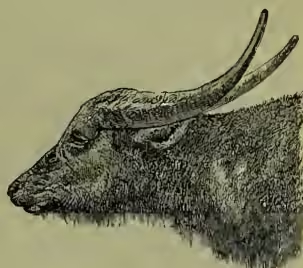
(Bubalus buffelus).
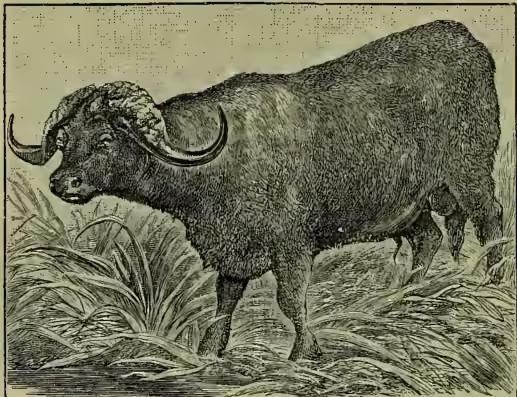
The Cape Buffalo (Bos caffer) is generally regarded as a distinct species. The horns are very large; they spread horizontally over the top of the head, and are then bent down laterally, and turned upwards at the point. The head is carried, as by the common buffalo, with projecting muzzle and reclining horns, but the bases of the horns nearly meet on the forehead, where they are from 8 to 10 inches broad. The length of a full-grown Cape buffalo is about 8 feet from the root of the horns to the tail, and the height is 5½ feet. This animal is regarded as more formidable than any other in South Africa. The buffalo is still found in large herds in the marshy wooded regions of Mid and South Africa, but in Cape Colony, where it was once plentiful, it has now become comparatively rare. It grazes chiefly in the evening, and lies in woods and thickets during the day. It will readily act on the aggressive, and has never been domesticated. The flesh though coarse is palatable.—B. brachyceros is another African species.—The Dwarf Wild Cow of the island of Celebes (Anoa or Probucalus celebensis) is also related to the buffaloes.