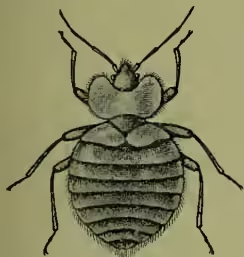
Bug, a popular name for insects in the order Hemiptera, and in the subdivision with unequal wings—Heteroptera. It may be widely applied to the whole of this subdivision, including land-bugs and water-bugs, the former to the number of almost 8000 species, the latter much less numerous. The Boat-fly (q.v.) or water-boatman has been already described, and may, along with the water-scorpions (Nepidae, q.v.), serve to illustrate the water-bugs. The Geocôres or land-bugs vary considerably, but have large long feelers with four or five joints, are especially at home in warm countries, are often brightly coloured, have an unpleasant smell, and usually eat other insects or sometimes also the juices of plants. The bug par excellence, however, is the Cimex or Acanthia lectularia, the well-known bed-bug. It was known to the Greeks as Koris, to the Romans as Cimex, and was believed by Aristotle to arise spontaneously from sweat. It is a wingless insect, thus differing from most of its fellow bugs. The body is very flat, the long slender feelers and the legs with fine hairs, the posterior part of the body almost circular. The length is about of an inch. The colour is rusty red, with traces of yellow. The mouth is suctorial. During the day the insect lurks quietly in crevices of walls and bedsteads, but is active and hungry at night, sucking the blood of higher animals, and notoriously of man. Since such opportunities but rarely occur, the animal prepares for long fasting by distending itself with blood when a meal is offered. As pests, they are too well known, especially where the furniture is not kept clean, and exasperated sleepers are no longer able to console themselves with the old belief that the bite was an antidote to the venom of snakes. The female bug is said to lay eggs four times between March and September, and each time about fifty. The larvæ are in most respects like the adult, the metamorphosis being incomplete. The first three broods, each reaching sexual maturity in about eleven weeks, develop, the last brood appears to perish, while the adult insects persist through the winter, enduring a considerable degree of cold. The bed-bug is said to have come from the East, and it certainly follows human migration. It was not known in Strasburg, according to Leunis (Synopsis des Thierreiehs), till the 11th century, and the refugee Huguenots have been blamed for bringing it to London. Strict cleanliness is the best preventive; turpentine and even corrosive sublimate are among the recommended insecticides. The same species is known to attack pigeons, and other species trouble bats and swallows. For an account of the bug family as a whole, systematic works on insects must be consulted. Many of the thousand forms have some scientific interest and practical importance. A large number may be studied on our common plants and trees. Some of the winged wood-bugs or field-bugs are capable of inflicting very painful wounds. Forms an inch in length are known to occur. Flying-bugs, 'enormous and fetid,' are among the pests of India. Night is the time of their activity. Warm countries generally have winged bugs of great size and beauty; but if touched or irritated, they 'exhale an odour that, once perceived, is never after forgotten.' A winged bug, as large as a cockchafer, lodges in the thatch and roofing of houses in Chili, and sallies forth at night, like the bed-bug, to suck blood, of which it takes as much as a common leech.—It is worthy of notice that a species of field-bug (Acanthosoma griseum), a native of Britain, is one of the few insects that have yet been observed to show affection and attention to their young. De Geer observed the female of this species, which inhabits the birch-tree, conducting a family of thirty or forty young ones as a hen does her chickens, showing great uneasiness when they seemed to be threatened with danger, and waiting by them instead of trying to make her own escape.