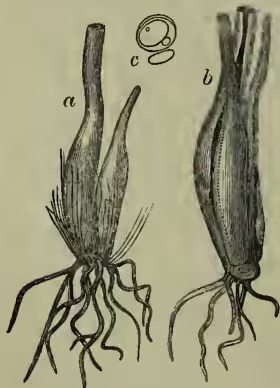
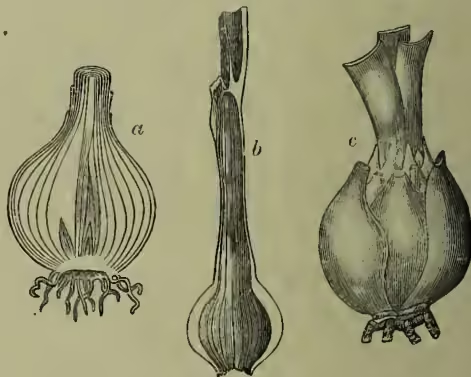
Bulb. Our perennial herbs which die down during the winter have always accumulated during the summer some store of reserve material (starch and nitrogenous matters) which serves as capital upon which to draw for their new and rapid start in spring. This subterranean store may be deposited in roots (e.g. orchis), in an underground creeping stem (e.g. rhizome of iris or primrose), in definite portions of rhizome which are then called tubers (e.g. potato, Jerusalem artichoke), or in the lower portion of the main axis (corm of crocus), which thus assumes a bulbous form (see ROOT, RHIZOME, TUBER, CORM). The term bulb is, however, restricted by botanists to those cases in which the store is deposited in the leaf-bases, or in modifications of entire leaves. The incipient bulb is best seen in the common wood-garlic (Allium ursinum), in which the store is deposited in the swollen spindle-shaped base of a foliage leaf (fig. 1). The first leaf of the following year's growth is not swollen, but almost completely insheathes the developing flower axis, the first foliage leaf of which again thickens as the bulb, and develops in its axil the bud of next year. From such a simple form transitions in all directions are easy: thus if we increase the number of leaves, and unite without greatly thickening their sheathing bases, we have the incipient bulb of the leek. Here the store is deposited along an indefinite extent of leaf-base, which the gardener accordingly artificially extends by hoeing up earth around the plant, and so arresting vegetation in the blanched portion, and giving us the succulent parenchymatous esculent which is so familiar in cookery. In the onion or hyacinth, however, the area of storage becomes clearly marked off, and in autumn the vegetative portion of the leaf dies away, leaving the successive leaf-bases overlapping each other around the foliage leaf (fig. 1). The first leaf of the following year's growth is not swollen, but almost completely insheathes the developing flower axis, the first foliage leaf of which again thickens as the bulb, and develops in its axil the bud of next year. From such a simple form transitions in all directions are easy: thus if we increase the number of leaves, and unite without greatly thickening their sheathing bases, we have the incipient bulb of the leek. Here the store is deposited along an indefinite extent of leaf-base, which the gardener accordingly artificially extends by hoeing up earth around the plant, and so arresting vegetation in the blanched portion, and giving us the succulent parenchymatous esculent which is so familiar in cookery. In the onion or hyacinth, however, the area of storage becomes clearly marked off, and in autumn the vegetative portion of the leaf dies away, leaving the successive leaf-bases overlapping each other around the excessively shortened disc-like axis. This is the so-called tunicated bulb (fig. 2).
In almost all forms of this, one or more of the lowermost leaves of the axis cease to appear above ground; and in some cases (e.g. Lilium candidum) where the bulb is made up of more than one year's growth, it is composed of first the thickened leaf-bases of a previous year; next the short, thick, scaly leaves of the lower portion of the axis; and within this the swollen leaf-bases of the upper portion (fig. 2, c). This leads to the case presented by other lilies (e.g. L. martagon and bulbiferum) in which the foliage leaves are restricted to the upper portion of the axis, and the leaves of successive years forming the bulb are all subterranean and reduced to swollen overlapping scales. This is the so-called scaly bulb.
In some cases many new daughter-bulbs may develop in the axils of the leaves composing the parent bulb; such are the so-called cloves of garlic (Allium sativum). Tunicated bulbs are hence sometimes propagated by cutting across transversely; a series of axillary buds is thus compelled to arise. In Lilium bulbiferum the same principle appears, and in its simplest form; for the buds in the axils of the foliage leaves are developed as small bulbs (bulbils), and these readily fall off and take root. In other species (A. Schanoprasum, A. fallax), we find incipient cases of bud formation along a rhizome; and this becomes strongly marked in the common Saxifraga granulata, of which the crowded bulbs are not infrequently mistaken for mere tuberous swellings along the roots, until dissection proves that we have to do with the bulbous buds of spreading rhizomes.
The use of the bulb to the plant, as affording at once a citadel of refuge during the severity of the winter of cold climates, or of the dry season of warmer ones, and a store of materials for a vigorous start in spring before the competition of other plants has become active, will be sufficiently obvious; and the importance of bulbous plants in such peculiar climates as that of Siberia or of the Cape of Good Hope is thus readily accounted for. The large nutritive store gives a proportional possibility of reproductive outlay, and the remarkable size and beauty as well as the earliness of flowering of most bulbous plants is thus explained. For all these reasons, as well as the ease of their cultivation, preservation, and transport, they have always been greatly valued by the florist; their nutritive store in some cases makes them valuable and savoury articles of food; while others—such as that of Squills (Scilla, q.v.)—contain also products of vegetable waste, which have turned out to be of medicinal importance.