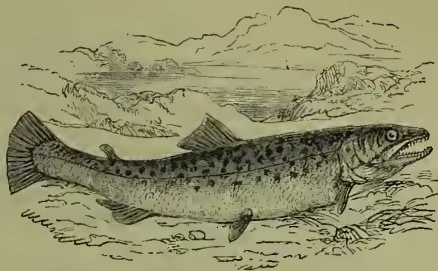
Bull Trout (Salmo cambricus or griseus), a species of the Salmon genus, and like it, migratory in its habits, ascending rivers, in which it deposits its spawn, but living chiefly in the sea. It occurs in many of the rivers of Britain, and is not unfrequently taken in the Tweed and its tributaries. It is frequently called the Gray Trout, or simply the Gray, and is the Sewen of the Welsh rivers. It occasionally attains the weight of 20 lb., although even the larger ones are commonly under 15 lb. weight. It is less elegant in form than the salmon; the head and nape of the neck are thicker in proportion; the teeth are longer and stronger; the gill-cover is larger and more nearly square; the anal fin is further back; and the tail, beyond the adipose fin, is more bulky and muscular. The tail fin is square at the end in young fish (in some places called whitlings), and in older ones becomes convex by the elongation of the central rays, whence the name roundtail sometimes given to this species. The scales are rather smaller than those of a salmon of equal size, the lower jaw of the male less elongated; the colour is less bright; the males in the spawning season being reddish or orange brown, the females blackish gray; at other times the general colour is like that of the salmon trout. The bull trout agrees with the salmon in having only a few teeth on the most anterior part of the vomer (the bone which runs down the centre of the palate); while the salmon trout, the common trout, and the great lake trout, have a long line of teeth in that position. To anglers, the bull trout is next to the salmon as a prize, and by many is mistaken for it. The flesh is paler in colour, coarser, with much less flavour, and is proportionately less esteemed.—The name has been also given to the Hucho (S. hucho), or salmon of the Danube, which sometimes attains the size of 30, or even, it is said, of 60 lb. The laws for fishing salmon apply also to the Bull Trout. See SALMON.