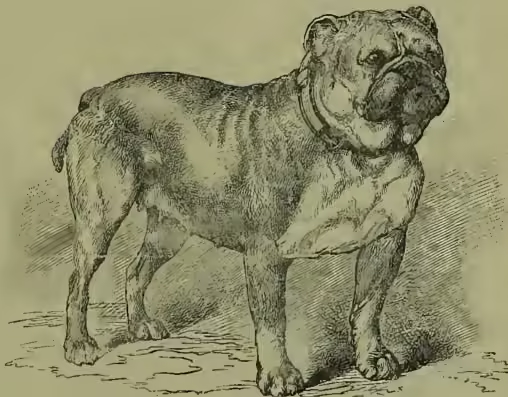
Bulldog, a breed which is regarded as peculiarly English, the only country in which it has been kept pure. The bulldog disputes with the greyhound the honour of being the oldest known dog. The general appearance of the bulldog is that of a smooth-coated, compact dog, low in stature, but broad and powerful, with a massive head, large in proportion to its body, which is short and well knit. The bulldog should convey an impression of determination and strength, without unwieldiness. The following are its principal points: Head as large as possible, measuring over 20 inches in circumference in first-rate specimens; forehead flat, with the skin much wrinkled, with a groove or indentation called the 'stop' running up between the eyes; ears small and thin, folding over at the back, showing the inside; eyes round, black, and not bloodshot; the face very short, the nose being set almost between the eyes, allowing the dog to breathe while pinned on to the bull in the old days of bull-baiting; upper lip joining the lower, quite covering the teeth, which should not project; shoulders sloping back and muscular; body well ribbed up, with the belly tucked up; back short, narrow at the loins, the spine rising from the shoulders to the loins, and curving to the tail, forming an arch, a characteristic of the breed termed 'roach-back'; the tail short and smooth, with a slight twist which prevents it being raised high—an abortive or 'screw-tail,' though common, is not a good point; fore-legs straight boned, but carried wide apart, presenting a bowed appearance; action, a peculiar roll, the body swinging between the fore-legs; colour, brindle, white, or fawn; weight, about 50 lb. The bulldog was extensively used for Bull-baiting (q.v.), whence he derives his name. After the abolition of this pastime the breed fell into discredit, till his qualities as a devoted and faithful companion gradually restored his popularity. The bulldog shares with the gamecock the distinction of being the most fearless of animals, but in disposition is so lazy that he is slow to take offence, though he will fight to the death if attacked.
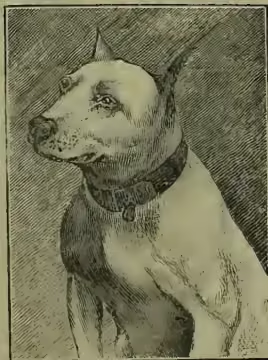
The BULL-TERRIER was originally a cross between the bulldog and the terrier, but is now a distinct breed. He combines the courage of the bulldog with the activity of the terrier; his quickness and sagacity make him a good companion, though somewhat quarrelsome. Head long, with pointed muzzle; ears naturally large and erect, but generally cut to a fine point; body lightly ribbed but powerful; colour, pure white.