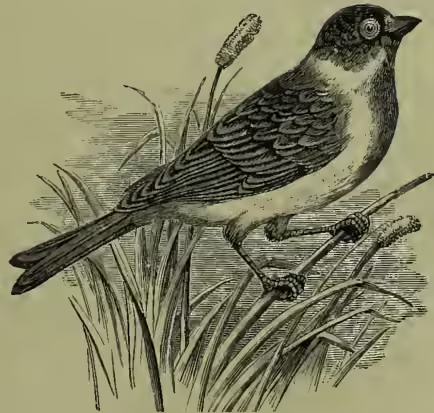
Bunting (Emberiza), a genus of birds in the great finch family Fringillidæ. They are nearly allied to the crossbills. The most marked characteristics are a short, straight, conical bill; a curved form of the gape, produced by a narrowing of the sides of the upper jaw, and a corresponding enlargement of the under one; and a hard rounded knob on the palate or inner surface of the upper jaw. This knob probably aids in crushing the seeds, which are a principal part of the food of these birds. The species of bunting are numerous, and may be arranged in several sub-genera.—The Common Bunting, or Corn Bunting (E. miliaria), is a bird considerably larger than a house-sparrow, brown, with darker streaks on the upper parts, whitish brown with spots and lines of dark brown on the under parts, and with a slightly forked tail. It is frequent, particularly in low cultivated grounds in Britain, and in most parts of Europe, extending also into Asia, living in pairs during spring and summer, but in flocks in winter, and often visiting barn-yards at that season, along with chaffinches and sparrows. It is the largest of the British buntings. It is supposed that the winter flocks in Britain are much increased by migration from more northerly regions. This bunting often passes the night on the ground in stubble-fields, and is taken in the nets employed for catching larks, and brought with them to market. It usually builds its nest on or very near the ground. Its notes are harsh and unmusical, and sometimes sound like the clicking of knitting needles.—The Reed Bunting, or Black-headed Bunting (E. schoeniclus), is a species common in marshy situations, both in Britain and on the continent of Europe. It feeds much on willow and other buds. It is a very pretty little bird, in the male with black head, cheeks, and upper throat; in the female with brown instead of black, and with a white throat.—The Cirl Bunting (E. cirrus), of which the head is olive-green, with black streaks, and with patches of bright lemon-yellow on the cheeks and over the eyes, is a rare British bird, and belongs chiefly to the south of Europe and the north of Africa. To this genus belong also the Ortolan (E. hortulanus, q.v.), and the Yellow-hammer (E. citrinella, q.v.).—The Snow Bunting (q.v.), or Snowflake (E. nivalis of many authors), has been placed in the new genus Plectrophanes. The name bunting has been often very vaguely used, and many species have been almost indiscriminately called buntings or finches. The palatal knob affords the best distinctive character. North America has a large number of species of bunting.—The Black-throated Bunting (E. Americana) is extremely plentiful on the prairies of Texas and other south-western parts of the United States; extending, however, as far as to Ohio, and even to Massachusetts. In the middle and northern states it occurs only as a summer bird of passage. In its habits it closely resembles the Common Bunting of Europe; but the palatal knob is less hard. See Macgillivray's British Birds, vol. i.