Burbot (Lota vulgaris), a fish closely allied to the Ling (q.v.), and remarkable as the only fresh-water species of the Cod family (Gadidæ). It is found in the Cam, the Trent, and other rivers of the eastern and midland counties of England, but is one of the most local of British fresh-water fishes. It is found also in various parts of middle
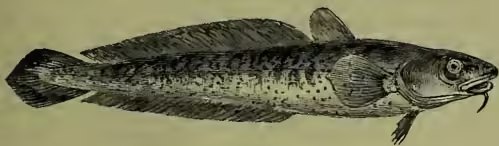
Europe, and in Asia. In English rivers, it often reaches 2 or 3 lb. in weight, but has been taken of 8 lb. weight; and in some parts of Europe, it is said to reach as much as 10 or 12 lb. In appearance, the burbot very much resembles the ling, but is rather thicker at the neck, and tapers somewhat more rapidly, although still of a somewhat elongated form. It has two dorsal fins, the first short, the second very long, and a very long anal fin. It differs from the ling in the form of the tail-fin, which is oval and slightly pointed; but agrees with it in having a single barbule on the lower jaw. It is of a greenish-brown colour, clouded and spotted with darker brown on the upper parts, the under parts lighter; the scales are small; and the whole body is covered with a mucous secretion. The flesh is white, firm, and of good flavour. The burbot usually keeps to the bottom of deep water, and swims up the river at spawning times (midwinter). It can survive for a long time out of water. It is commonly taken by trimmers and night-lines, as it feeds principally during the night. Its food consists of small fishes, worms, molluscs, fish-spawn, &c. Its liver yields an oil similar to cod-liver oil. It is one of the hosts of the asexual stage of the formidable parasite, Bothriocephalus (q.v.).