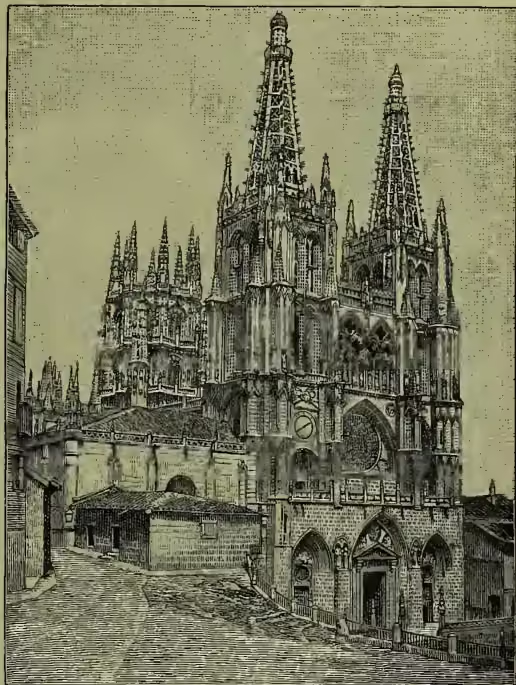
Burgos, a city of Spain, the ancient capital of the kingdom of Old Castile, stands on the right bank of the river Arlanzon, 225 miles N. of Madrid by rail. Burgos, which is the see of an archbishop, was founded in 884. Many of the gloomy old houses of its early history still remain. In the castle, Edward I. of England was espoused to Eleanor of Castile. The cathedral, founded in 1221, ranks with those of Toledo and Leon, the three great Spanish churches of the Early Pointed period. 'Better known than either of the others,' says Mr Street, 'Burgos is inferior in scale and interest, and its character has been much altered by added works more or less Rococo in character, so that it is only by analysis and investigation that the 13th-century church is still seen under and behind the more modern excrescences.' Still, it is a glorious building, with its twin-spired western façade, its exquisite lantern, and its fifteen chapels so rich in fine sculpture and tombs, of which there are upwards of 60, with 44 altars and fully 100 full-length statues. The church of Agueda is associated with the legend of the Cid; that of San Esteban was formerly a convent. The chief street is the Espolon, which forms a promenade by the river. The town-hall is a modern building. There are several convents in the neighbourhood. The suburbs are connected with the older part of the town by three stone bridges. Burgos was the birthplace of the Cid (q.v.), whose bones are preserved at the town-hall, as also those of Pedro the Cruel, San Julian, and San Lesme.
It has manufactures of woollens and linens, and some traffic as a mart of agricultural produce. It has several hospitals and educational institutions; the university founded in 1550 is now extinct, but there is an institute and seminaries for priests and teachers. The city formerly had a much larger population—as many as 50,000—but on the removal of the court to Madrid in the 16th century, it began to decline in population and importance. It was further greatly injured in November 1808 by the French, who sacked it. In 1812 the city was four times unsuccessfully besieged by Wellington, who, however, took it in the following year, when the French blew it up, as well as the fortifications. Pop. 34,325.—The province of Burgos has an area of 5651 sq. m., and a population of 338,551. The surface is elevated, the soil fertile, yielding grain and fruits. The hills afford rich pasturage; and gold, silver, iron, lead, and copper are found.