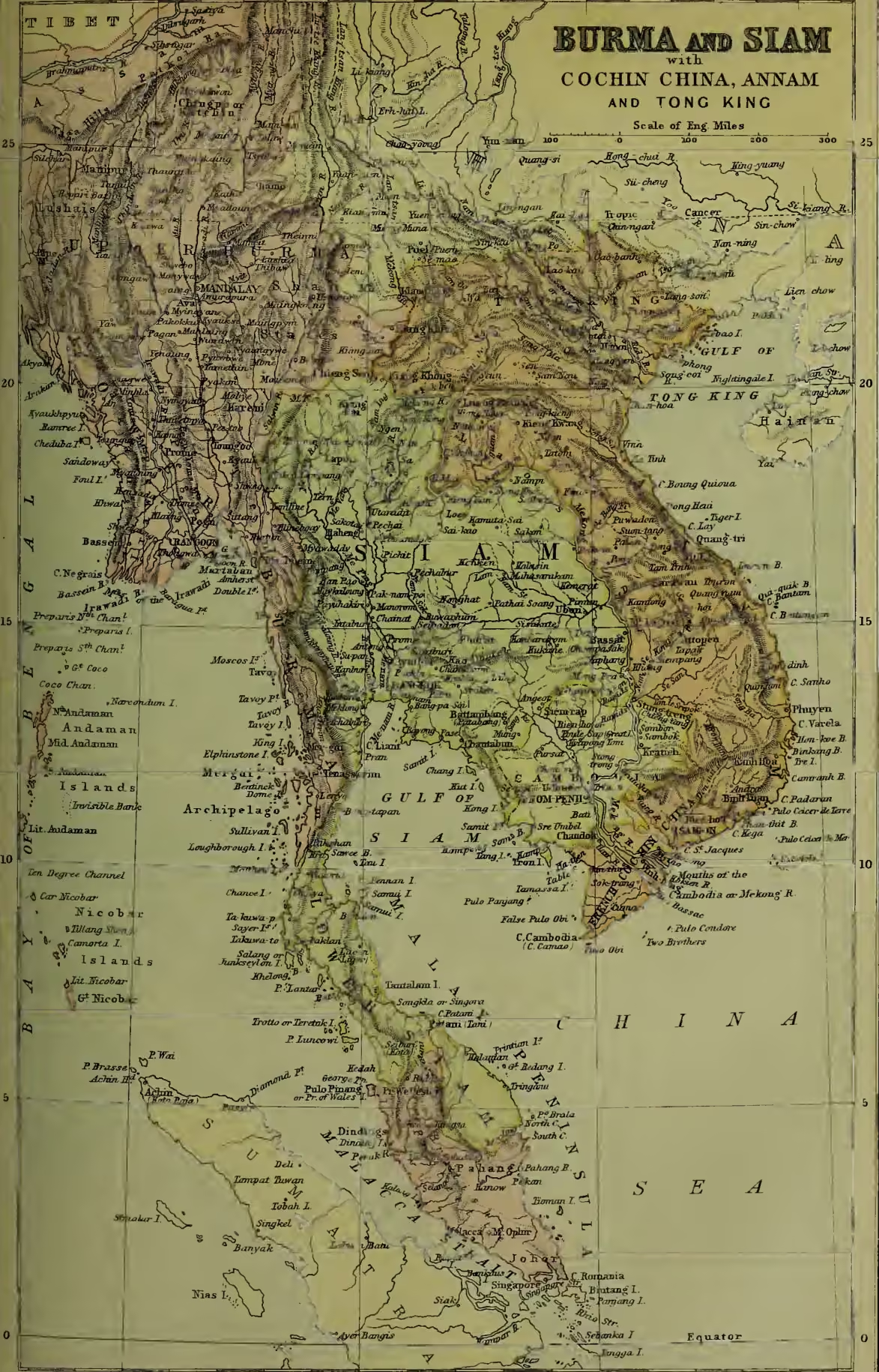
Burma is the largest of all the provinces of the Indian empire. It stretches from 28° lat., on the confines of Tibet, southward for 1100 miles, to 10° lat., far down the Malay Peninsula, and from 103° long., on the Chinese border, for 700 miles westward to the Bay of Bengal. It is conterminous with China and Siam on the east; and for the rest it is bounded by the Indian provinces of Bengal and Assam, and by the ocean. Its total area is about 280,000 sq. m., of which one-third belongs to the old province of Lower Burma and two-thirds to the new province of Upper Burma. The country consists of the great basin of the Irawadi and its affluents; the rugged country drained by the Salween and Sittang rivers, on the upper waters of which are situate the Shan States; and the narrow maritime provinces of Arakan and Tenasserim. The deltas of the Irawadi, Salween, Sittang, and Koladan rivers are flat plains, and there are smaller areas of level land at the mouths and on the banks of some of the feeders of the Irawadi. The level cultivable plains probably do not exceed 50,000 sq. m. in all. The rest of Burma is hilly broken country, covered for the most part with forest. There are large highland tracts, with a ruling elevation of 2000 to 4000 feet. The principal hill-ranges are the Patkoi Mountains in the north, which reach at one point a height of 12,000 feet, and from which outliers jut far down into the valleys of the Irawadi and the Chindwin; the China hills in the north-east, culminating in perpetual snow-peaks 15,000 feet high, close to the Chinese city of Talifoo; the Arakan Yoma range, running from Bengal to Cape Negrais; the Pegu Yoma range, separating the Sittang valley from the basin of the Irawadi; the Tenasserim range, running from the Salween River to the foot of the Malay Peninsula; and lastly, the Shan States, a vast upland, cleft by deep chasms, in which flow the Salween and the Cambodia rivers and their feeders. The chief river of Burma is the Irawadi, with a course of probably 1100 miles from its unknown source in the snows of Tibet down to the Bay of Bengal. This great stream is navigable all the year round by river-steamers, which, with their flats, carry 1000 tons of cargo and hundreds of passengers up to Bhamo, 700 miles from the sea, and 50 miles from the Chinese border. Some hundreds of miles of deltaic channels of the Irawadi are also navigable by large river-steamers. Of the affluents of the Irawadi only the Chindwin, the Shweli, and the Myit-nge are navigable by large craft. The Chindwin is navigable for 300 miles in the rainy, and 150 miles in the dry season. The Salween River, which has its origin in the Tibet snows, is navigable for only about 80 miles from the sea. The Sittang River rises in the hills to the south-east of Mandalay. All these rivers and many of their feeders are traversed in the rainy season by tens of thousands of native barges and boats, which carry cargoes up to 120 tons. The rivers are the chief, and were, until British occupation, the only highways of the country. During the dry season all the rivers, except the very largest and the tidal channels, are too low for navigation; and therefore, until recently, no movement of heavy goods for any distance could take place from December to July over the greater part of the country. During the flood season the Burma rivers top their banks. The Irawadi at Prome, 200 miles from the sea, is about a mile wide, and there the difference between the highest and lowest level of the river is 45 feet. During the great floods the river water spreads over the country; and sometimes the floodwaters of the Irawadi submerge the country for 10 or 15 miles on either side to a depth of 4 to 14 feet. The inundated villages, however, do not suffer, as the houses are all built on piles, and the flood-waters move slowly.
Climate and Rainfall.—The rainfall varies widely in different parts of Burma. Along the coast from Akyab to Mergui the average rainfall exceeds 200 inches a year at each of the six registering stations. At Bassein, Rangoon, and Pegu, a little way inland, it averages 100 inches. Up the Irawadi valley the rainfall decreases rapidly; at Prome it is 42 inches, and at Thayetmyo only 37 inches. Information about the rainfall of Upper Burma is as yet meagre. Apparently there is a dry belt, with less than 30 inches of rain per annum, from Thayetmyo to Myingyan; at Mandalay, where the hills approach the river, the rainfall is about 45 inches a year; it may increase to 60 inches at Katha, and perhaps to 80 at Bhamo. On the Upper Chindwin, on the Ruby Mines plateau, on the Shan hills, and in the narrow valleys of the Salween and Sittang, the rainfall is heavy. In the delta and along the coast the rainy season lasts for five, six, or sometimes even seven months. During
95
100
105
110
BURMA AND SIAM
with
COCHIN CHINA, ANNAM
AND TONG KING
Scale of Eng. Miles
0 100 200 300
25
25
20
20
15
15
10
10
5
5
0
0
95
100
105
110
Longitude East of Greenwich

those months the climate is very moist, but the heat is by no means excessive. From the middle of November to the end of January the climate is cool, and the thermometer at dawn sometimes falls as low as 60° F. From February to the end of April the climate of the delta is dry and hot, and the thermometer occasionally reaches 100° in the shade; but the nights are always cool, and there is never any hot wind as in India. Higher up the Irawadi valley at Prome, Thayetmyo, and in the dry belt, the climate is much hotter and dryer in the summer, and it is much cooler in the winter months. At Mandalay and Bhamo the months of December and January are cooler still; at Mandalay and over the dry belt, the dust and glare are sometimes excessive in April and May. On the Ruby Mines plateau, at an elevation of 5600 feet, the thermometer in the shade does not exceed 86° in the hottest season: in this neighbourhood an attempt is being made to found a sanatorium for European troops. The climate of Burma is more trying to Europeans than that of the plains of India.
Flora and Fauna.—The forests of Burma contain an abundance of useful and beautiful trees. The most important and valuable tree is the Teak (Tectona grandis). Teak trees, as well as trees of other kinds, are seen 15 to 25 feet in girth, and 90 or 120 feet from the ground to the lowest branch. The most beautiful and not the least useful of the products of the Burma forests is the bamboo. Different species, from the slender bamboo used for arrows, up to the giant bamboo 9 inches thick and 100 feet high, are employed for manifold purposes (see BAMBOO). Several Burma trees produce valuable wood-oil, varnish, tannin, and gums; and many creepers yield valuable fibres. There are rubber-yielding creepers besides the Ficus elastica; and cutch, obtained from the Acacia catechu, is a most valuable gum. Orchids, ferns, and mosses of much beauty are found in abundance. Ground flowers are comparatively few; but a Burma forest, particularly in the month of March, is quite bright with the many colours, and sweet with the varying scents of thousands of flowering trees, flowering creepers, flowering shrubs, and orchids.
Among the wild animals of Burma may be mentioned the elephant, three species of rhinoceros, tapir, buffalo, bison, many kinds of deer, small wild cattle, hog, tiger, leopard, bear, and wild dog. The forests are so vast, and in parts so dense, that the pursuit of wild animals is difficult. Among domestic animals, the buffalo, oxen, elephants, and ponies are all good. No horses are bred, sheep and goats are rare, and donkeys are hardly ever seen. The domestic fowls are better than in India. Pythons and cobras abound; and the hamadryad, the most deadly of eastern snakes, is occasionally met. The variety of birds is immense: the peacock of Burma is larger and more gorgeous than its Indian congener; the argus pheasant, the golden and the silver pheasant, are the most brilliant of the gallinaceous birds; aquatic birds, from the pelican and wild goose down to the snipe, abound. The quantity and variety of the fish caught on the coasts and inland waters of Burma are prodigious. Alligators are not usually eaten, but every other inhabitant of the water, from the shark down to the shrimp and sea-slug, either fresh or dried and salted, contributes to the food of the Burmese. Among the rarer delicacies furnished by marine creatures may be named the edible birds'-nests found in the caves of the Mergui Archipelago, and the eggs of the sea-turtle. The right to collect these eggs is leased by the state; and a small turtle-bank, not one mile long, on an island near one of the mouths of the
Irawadi, yields a rental of £1500 a year to the public treasury for turtle-eggs only.
Minerals.—The geology of Lower Burma has been examined by scientific officers of the Survey. Gold is found in small quantities by washing river-sand; silver is extracted at lead-workings in the Shan States, but not in great quantity. Iron, copper, lead, and tin exist in great quantity, but none of these pay for working, except tin, which is worked by Chinese settlers in the Mergui district. Attempts to work tin and lead after European methods have failed. Earth-oil or petroleum is found at many points on the Irawadi River and in Arakan. The Irawadi oil is a dark, viscous fluid, yielding only 20 per cent. of burning oil; while the Arakan oil is a light-coloured, clear fluid, that can be burned in a lamp as it comes from the well. About 550 wells in the Irawadi oil-region, and 150 wells in the Arakan region, are or have been worked. As yet, nothing in the shape of a springing well or of a constant supply has been found. Jade and amber are both found and worked in the country north of Bhamo, on the feeders of the Chindwin River. The mines are worked by the local tribes under the superintendence of Chinese; and jade is exported to China and Japan to a value of some £50,000 a year. Fine white marble is found near Mandalay, and is used for images of Buddha and for ornamenting pagodas. Coal exists at several places in the Shan States, at Kalé on the Chindwin River, and at Thingadaw on the Irawadi River above Mandalay. All these coal sources are in Upper Burma; one only, that on the Chindwin River, is being worked for steamer-fuel; some of the others were examined in 1887. The coal found as yet in Lower Burma has proved of poor quality and scanty in quantity. Limestone of good type is found and burned in many parts. Building stones are found in most districts outside the delta; near Mandalay the stone is particularly good. The ruby mines north of Mandalay yield the best rubies in the world. The ruby-yielding area stretches over about 200 sq. m. Rubies are found by sinking holes down to the ruby-bearing stratum, and then sifting or washing the earth raised therefrom. The mines were worked in rude fashion, and yielded about £100,000 worth of rubies a year. All large stones were royal property, but, in practice, most of the valuable gems were secreted and smuggled away. European machinery and skill have since 1888 been applied to working these mines.
Population.—The census of February 1881 showed the population of Lower Burma to be 3,736,771, that of 1891 gave 4,569,680 for Lower Burma, and 2,984,730 for Upper Burma, without the Shans (q.v.), who number about 2,000,000. Probably the whole population of Burma may be distributed somewhat thus:
| Burmans..... | 5,450,000 |
| Shans..... | 2,000,000 |
| Karens..... | 700,000 |
| Other hill tribes..... | 800,000 |
| Indians, Chinese, Europeans, and others..... | 300,000 |
| Total..... | 9,250,000 |
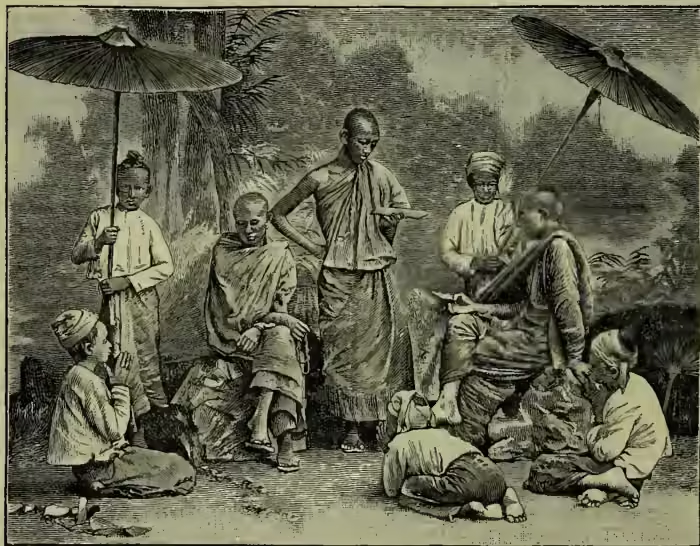
The Burmans are a short-statured, thick-set people; they wear long hair on their heads, but have little hair on their faces. They are flat-featured, and nearer the Chinese than the Aryan type. They are excitable and impulsive; fond of fun and laughter; much given to dramas, dances, and shows of all kinds; up to a certain point courageous. They are callous to suffering in others, and ready to commit crimes of violence. Dacoity or robbery with violence by gangs is a common crime among Burmans; the proportion of violent crimes and of convicts to the population is far larger than in any other Indian province. Burmese women are well treated; they go to market, keep shops, and take their full share in social and domestic affairs. Men and women are well clad; they delight in gay colours and in silk attire. Burmese young men and maidens arrange their matrimonial affairs for themselves when they grow up. Women as well as men can procure divorce for good cause. Widows and divorced wives can re-marry. Burmans make good peasant farmers, good boatmen, good shopkeepers. But they are unmethodical and unpunctual; they do not make good soldiers, or policemen, or factory hands. They are lavish in their expenditure, and seldom hoard money. The general level of prosperity and standard of comfort is high; there are few poor, and no beggars. The wages of unskilled labour may be quoted at 4 rupees a week in the delta districts, and at 2 rupees in Upper Burma, as compared with rupees in continental India. The staple food of the people is rice, which is as cheap as in India. Burmans eat fish or meat daily, and have more liberal diet than Indians of the same class. The existence of ample fertile land, near to good markets and available on payment of a moderate land-tax, explains the high rate of wages. Burmans are Buddhists by religion, and their form of Buddhism is purer than in any other country except Ceylon. There are no large land-owners, and there is no aristocracy in the country except the officials. The most influential and respected class are the Buddhist monks, whose function is to set an example of a correct life, and to instruct the young. These monks, of whom there are over 20,000 in the country, strictly observe their vows of celibacy and poverty; but they can unfrock themselves and return to the world when they please. They shave their heads, wear yellow robes, and live in monasteries. They are well cared for by their lay supporters. No monastery or pagoda has any property or endowment.
The Shans resemble the Burmans; but being highlanders, are poorer, harder, and more courageous. They have a remarkable turn for trading of all kinds. The Karens used to be nature-worshippers; they were despised and oppressed by the Burmans among whom they lived. They are less clever, but more persevering and methodical than Burmans. A large number of Karens have embraced Christianity at the teaching of Ameri- can Baptist missionaries; and now there are over 500 parishes of Christian Karens, containing nearly 200,000 souls; each parish supports its own church, pastor, school, and schoolmaster. The Chins live in the uplands between Arakan and the Chindwin River; they make yearly raids upon the peaceful villages of the Kubo and Chindwin valleys. Some Chin settlements are found on the hills of Lower Burma, where they live very poorly. The Kachins inhabit the hills, and dominate the trade routes north and east of Bhamo: they used to levy blackmail on caravans to China. They are courageous, and defend their mountain fastnesses well. They command the approach to the jade mines, and the path from the Upper Irawadi into the Assam valley. Close under the Assam hills the Chins merge into and are apparently identical with the Singphos. The Palouns are the wildest of the Shan races; they pluck and send to market wild tea from their hills.
Language.—The Burmese language is monosyllabic; it is written from left to right; the shape of the letters is circular; and most of the letters are perhaps rounded modifications of Sanskrit letters. The grammar is simple; but the language is difficult to acquire perfectly by reason of its many breathings and tones. Among other peculiarities of the language, two may be mentioned. Ordinary acts, such as sleeping, eating, or walking, are denoted by different words according to the status of the actor; and, when a number of persons or things is mentioned, a generic noun is added after the numeral. For instance, one man = lu ta youk, or man one person; two monks = pongyi na ba, or monks two holy men; three cows = nawa ma thón goun, or she cattle three head; five hills = toun nga lón, or hills five round things; ten guns = they nat tsé let, or guns ten long things. Burmese has been a written language for perhaps 800 years. The Shan language has also been long written; it is akin to Burmese. Karen has recently been reduced to writing by the American missionaries. None of the other hill tongues are written languages. The classical language of Burma is Pali, in which are written the sacred books and the laws of Mann. Pali manuscripts are kept in many monasteries, and learned monks study Pali. The older literature of Burma consists of manuscript Pali books on religion and law, and of Burmese translations from these books. There are some few more or less apocryphal histories in Burmese. The favourite literature of the country consists of dramas and poetical fables. Of late years tens of thousands of copies of old and new dramas and fables have been struck off by presses established at Rangoon. About 1872 it would have been nearly impossible to find a book anywhere save in a monastery or in a large town. Now printed books are finding their way all over Lower Burma, and are sold in nearly every market. There are seven or eight vernacular newspapers. A. Judson published a grammar (1866; new ed. 1891) and a dictionary (3d ed. 1877), and A. W. Lonsdale a grammar (1899). The name Burma is, according to Yule in Hobson-Jobson, an Englished form of Mram-ma, pronounced by the people Bum-má. The following passage is the translation of John iii. 16 in Burmese, as published by the British and Foreign Bible Society (and see ALPHABET, vol. i. p. 189) :
ဘုရား သင်၍သာ တော်ကိရ်ကြင်သော
သုခပေါင်းတို့သင့်ပျက်စီးခြင်းသို့မရောက်။ အ
စည်ထာဝရအသက်ရှင်ခြင်းကိုရစေခြင်းငှါသု
ရား သင်သည့်မိမိ၌တပါးတည်းသောသား
တော်ကိုစွန့်တော်မူသင့်တိုင်အောင်လောက်သ
ားတို့ကိုချစ်သနားတော်မူ၍။
Education.—The primary schools of the country are the Buddhist monasteries, in which every Burman lad must, according to national custom, sanctioned by religion, spend a part of his boyhood as pupil and as acolyte. At every monastery boys are taught to read and write; in Lower Burma most monasteries have accepted inspection by public officials, and teach up to the government standards. Some of the improved monastic schools have 120 or 150 boys apiece, and earn up to £100 a year as grants in aid. Census figures show that over 60 per cent. of the males in Lower Burma above the age of twelve could read and write. Girls are not admitted to monastic schools; but they are frequently taught with boys in lay schools, and schools for girls are being gradually established. Recent statistics of education for Lower Burma show :
| Number of Institutions. | Boys and Girls on Rolls. | |
|---|---|---|
| Colleges..... | 1 | 20 |
| Secondary Schools..... | 70 | 8,881 |
| Primary Schools (chiefly monastic) 5325 | 5325 | 149,621 |
| Training and Technical Schools. .... | 16 | 410 |
| Total..... | 5412 | 158,932 |
Boys, 148,715; Girls, 15,217.
Trade.—The external sea-borne trade of Lower Burma is valued at fourteen millions sterling. Most of this trade centres in Rangoon. The chief export items are rice, valued at six millions sterling; teak timber, one million; cutch, hides, cotton; while the chief import items are cotton piece-goods and yarns, silk goods, coal, hardware, salt, and metals. The trade between British and Upper Burma before the last war was valued at three and a quarter millions sterling. The great staple of Lower Burma is rice, of which as much as 1,150,000 tons are exported in one year. This great trade has been fostered by the establishment of rice-cleaning mills at all the seaports. Burma rice goes direct to England, Germany, Italy, America, Singapore, and China; it fetches a better price than any Eastern rice except the Japan and Java products. It is usually quoted about 20 per cent. above the rice of Saigon or Bangkok. The activity of internal trade in Burma may be measured by the financial success of the Irawadi Flotilla steamers, and of the two railways.
Arts and Manufactures.—The arts in which Burmese excel are wood-carving, silver repoussé work, woven silk fabrics of many colours, and lacquer-ware. In wood-carving Burmese workmen display much skill and imagination; each man draws on the wood his own patterns, according to his own fancy, before he begins with his graving tools. Much of the lacquer-ware is made on delicate woven bamboo frames. Excellent boats are built on all the larger rivers. The foundation, or lower part of the hull, always consists of a hollowed, widened trunk of the thingan tree; the sides are built up with planks; both prow and stern are raised several feet above the deck, and are ornamented with much beautiful and grotesque carving.
Public Works.—Under Burmese rule no roads or public buildings save temples and monasteries were made by the state; but certain valuable, though short, irrigation canals were made near Mandalay, Kyouksé, and Salen; while in many towns and villages brick pathways were laid down, and bridges were built, as works of religious merit. Since Burma came, province by province, under British rule, about 500 miles of metalled and bridged roads have been made, besides streets and roads in towns; three navig- ation canals, aggregating 70 miles in length, have been dug; many cross-country roads and paths have been cleared; two railways, aggregating 330 miles, had already been opened, when a third (1888), 440 miles long, connected Mandalay, the capital of Upper Burma, with the seaboard; embankments to keep flood-waters off the land have been erected for 250 miles along the banks of the Irawadi River; the Irawadi Flotilla Company have placed on the Irawadi River a fleet of forty-seven large steamers and one hundred flats; court-houses, hospitals, schools, barracks, prisons, churches, and public offices have been built all over Lower Burma, and are being begun in Upper Burma; and the peace of the country is safeguarded by forts at Rangoon, Thayetmyo, Toungoo, Mandalay, and Bhamo, as well as by batteries at the ports of Rangoon and Maulmain.
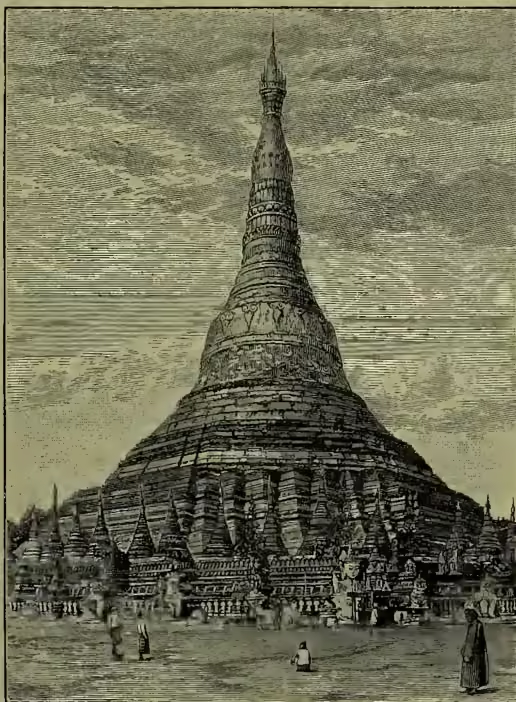
Architecture.—Everybody in Burma lives in either a wooden house or a bamboo hut, save in the large towns where a few rich people have built masonry houses. Every house is built on posts or piles, so that the lowest floor is from 1 foot to 12 feet off the ground. In the inundated tracts house-posts are necessarily high; but even in upland country a Burman always has a space between his lowest floor and the ground, as he deems it unhealthy to sleep on the ground. Well-to-do people build their houses of teak or other wood planks; the high-pitched roofs, with projecting eaves and carved finials, are picturesque. The solid pagodas of masonry, and the teak monasteries, surmounted by three or seven-tiered roofs, and ornamented with beautiful or grotesque carvings, are the most notable structures in Burma. Monasteries (kyouns) and rest-houses (zayats) are erected in every town and village by devout Burmans, who consider that such works secure for them kūtho—that is, merit or reward in the next life. Rangoon, Maulmain, Prome, and Pegu, all possess beautiful pagodas and monasteries; so also do many towns on the banks of the Irawadi. But Mandalay is famous beyond all places in Burma for the number of its monasteries. The finest and most sacred pagoda in Burma is the Shway Dagón Pagoda at Rangoon; and among the finest monasteries are the Atoo-mashee ('incomparable') Monastery, and the Mee-baya ('Queen's') Monastery at Mandalay. The most graceful wooden structure in Burma is the lofty woodwork spire above the hall of audience in the Mandalay palace; the exterior is gilded, beautifully carved, and lit up with innumerable mirror facets.
Finances.—The rate at which the revenues of Lower Burma have increased since the annexation of Pegu in 1854 may be seen from the following figures:
| 1855..... | total revenue, 45 lakhs. |
| 1861..... | " " 80 " |
| 1871..... | " " 123 " |
| 1880..... | " " 270 " |
| 1886..... | " " 308 " |
As a lakh of rupees is equal to £7500 at an exchange of 1s. 6d. per rupee, these 308 lakhs would equal £2,310,000. But 34 lakhs must be deducted as being rather municipal than public; so that the total public revenue in 1886 was 274 lakhs (£2,055,000). In the same year the imperial expenditure was 184 lakhs. In the year 1892-93 the total revenue of Burma, Lower and Upper, was 38,232,210 rupees, the expenditure 24,561,220, leaving a surplus of 13,670,890 rupees (rupee then worth 1s. 1¾d.) for the Indian treasury.
Land is held by petty occupiers direct from the state, on payment of a land-tax, ranging ordinarily from half a rupee to 2½ rupees per acre. The average value of the rice crop on an acre may be quoted at 20 rupees, so that the land-tax is probably about one-tenth of the gross yield. The total area under cultivation is close on 5,000,000 acres, of which six-sevenths are under rice, and 300,000 acres are kept fallow. The capitation-tax is an old Burmese impost, leviable on all adult males. The usual rate is 5 rupees a year for each married man, and 3 rupees for each bachelor.
All forests belong to the state, and the teak tree is everywhere reserved by ancient custom and by law as a royal tree. In all reserves conservancy and reproduction of teak is scientifically conducted.
Excise revenue is raised by a still-head duty of 4 rupees per gallon on all London-proof spirit, by fees paid for licenses to sell opium and liquor, and by the sale of Bengal opium to licensed vendors. The excise revenue remains low by reason of the refusal to license additional liquor or opium shops. There are in Lower Burma only some 20 licensed opium shops, as compared with 68 shops in 1880. The salt-tax is levied at 3 annas per maund (about 5d. per cwt.), or one-tenth of the Indian salt-tax rate. Most of the salt consumed in Burma comes from Europe; some little is made locally from sea-water and from brine-wells. The import customs revenue to the amount of 7 lakhs a year is derived from duty on imported liquors. Export duty to the amount of 50 lakhs is levied on rice exported by sea, at the rate of 3 annas per maund, equal to about 7 per cent. ad valorem.
During the best times of Burman rule the public revenues of Upper Burma were approximately about 95 lakhs. But, for various reasons, more than one-third of the nominal revenue of the late government was lost to the British administration; and for some years the cost of occupying the country by troops and military police was very great. And so Upper Burma caused a heavy drain on the Indian exchequer. The cost of the army and military police was largely reduced as the country was brought into order. A convention was concluded with China in 1894 by which Burmese goods had free passage into China for six years, the duty arranged for ultimately being 6 per cent. ad valorem. In the same year the Northern Chin Hills were subdued and disarmed.
Government.—Burma is governed by a lieutenant-governor (till 1897 a chief-commissioner), whose headquarters are mainly at Rangoon. The territory is divided into eight provinces, over each of which a commissioner is the supreme judicial and executive officer; and each commissioniership is again divided into districts. The deputy-commissioner is the head of his district in all executive, judicial, police, and revenue affairs; he has under him one or more European assistants; and each district contains five to ten townships (myos), over which presides a Burman magistrate. Beneath the township officer are the circle officers (thuggys). In each village one of the chief inhabitants is appointed headman, and is vested with petty police and revenue powers. The district administration is supported by a strong police force, partly Burmans and partly Indians, who are commanded by European officers. A military garrison, consisting in 1894 of 14,500 men (4000 Europeans), occupies the country.
History.—The royal chronicles kept by the kings of Ava derive the earliest Burmese dynasty from Buddhist monarchs in India. It is conjectured that the Burmans came into the Irawadi valley from the highlands of Central Asia about 2000 years ago, and amalgamated with the races then living in the country. It seems certain that the Buddhist religion and a Buddhist dynasty were established on the Irawadi, perhaps near Prome, about the time of the Norman Conquest. In the 12th and 13th centuries flourished Burmese kings who had their capital at Pagán on the Irawadi, about 400 miles from the sea, where are still extant most remarkable groups of temples built by that dynasty. In those days Burmese was a written language, and the Pagán kings had a civilised court. After that time the seat of power was transferred at intervals to Pegu, to Toungoo, to Prome, to Sagain, and to Ava. The empire was wrested from the Burmans, and held for a short time by the Shans, and by the Talaings, a race who had preceded the Burmans in the Irawadi delta. In the 16th century a European traveller visited the court at Pegu, and has recorded an account of its magnificence. During the 17th century settlements in the Irawadi delta were made by the French and the English. At Syriam, near Rangoon, the Portuguese had established themselves nearly two centuries earlier. The last Burman dynasty was founded by Alomprau (Ahompya), a Burman villager of Monshobo (Shwebo), 50 miles north of Mandalay. He rose against the Pegu king in 1753, and eventually established his power over Burma in 1757, but died at the head of his army during an invasion of Siam. His successor carried Burmese arms to Arakan, Manipur, and the capital of Siam. During the later part of the 18th century Siam revolted, and Burma suffered three invasions by Chinese armies from the north. Early in the 19th century the Burmese conquered Assam, and about 1820 they first came into contact with the British power in India. The Burmese made incursions into British territory, maltreated British subjects, attacked British troops, and refused repeated demands for redress. In 1824 broke out a war which ended (February 1826) with the Yandabo treaty, whereby Ava ceded to the British the provinces of Arakan and Tenasserim. For a while the Burmans observed the treaty. But after 1830, when a new king succeeded to the throne, slights and insults were put upon the resident, who had to leave the capital and reside at Rangoon. By various acts the Burmans showed their hostility and contempt for the British. Eventually they seized certain British sailors, and refused redress. After a final protest by the British, war again broke out, and ended, after ten months' duration, in the acquisition of Pegu by the British. King Mindoon Min, who succeeded to the throne in 1853, made compacts with the British, treated traders well, entertained an English resident at Mandalay, and abstained from anything that might provoke hostilities. During the crisis of the Indian Mutiny in 1857 the Burmans kept quiet. In 1879 this enlightened monarch died, and was succeeded by his son Thebaw, whose accession was signalised by the massacre of his brothers, sisters, and relatives. The British resident protested against these barbarities, and his position at Mandalay was made so perilous that he was recalled. From 1880-85 the Mandalay government showed unfriendliness in many ways; infringed the terms of the existing treaty; arranged to give to a rival European power preponderating influence on the Upper Irawadi; and imposed a fine of a quarter of a million sterling on a British company working in Upper Burma. The Mandalay government refused requests for redress; in October 1885 an ultimatum was despatched to Mandalay, the terms of which were refused; and early in November King Thebaw published a proclamation calling all Burmans to join him in driving the English into the sea. On the 15th November a British force crossed the frontier and steamed up the Irawadi. What little resistance was made proved ineffectual. By the 28th November the Burmese troops had laid down their arms at Ava; the capital (Mandalay), with the palace, fort, and arsenal, were surrendered; and the king was carried off captive to India. Early in 1886 the whole of Upper Burma was incorporated with the Queen's Indian dominions. For a time guerilla warfare was waged in different parts of the country; but by 1895 the country was practically pacified.
See Forbes, British Burma (1876); Fytche, Burma, Past and Present (1878); Scott ('Shlawy Yoe'), The Burman, his Life and Notions (1882); Sir Arthur Phayre, History of Burma (1883); Scott, Burma as it was, is, and will be (1886); E. D. Cuming, In the Shadow of the Pagoda (1893) and With the Jungle Folk (1896); H. Fielding, Thibaw's Queen (1899); and for the railway scheme from India through Burma, Siam, and the Shan States to China, see works by Colquhoun and Holt Hallett.