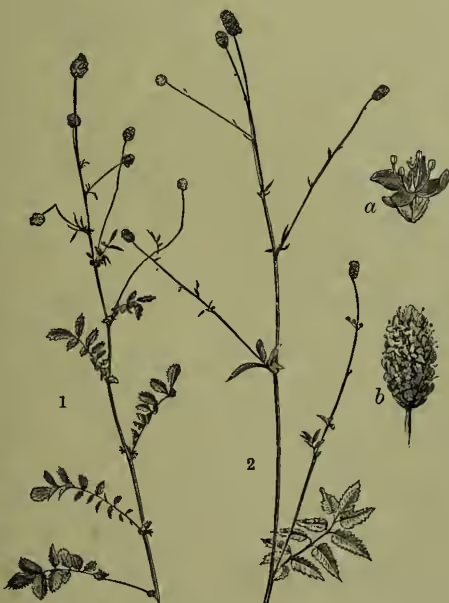
2, Great Burnet (Sanquisorba officinale):
a, a floret; b, flower-head.
Burnett's Disinfecting Liquid is a liquid introduced by Sir William Burnett (1779-1861) for the purpose of deodorising the bilge-water of ships, sewage-water, &c. It is a strong solution (sp. gr. 2) allied and often united genera of Rosaceæ—Potterium and Sanquisorba.—Great Burnet (Potterium of chloride of zinc, accompanied by a small amount of chloride of iron; and when intended to be used, it is mixed with water in the proportion of one pint to five gallons of water. The liquid acts only as a deodoriser and antiseptic (see ANTISEPTICS), and does not yield any vapour which can exhibit the properties of a Disinfectant (q.v.). It is of service in preserving dead animal tissues, as in the dissecting-room, and in jars containing anatomical specimens. It is said to have little action on dissecting knives, but this is doubtful. When added to bilge or sewage water, the chloride of zinc, , mainly acts by decomposing the offensive sulphide of ammonium, , which it does by forming the sulphide of zinc, , and chloride of ammonium, , both of which are odourless. The strong solution of chloride of zinc has also been applied to the preservation of timber from the ravages of dry-rot, and the process of so treating wood is called, after its inventor, Burnettising. Crewe's disinfectant liquid is chemically the same as the above.