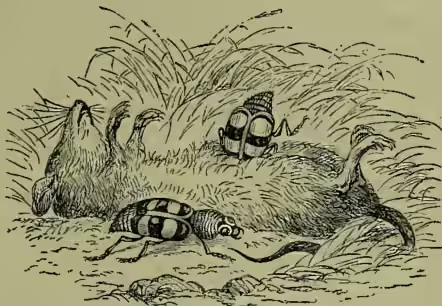
Burying Beetle (Necrophorus), a genus of Coleopterous (q.v.) insects, of the family Silphidae, with short club-shaped antennæ, remarkable for their habit of burying the bodies of mice, moles, and other small animals, in order to deposit their eggs in them, and to provide a supply of food for their larvæ. They all produce a chirping noise caused by rubbing the fifth abdominal ring against the wing-covers. When touched they give off a fluid with an extremely fetid and persistent smell. They are often covered with little red mites. Some of the species are natives of Britain, among which is N. vespillo, in which the habits were first observed. This form is still commoner in some parts of continental Europe. It is a black beetle, about an inch long, with two bright orange bands on its wing-covers. Its sense of smell would seem to be extremely acute, and a dead animal soon attracts it, a pair generally arriving together to feed upon the body. The male proceeds to inter the corpse if sufficiently small, previous to which, however, they have sometimes to drag it to some distance to a place suitable for their purpose. The head of the insect is the only tool employed in the operation, and is held sloping outwards, and employed in a manner which exhibits great muscular power. A furrow is first made around the body, then another within the first, and so on till the earth is so excavated from beneath, that the body begins to sink, when the insects, by great efforts, drag it down into the hole, and when it is fairly in, the excavated earth is thrown back over it. The female then lays her eggs in it; and when this is accomplished, and the cravings of appetite are satisfied, it is left for the larvæ, which are of a lengthened form, with six feet, whitish colour, and a brown head.—The known species are mostly natives of Europe and of North America. Silpha and other genera of the same family are common forms on dead and putrefying bodies.