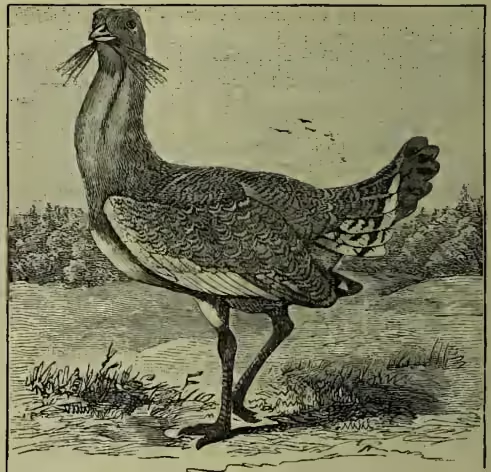
Bustard (Otis), a genus of birds, sometimes made the type of a family, Otididae, usually ranked in the order of marsh birds like the cranes (Grallæ, q.v.). Bustards are birds of bulky form, with long neck and lank naked legs; the toes, three in number, all directed forward, short, united at the base, and edged with membrane; the wings rather rounded; the bill of moderate length, straight, or nearly so, with a wide gape; and in form not unlike that of a hen. They are mostly inhabitants of dry open plains, to which all their habits are adapted. They are shy but cunning, not well adapted for flight, live in companies, and feed on green parts of plants, seeds, insects, worms, &c. The nests are simple excavations in the ground.—The Great Bustard (Ovis tarda) was at one time plentiful in some parts of England, and was also an inhabitant of the south-east of Scotland; but extending cultivation, and the persecution to which it has been subjected, have unfortunately banished it. It is common in the south and east of Europe, and yet commoner in the steppes of Tartary. It is the largest of European birds, the male sometimes weighing nearly 30 lb. A full-grown male is over a yard in length, and measures 8 feet from tip to tip of extended wings. The female is much smaller than the male. The bustards occur in small flocks, and are polygamous. The males fight freely. The maternal instincts are strong, though the nest is simple. Many of the young fall victims to birds of prey. The plumage is of a pale chestnut colour on the upper parts, beautifully varied with black; there is much white and black on the wings. The under side is whitish. The white-tipped tail is short, spreading, and rounded. A white whisker-like tuft of split-up feathers is present on each side of the throat in the summer dress of the male, and partly conceals a long stripe of bare skin on each side of the neck. The anatomy of the male exhibits a remarkable peculiarity in a large air-filled pouch, the entrance to which is between the under side of the tongue and the lower mandible.
The use of this bag is unknown. It has been poetically conjectured to be for conveying water to the females and young, in the arid plains. It is also said to add impressiveness to the voice of the male in his courtship. The Great Bustard feeds indiscriminately on animal and vegetable food, swallows frogs, mice, worms, &c., and is very fond of the green tops of some plants. This partiality is apt to be disastrous to turnip-fields and the like. Its flesh is highly esteemed for its flavour. The bird is said to afford good sport. The sharp sight, quick movements, habit of appointing sentinels, &c., make them difficult game. No difficulty is found in taming it, but all attempts to reduce it to a state of true domestication have hitherto failed, from its not breeding in the poultry-yard.—The Little Bustard (O. tetrax), frequent in the south of Europe and north of Africa, is only an accidental visitant in Britain. It is not half the size of the Great Bustard.—The Collared Bustard or Hubara, a separate genus (Eupodotis undulata), occurs in North Africa and Arabia, and occasionally strays northwards.—The Black-headed Bustard (O. nigriceps) is found in large flocks in the open plains of the Mahratta country. Its flesh is esteemed one of the greatest delicacies which India produces.—The Kori Bustard (O. kori) of South Africa, a magnificent bird, standing upwards of 5 feet in height, has a similar reputation as one of the best kinds of game.—Australia possesses a bustard (O. australasianus) somewhat exceeding the Great Bustard of Europe in stature. It is called Wild Turkey by the colonists of New South Wales. Its plumage is finely freckled or spotted; the prevailing colour is brown. It has become comparatively rare in the more settled districts, its flesh being particularly delicate and well flavoured, but may be seen stalking majestically in the grassy plains where human footsteps are still rare.