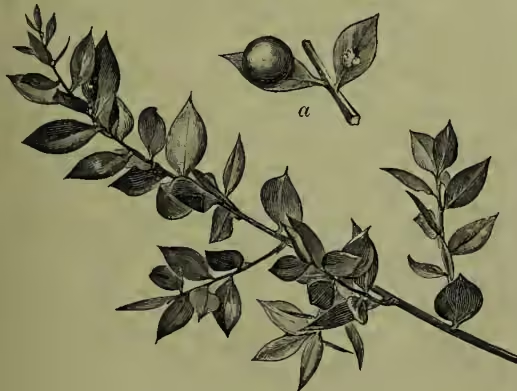
a, fruit.
Bute, JOHN STUART, third EARL OF, born in 1713, succeeded his father in 1723, and about 1737 attracted the favourable notice of Frederick, Prince of Wales, who made him one of his Lords of the Bedchamber. On the prince's death (1751), Bute became Groom of the Stole to his son, afterwards George III., over whose mind he obtained a strong influence. In March 1761 he was appointed one of the principal secretaries of state; and from 29th May 1762 to 8th April 1763 he was prime-minister. His government is memorable only as one of the most unpopular that ever held office in Britain, its fundamental principle being the supremacy of the royal prerogative, of which the executive government were merely the humble servants. Bute was incapable; but, worse than that, he was deemed by green, usually dioecious, shrubs of the Asparagus the popular verdict, as set forth by a contemporary, 'unfit to be prime-minister of England, as (1) a Scotchman, (2) the king's friend, and (3) an honest man.' For some time he retained his influence over the king, but the last twenty-four years of his life were chiefly spent in complete retirement in the country, where he engaged in botany and other scientific pursuits. He died 10th March 1792.—His fourth descendant, John-Patrick Crichton-Stuart, born at Mount-Stuart, in Bute, 12th September 1847, in 1848 succeeded his father as third Marquis of Bute. Educated at Harrow and Christ Church, Oxford, in 1868 he was admitted into the Catholic Church by Monsignor Capel. He is author of several works, including a translation of the Roman Breviary (2 vols. 1879).