Butterfly, a general name for any of the daylight Lepidoptera, in contrast to the twilight and nocturnal forms similarly slumped together under the popular name Moths (q.v.). Butterflies may be fairly called the favourite insects; the ravages committed in their caterpillar stage seem absolved by the grace and beauty of their adult life; the contrasts of their life-history have formed the subject of oft-repeated parables; the richness and variety of their colouring make them at once the cruel delights of boyhood and the living jewels of the artist; their thousand variations have for long afforded scope for the unrevealing labours of the entomologist; while their ethereal winged beauty has appeared to many a poet fitly symbolic of the human soul.
Zoological Position.—The Lepidoptera form one of the highest orders of insects, with these general characters—the mouth parts are most conspicuously represented by a rolled-up proboscis; the first ring of the thorax is not free; the body is cylindrical and compact; both pairs of wings are alike, membranous, and covered with fine, dusty, coloured scales; the 'tibia' joints of the thin legs are spurred; the metamorphosis in the life-history is complete; they almost all live on vegetable juices. Some naturalists find relationship between the Lepidoptera and such Neuroptera as the caddisflies (Trichoptera), among which they would look for representatives of the ancestral butterflies. The Lepidoptera, as a whole, form an immense order, with probably more than 20,000 species. The classification of these is a problem of much difficulty, as is always the case when numerous modifications occur within a narrow range. It has been the custom to distinguish Macrolepidoptera, including eight families, from Microlepidoptera, with four. But the main differences between these two divisions refer to size and habit, though certain distinctions in regard to the veining of the wings can also in most cases be drawn. With more justice the butterflies proper (Rhopalocera) have been distinguished from the mob of moths (Heterocera). In the former, the antennæ have club-shaped ends; there are no eye-spots; the wings are held upright when at rest; the posterior pair is not hooked to the anterior. In the latter, the antennæ are spindle-shaped, thread-like, or often with comb-like processes; the wings when at rest are flat, or at anyrate not upright; the posterior pair is very generally linked to the anterior. But while the former division includes only one family of butterflies proper, or Papilionidæ, the latter includes a dozen or so, and the distinction of these into twilight moths (Crepuscula), nocturnal forms (Nocturna), and Microlepidoptera does not greatly simplify matters. For our present purpose, however, the classification is sufficient so far as it distinguishes the butterflies proper (Rhopalocera or Papilionidæ) from the other families of Lepidoptera.
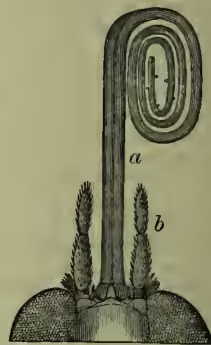
Structure.—Without describing those characters in which the butterflies agree with other insects, a few of the more striking features must be noted. Butterflies vary in size from less than an inch to almost a foot across the expanded wings. (a) External characters. Every one is familiar with the slender body of the butterfly, with the club-tipped (in one family also hooked) feelers, large eyes, long rolled-up sucking tube, hairy or scaly skin, and broad outspread wings. The three joints of the middle portion or thorax are fused together; the abdomen especially is slender. (b) The mouth organs, which are so important in insects, consist of the usual parts, but only one pair of these, the maxillæ, attain conspicuous development. The upper lip (labrum) or portion of the head just above the mouth is very small; the first pair of appendages or mandibles are degenerate; the second pair or maxillæ are prolonged to form between them the long suctorial tube or proboscis, but their side pieces or palps are usually extremely rudimentary; the second pair of maxillæ (forming the labium) are in themselves small, but their lateral pieces (labial palps) are relatively large three-jointed organs. The two half-tubes forming the proboscis are well known to be rolled up in a spiral when not in use. The presence of scent-producing organs in some butterflies, apparently a sexual character in some cases, though doubtless protective in others, implies the existence of some sense of smell, though the nature of this is unknown. The structure of their eyes, and their behaviour in regard to flowers, point to considerable powers of vision. (c) The legs are hairy, and are very little used in locomotion. The most anterior pair are often shortened, without claws, markedly different from the other two pairs, and are sometimes degenerate in the males, or in both sexes. (d) The wings are broad, not hooked together, and are almost always held upright during rest. They are covered with scales or flattened sac-like modifications of hairs, which inclose the familiar colouring matter, and often by their fine striate markings produce a metallic sheen. There are few transverse veins or nervures. The anterior wings have only one 'dorsal vein,' the posterior may have two, and then exhibit a groove suited to the abdomen or posterior portion of the body, or they have but one, and then have their inner margin cut away to fit the abdomen. The posterior wings are sometimes prolonged into beautiful tail-like appendages. At the root of each anterior wing, on the dorsal surface of the large middle ring of the thorax, is a shield, half-hidden with hair, which more or less conceals the third ring. The motion of the wings during flight is very complex. Many of the stronger forms can fly straight and swiftly, very many have a peculiar hesitating zigzag flight, while others can soar steadily in the air.
Internal Structure.—The anatomy of the internal organs does not differ in any conspicuous way from that of typical insects (see BEE); the front part of the food-canal usually bears a short crop into which the nectar passes from the flowers; the more numerous ganglia of the caterpillar are concentrated in the adult into those of the head, two in the thorax, and five or so in the abdomen; heart, air-tubes, excretory tubules, and reproductive organs are much as usual.
Nutrition.—Butterflies feed on the nectar of flowers, but in their adult state they eat very little. Their long tongues are thrust into the honey-secreting organs; the fine points on the surface of the organ doubtless aid in ransacking these treasures of sweetness; the action of the muscular sucking stomach or crop, helped by capillary attraction, causes the fluid to ascend into the mouth. While they thus rob the flowers, they act like other insects of similar habit in carrying the fertilising pollen from one flower to another. Many orchids, for instance, are thus fertilised by Lepidoptera. No parasitic butterflies are known, but Papilio turnus has been observed to be attracted by decaying fish. Butterflies are never exactly social, though the caterpillars of a brood are sometimes curiously associated (see ARMY-WORM, CATERPILLAR). The life of butterflies does not afford scope for much exhibition of intelligent habit. The larvæ sometimes show some acuteness in their search for suitable places for their pupa sleep.
Colour.—Some butterflies are dingy, others uniform, but in contrast to moths the majority are beautifully coloured. This is especially the case with tropical forms. How the colours are varie- gated and contrasted in spots and bands, how the hues are embellished by metallic shimmer, every one knows; what exactly the colour means is, however, still obscure. The pigment is especially laid down in the scales of the skin, but what the physiological conditions of its production are we do not know. A few general facts may be first noticed: (1) The colour is in many cases subject to variation—it cannot be said to be absolutely constant for a species; (2) in some instances, at any rate, it is influenced by external conditions, for 'seasonal dimorphism,' or different forms at different periods of the year, is known in many forms; (3) sometimes the colour and markings, especially of the under surface of the wings, are obviously of use for the protection of the resting butterfly; (4) in some cases this protective adaptation is so pronounced as to deserve to be called mimicry; (5) in many cases the colouring is in direct connection with the physical constitution of the species, and is usually most marked in the males.
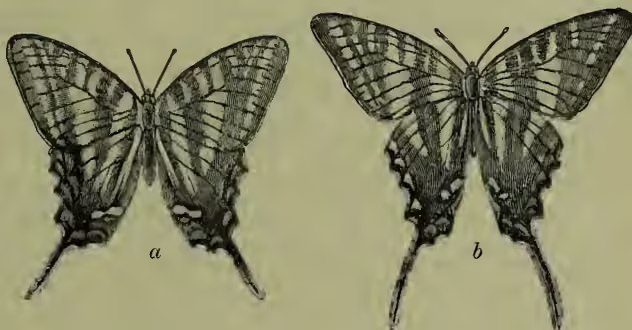
Seasonal Dimorphism.—Many cases are known where a butterfly species produces in the year more than one brood, of which the winter forms are so different from the summer generation that they have often been described as different species. A variation of this nature is known as seasonal dimorphism. It is a reminiscence of past climatic changes, as the result of which a species became split up into two varieties. Araschnia levana and Araschnia prorsa are respectively the winter and summer broods of one species. In the glacial epoch there was probably only A. levana, the winter form; the change of climate since then has evolved a second summer variety, A. prorsa. Both Weismann and Edwards have succeeded, by artificial cold, in making the pupæ which should normally become the summer A. prorsa, develop into the winter A. levana. According to Weismann, 'seasonal dimorphism must arise in butterflies whenever the pupæ of the alternating annual generations are exposed throughout long periods of time to widely different regularly recurring changes of temperature.'
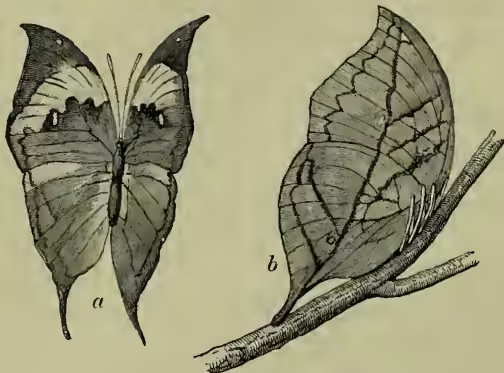
a, flying; b, at rest.
Protective Colouring and Mimicry.—The great majority of butterflies raise their wings vertically when at rest, so that the brightly coloured upper surfaces are hidden. The exposed under sides often resemble the objects on which the insects rest. The closed wings of some Vanessa and other forms look like bark; 'in Thecla rubi the wings when closed are of an emerald green, and resemble the young leaves of the bramble, on which, in spring, this butterfly may often be seen seated; one of the Lycæne, which rests with its brown wings expanded, is almost invisible on the bare ground; in the English orange-tip the under surface resembles the flower-head of the wild parsley, on which it often rests at night. Wallace has recorded the case of an Indian and Sumatran butterfly (Kallima) which in form, colour, and veining is so like a withered leaf, that it becomes practically invisible when it lights on a bush. Bates and Belt have shown how the conspicuous but distasteful South American Heliconiæ are closely mimicked by butterflies of distinct families, which find a common protection in being like a form whose safety is more insured. See CATERPILLAR, and MIMICRY.
Sexes.—In many cases the male and female butterfly resemble one another in their external characters, but differences in size, form, and especially in colour, very frequently occur. The male is usually the more gorgeous, though in exceptional cases the reverse is true. Even within a single genus, the different species may illustrate a gradual transition from perfect resemblance of the sexes to most marked differences. The Purple Emperor (Apatura iris) and Orange-tip (Anthocaris cardamines), among British butterflies, well illustrate the predominant decorativeness of the males, but such examples are greatly surpassed by tropical forms. In our cabbage-butterflies, &c., the rarer contrast is seen of females more decorated than the males. In some cases bisexual or hermaphrodite forms have been recorded, in which the colouring of the wings was on one side of the body that of the females, on the other side that of the males. The physiology of the colour is not yet known. Since the external conditions and the habits of the two sexes are generally the same, while the colouring is often very different, it is necessary to conclude that the male is more brightly coloured simply because he is a male. It is part of his constitution, of his maleness; but when the colouring or increased colouring has once been started, it is not difficult to understand how a more brilliant male might find favour in the eyes of the females, and succeeding well in his courtships, become the progenitor of a more brightly coloured race. Colour variations occur abundantly, the butterflies are a colour-loving race, the courtship is deliberate and protracted, there is reason to believe that there are more males than females, there is certainly rivalry and combat between the abundant suitors, and these are the conditions which, according to Darwin, afford scope for Sexual Selection (q.v.). Where the females are more brightly coloured, it is probable that this has been corroborated and augmented by choice on the part of the males. Whether sexual choice has been an important factor in evolving colour or not, the facts remain that bright colouring is usually the attribute of maleness, that even the ethereal butterflies fight ferociously for mates, and that they preserve a certain dignity of deliberation in their courtships. In a few cases sounds are produced during the sexual period. Another remarkable fact about the sexes is the occurrence within one species of two or three different female forms. In his studies on Malayan butterflies, Wallace has shown that in Papilio memnon there are two forms of female, one liker the male than the other, while in P. pamnon three different female forms actually occur. These sexual variations are technically designated di- and tri- morphism.
Life-history.—Butterflies pass through a complete metamorphosis. The egg develops into a caterpillar, naked or hairy, white or coloured, which will be discussed by itself (see CATERPILLAR). The caterpillar after its voracious active life rarely forms a cocoon, but hangs itself by a fine silken thread to a twig or the like, and there dreams away the momentous pupa stage from which the winged insect, as the result of the marvellous metamorphosis, eventually awakens. The frequent golden colour of the pupa has given origin to the term chrysalis (Gr. chrysos, 'gold'). In some cases the suspending thread is fixed to the tail of the young insect; in others, a thread goes also round the body. The leaves of the plant on which the eggs are generally laid usually form the peculiar food of the resulting caterpillar. The adult insect is comparatively short-lived. Its literal honeymoon is soon over, partly perhaps because the life is high-pitched, partly because the delicate organism is readily injured by weather changes, partly because the birds are unkind. In rare cases the adults survive the winter in sheltered nooks, but this unpropitious season (where it exists) is usually slept away in the pupa stage.
Distribution.—Butterflies are distributed all over the world, but are especially abundant in the warmer regions. Gerstæcker notes that at a single point in Brazil, three times as many butterflies occur as in the whole of Germany. During the recent British North Pole Expedition, several butterflies were captured, and these belonging to genera (Colias, Argynnis, Lycæna, &c.) common in the temperate zones. Even in the short summer of Greenland and Spitzbergen butterflies occur. Heilprin notes that M. Bonpland observed butterflies on the slopes of Chimborazo, at an elevation of 16,626 feet. Some species, like Cynthia cardui, whose caterpillar feeds on thistle-leaves, occur over a wide area; others again are more local. The distribution of the favourite plants must obviously determine the range of the butterflies. Some gorgeous forms found in tropical America and elsewhere are remarkable not only as 'the most splendid insects in creation,' but on account of their migrations. In his work on Ceylon, Sir James Tennent describes 'the extraordinary sight of flights of these delicate creatures, generally of a white or pale yellow hue, apparently miles in breadth, and of such prodigious extension as to occupy hours and even days uninterruptedly in their passage, whence coming no one knows, whither going no one can tell.'
Bates found 550 distinct species of butterflies at Ega in the Upper Amazon country. Eighteen species of the swallow-tail genus (Papilio) were found within ten minutes' walk of his house. 'The number and variety of gaily tinted butterflies, sporting about in the grove on sunny days, were so great that the bright moving flakes of colour gave quite a character to the physiognomy of the place. It was impossible to walk far without disturbing flocks of them from the damp sand at the edge of the water, where they congregated to imbibe the moisture.' The gay individuals were almost all males, and 'every afternoon as the sun was getting low, the gaudy sunshine-loving swains might be seen trooping off to the forests, in the shades of which their more soberly dressed and immensely less numerous sweethearts and wives were confined.'
Hooker, describing the scenery on the banks of the Great Runjeet in the Sikkim Himalaya, says that 'by far the most striking feature consisted in the amazing quantity of superb butterflies, large tropical swallow-tails, black, with scarlet or yellow eyes on their wings. They were seen everywhere, sailing majestically through the still, hot air, or fluttering from one scorching rock to another, and especially loving to settle on the damp sand of the river edge, where they sat by thousands, with erect wings, balancing themselves with a rocking motion, as their heavy sails inclined them to one side or the other, resembling a crowded fleet of yachts on a calm day.'
Butterflies possess no small power of wing; some of them, indeed, in which the wings are comparatively thin and delicate, are inferior in this respect, and have a sort of zigzag flight; but others soar in the air with a steady and continuous motion. The earliest Lepidoptera occur in the oolitic strata, but fossil forms are always rare even in Tertiary beds. Like other insects they are sometimes found preserved in amber.
Classification.—The 5000 or more species of butterflies are grouped in a number of families, but as to the number and limits of these there is much diversity of opinion. Some of the facts taken into consideration in grouping butterflies may be briefly noticed. The pupa is sometimes hung by the tail (Suspensi), sometimes by a thread round the body also (Succincti). The front pair of legs is degenerate in both sexes in the Nymphalidæ, in the males in Erycinidæ and Lycænidæ. In Hesperidæ, the club of the feelers bears a hook, the wings when at rest are not usually upright, the pupa has a rudimentary cocoon and may be buried in the ground. Many have only a single pair of spurs on the tibia or fourth joint of the legs; the others have two pairs of spurs, one pair at each end of the joint. Among the families the chief are the following eight: (1) Hesperidæ (e.g. Hesperia), with peculiarities noted above; (2) Lycænidæ (e.g. Polynomatus, Lycæna, Thecla), usually blue or red; (3) Satyridæ (e.g. Satyrus, Erebia), with degenerate anterior legs; (4) Nymphalidæ (e.g. Apatura iris, or Purple Emperor, the common Vanessa, Libythea, Argynnis); (5) Pieridæ (e.g. Pieris brassicæ, or Cabbage-butterfly, Colias); (6) Danaidæ (e.g. Danais); (7) Heliconidæ (Heliconius), mostly Brazilian, females with a repulsive smell, often mimicked; (8) Euitidæ (e.g. the common Papilio), in some cases with di- or trimorphic females.
Among common British forms may be noted: The Swallow-tail (Papilio machaon), Marbled White (Hipparchia galathea), Scotch Argus (H. blandina), White Admiral (Limenitis camilla), Red Admiral (Vanessa atalanta), Peacock (V. io), Large Tortoise-shell (V. polychoros), Camberwell Beauty (V. antiopa), Painted Lady (C. cardui), Purple Emperor (Apatura iris), Brown Hairstreak (Thecla betulæ), Fritillaries (Melitæa and Argynnis), Large Copper (Lycæna dispar), Cabbage-butterfly (Pieris brassicæ), &c.
Practical Importance.—Butterflies are of most importance to man in their work of fertilising flowers, in the ravages of their caterpillars, and in the use which all beautiful objects have. There is one small species (Euplæa humata) which affords a supply of food to some of the wretched aborigines of Australia. Butterflies of this species congregate in such vast numbers on the masses of granite in the mountains, that they are collected by simply making smothered fires under the rocks, in the smoke of which they are suffocated. Bushels of them are thus procured, and they are baked by placing them on the heated ground, the down and wings removed, and the bodies made into cakes which resemble lumps of fat. The months of November, December, and January are quite a season of festivity from the abundance of this food.
Biological Importance.—The old butterfly-collecting was more a matter of æsthetic than of scientific enthusiasm. It was in part due to the 'mania for owning things.' Very different is the collecting of a modern naturalist such as Bates. To him the species of butterflies are more than beautiful curiosities to be named and pinned—they are emblazoned pages in the history of nature's processes. 'This tribe,' he says, 'is better adapted than almost any other group of animals or plants to furnish facts in illustration of the modifications which all species undergo in nature, under changed local conditions.' The simplicity and obtrusiveness of the specific characters, the large number of species, the facility with which series of specimens can be collected and compared, account for this superiority. 'It may be said that on the expanded membranes of the wings, nature writes, as on a tablet, the story of the modifications of species, so truly do all changes of the organisation register themselves thereon. Moreover, the same colour-patterns of the wings generally show, with great regularity, the degrees of blood relationship of the species. As the laws of nature must be the same for all beings, the conclusions furnished by this group of insects must be applicable to the whole organic world; therefore the study of butterflies—creatures selected as the types of airiness and frivolity—instead of being despised, will some day be valued as one of the most important branches of biological science.'
Brief notices of a few of the principal kinds of butterflies will be found in other parts of this work. See CABBAGE-BUTTERFLY, CAMBERWELL BEAUTY, MIMICRY, PURPLE EMPEROR, &c.
Literature.—Bates, Naturalist on the Amazon (as to mimicry); Boisduval, Histoire Générale des Lépidoptères, and other works; Darwin, Descent of Man, chap. xl. (sexual selection); Doubleday and Westwood, Genera of Diurnal Lepidoptera; Guenée, Species Générale des Lépidoptères; Morris, British Butterflies; Packard, Guide to Study of Insects; Herrich-Schäffer, Systematische Beschreibung der Schmetterlinge von Europa, 5 vols.; Walker, British Museum Catalogue of Lepidoptera; Wallace, Butterflies of Malayan Region (Transactions of Linnean Society, xxv., 1865); Weismann, Studies on Theory of Descent (seasonal dimorphism); Glaser, Catalogus (Berlin, 1887); Edwards, Butterflies of America; Scudder, Butterflies (New York, 1881); and works by Stainton (1857-73), Hewitson (1866), Kirby (1884), Kane (1885), Lang (1885), Buckler (1886), Furneaux (1894), Kappel and Kirby (1896).