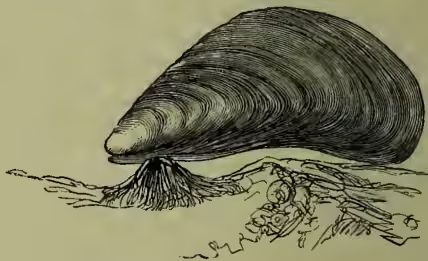
Byssus, an old name for silk-like threads secreted by the 'foot' or muscular ventral protrusion of many bivalve molluscs. The secretion is manufactured by a gland opening in a median posterior furrow, is at first fluid, but soon hardens into silky threads. The process may be readily watched in an aquarium. Its occurrence in the common mussel is very familiar. There, as in most other cases, the tufts of spreading threads serve to anchor the mollusc temporarily or permanently to its base of attachment. In other cases, however, it may be employed in binding together a rude nest (Crenella discors, Modiola vestita, Lima hians). In young forms also, as in the common fresh-water mussel, a byssus gland may be present weaving silken threads of attachment, but this does not appear to be exactly comparable to the adult organ. The silk of the very large Pinna nobilis is finer and more abundant than that of any other mollusc. It has been woven into small articles of dress, in early times for royal personages, now for lovers of curiosities. At Taranto, Reggio, and Cagliari in Italy, the byssus is still woven along with real silk into gloves, stockings, purses, and the like, but both demand and supply appear to be falling off. See BIVALVES, MOLLUSCA, MUSSEL, PINNA.