Byzantine Architecture is the style practised in Byzantium and the Eastern empire from the time of Constantine till the taking of Constantinople by the Turks in 1453, and of which the traditions are still preserved in the buildings of the Eastern Church. This style of architecture possesses considerable interest from its being one of the branches which grew out of the classic styles of Greece and Rome. Owing to the long continuance at Constantinople of part at least of the power and sovereignty of the Roman empire, and to the comparative exemption of the eastern capital from the invasions of the barbarians who overran and destroyed the monuments of the West, the transition from the classic forms of construction and design can be more clearly traced in the former than in the latter. When Constantine, in the beginning of the 4th century, removed the seat of the imperial court and government from Rome to Byzantium, he created in his new capital a fine field for the practice of the arts, and especially of architecture. Many new and splendid edifices were required, and every encouragement was given to those familiar with the constructive and decorative arts to come to Byzantium, and lend their aid in making the new city more splendid even than the old capital.
At this time Roman art was in its decadence. The classic forms and ornaments were debased and decrepit, and new features derived from the constructional elements of Roman building were beginning to supersede them. Thus, in the palace of Diocletian at Spalato, the horizontal classic entablature began to be carried round the arches, and the latter to spring directly from the capitals of the columns. In its transference to Constantinople this decaying Roman art came into contact with new elements, which inspired it with fresh life. The Romans were distinguished as constructors, and had elaborated the scientific use of the arch and vault on a great scale in their large edifices. These vaults were of several different kinds, comprising both the dome and the intersecting barrel vault. It is remarkable how the adoption of these forms of vaulting, the first by the Eastern and the last by the Western peoples, led to the development of the two great styles of the middle ages—the Byzantine and the Gothic. It seems certain that the Sassanians in Persia had practised the use of the dome for a considerable time, and it is probable that their vicinity to the meeting-point of East and West at Constantinople may have had an important influence in determining the final adoption and development of the domical form as the leading feature of Byzantine architecture. The same influence no doubt tended greatly to modify the classic details into those characteristic of the Byzantine style. The former being debased and worn out, the new ideas derived from the East were gladly seized upon, and in their turn inspired the artists with fresh vigour. The Greek element in the population also no doubt contributed to produce a strong influence on the taste and refinement displayed in this style.
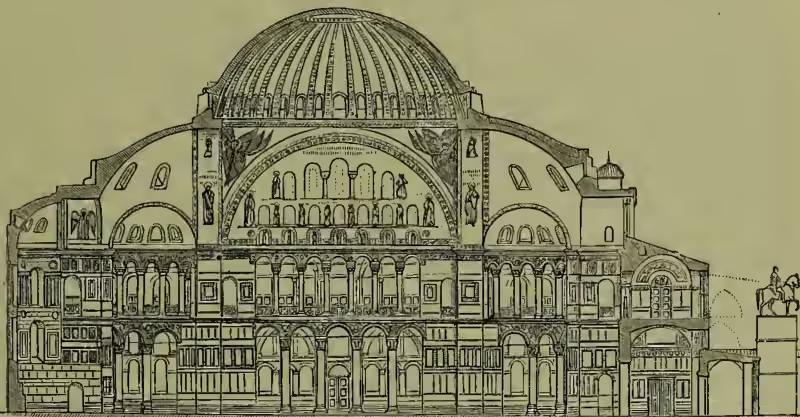
The churches built by Constantine seem to have been on the same plans as those of Italy—viz. either round or basilican in form. Of these two forms examples exist (although rebuilt) at Jerusalem and Bethlehem, and in both the ancient classic entablature and details are retained, while the arches spring from the capitals. By the time of Justinian, in the 6th century, the new style had been formed and fully developed in its main features. As above mentioned, the dome constituted the ruling element in the construction. The difficulty with this form was so to enlarge it as to give sufficient space for a great church. At first an aisle was placed round the central part (immediately under the dome), the latter being supported on eight pillars or piers. But these encumbered the floor and impeded the view, and after a time this inconvenience was obviated by the discovery that the dome might be supported on four pillars by corbelling out the angles between the circle and the square. This important invention enabled the design to be extended indefinitely by a number of domes, just as is the case with the groined arches of the West. The grandest example of this design is the church of St Sophia at Constantinople, built under Justinian, in the first half of the 6th century. There the interior is composed of a great central dome, 107 feet in diameter and 182 feet in height, carried on four piers, and length is given to the church by the addition of a semi-dome at either end. These also serve to sustain the pressure of the upper dome. The lower part of the building is divided up with small pillars and arches, which have the effect of enhancing the size and grandeur of the simple dome. The latter is pierced with a row of windows round its base. This feature became afterwards a constant one in Byzantine churches. Externally the sloping apertures looked awkward, and a series of upright arches was substituted, with a dome resting above them. This being a weak form of construction, it tended to limit the size of the domes used in later examples. One striking characteristic of the Byzantine style is the extensive use of coloured decoration. This is a notable feature in St Sophia, where the pillars are formed of and the walls are lined with the richest marbles, while the domes are adorned with splendid mosaics.
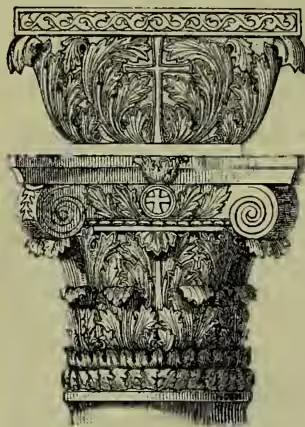
Byzantine ornament differs considerably from the classic as well as the Gothic of the West, being always flat and incised, while the latter is bold, and apparently applied to or projected from the structural form, as, for instance, in the cups. A curious reminiscence of the classic entablature is preserved in the block which usually intervenes in Byzantine architecture between the capital of the columns and the arch. The Byzantines were distinguished during the middle ages for all kinds of carving and metal-work, and there can be no doubt that these works of art had a great influence in the 12th century on the nascent art of the West, while their illuminations led the way to the revival of painting. The celebrated church of St Mark at Venice is a well-known example of the Byzantine style. It is, however, the only one in the West, and was doubtless the result of the commercial relations of Venice with the East. This church was copied soon after its erection in the 11th century at Perigueux, in Aquitania, and this fact led to the extensive use of the dome in that part of France. tania, and this fact led to the extensive use of the dome in that part of France.
BYZANTINE ART in general, developed at Constantinople under the same influences as Byzantine architecture, was mainly used for the decoration of churches. From the 6th century onwards for several centuries the most interesting remains of pictorial art were mosaics in the churches and miniature illustrations of Bibles and religious books. The Byzantine school, both in mosaic and painting, is characterised by a hierarchical stiffness in representing the human figure, by length and meagreness of limbs, features almost blank in expression, long, narrow eyes, and conventional attitudes. The colours, bright but crude, were often laid on a gold background. Yet even this type is superior in dignity and strength to the earliest Christian style of art, based on a degraded Roman pattern. The Byzantine style changed or developed very little for centuries, so that it is difficult to discover the date of a picture by internal evidence. It prevailed universally in Italy and other parts of Europe till the end of the 13th century, when Giotto (q.v.) broke from the Byzantine model which Cimabue (q.v.) still followed, and thus began the great renaissance of painting. The Byzantine method is still largely practised for religious subjects in Russia, Greece, and other countries belonging to the Greek Church. See ART, MOSAIC, PAINTING, RENAISSANCE.