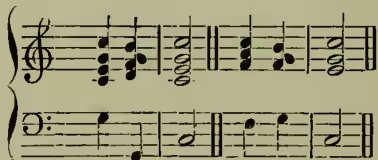
Cadence, in Music, is the close of a phrase; the term being generally applied to the final two chords of the phrase. There are three principal species—viz. the perfect, the imperfect, and the interrupted cadence. The perfect, also called the whole or final cadence, is generally used at the end of a composition or of an important section. Its final chord, either major or minor, must be on the tonic (in the solfa notation, doh)—i.e. it must have the key-note for its bass. This is preceded by a major chord on the dominant or fifth note of the scale (soh), as for example :
Another form consists of the progression from the chord of the subdominant (fah) to that of the tonic, as :
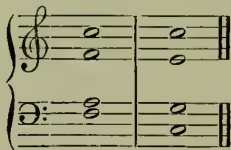
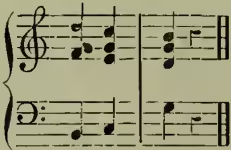
These two forms were formerly distinguished as the authentic and the plagal. The latter differs only as to its place in the scale from the next species, the imperfect or half cadence, which is like a colon or semicolon, for it is used to mark the termination, not of a composition or movement, but of an idea or section. Its harmony is often that of the perfect cadence reversed, as it must end on the dominant chord, which is most frequently preceded by the tonic chord, though sometimes by other chords, such as that of the subdominant (fah).
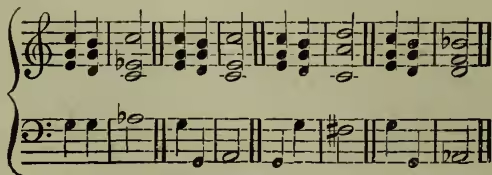
In the interrupted or false cadence the progression of chords is such as to lead to the expectation of a perfect cadence; but instead of the tonic chord, another harmony is unexpectedly introduced, often with strange and beautiful effect. This interruption may be made in so many ways that Reicha, in his Traité de Haute Composition Musicale, gives 129 varieties. The following are some of those most generally used :
In modern music, a desire for continuity and freedom from commonplace, has led to the avoidance of full cadences before the conclusion of a piece of music, and to the variation and disguise of them when they do occur. An extreme instance of this may be cited in Wagner's Tristan und Isolde, in the whole of which opera there is only one full close—at the end of act i.