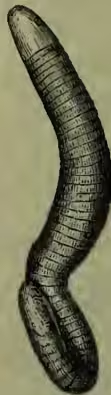
Cæcilia (Lat. cæcus, 'blind'), a genus of serpent-like amphibians, type of a small order of Gymnophiona, in which the body is worm-like, without tail or limbs, with transversely furrowed skin, and usually with small hidden scales. Their striking serpent-like appearance, suggestive too of the lizard slow-worm (Anguis), is simply an adaptation to similar semi-subterranean habits. The mouth is small, on the under side of the snout; there is an opening with a curious sensory organ beside each nostril; the eyes are not absent nor anatomically incomplete, but small and hidden under the skin; the tympanum and tympanic cavity are absent. Teeth are borne by jaws and gums; the tongue is fixed. The vertebral bodies are biconcave; the skull has two condyles; rudimentary ribs are borne by all the vertebrae except the first and last. Huxley notes that certain peculiarities in the skull are foreshadowed by the extinct giant amphibians or Labyrinthodonts. The cloaca is at the end of the tailless body. Rudimentary limb buds have been observed beside the cloaca. As in snakes, the right lung is much better developed than the left. That they are really amphibians is proved not merely by their anatomy, but by the gills borne by the young forms. In Ichthyophis (Epicerium) there are three beautiful plumose gills on each side; in Typhlonectis, a single pair, which used to be described as sacs, but are really leaf-like. They inhabit warm countries and damp places, burrow like earthworms, and eat worms and insects. About thirty species are known, and are very widely distributed. Cæcilia itself is a South American genus, about 20 inches in length, and the thickness of a large worm; Epicerium is found in Ceylon, Mexico, and Brazil; and Siphonops (over two feet in length) buries deeply in the soft earth of Brazil and elsewhere. The genera, of which 11 altogether are distinguished, are peculiarly divided; thus 5 species of Dermophis are American, and one is African. These animals should hardly be called 'blindworms.' It must be clearly recognised that the Gymnophiona (Cæcilia, &c.) are amphibians, the blindworms or slow-worms (Anguis) and the Amphisbænidæ are lizards, and that all have a superficial adaptive resemblance to snakes. See Claus, Text-book of Zoology, vol. ii.; Huxley, Anatomy of Vertebrate Animals; Leydig, Ueber die Schleichenwurche (1867); Wiedersheim, Anatomie der Gymnophionen (1879); Sarasin, Forschungen auf Ceylon (1887).