Cæsar, CAIUS JULIUS, son of a Roman prætor of the same name, was born 12th July 100 B.C., according to Mommsen in 102 B.C. His circumstances and connections made him a resolute adherent of the democratic party at Rome. His aunt Julia was wife of Caius Marius; and in 83 B.C. Julius himself was married to Cornelia, daughter of Lucius Cinna, one of the principal enemies of Sulla. The anger of the dictator at this marriage cost Cæsar his rank, property, and almost his life itself. Feeling that he would be safer abroad for a time, he went to Asia, 81 B.C.; but on learning the death of Sulla (78 B.C.), he hurried back to Rome, where he found the popular party in a state of great ferment, and anxious to regain what it had lost under the vigorous despotism of the aristocratic dictator. Cæsar, however, took no part in the attempts of Lepidus to overthrow the oligarchy; but he showed his political leanings by prosecuting (77 B.C.) Cnæus Dolabella—a great partisan of Sulla—for extortion in his province of Macedonia. To improve his eloquence, he went to Rhodes to study under the rhetor Apollonius Molo.
In 74 B.C. he returned to Rome, where he had been elected pontifex, and now for the first time threw himself earnestly into public life. He soon became the most active leader of the democratic party, and had a large share in effecting the agreement by which Pompey and Crassus accepted the popular policy. The result was the overthrow of the Sullan constitution in 70 B.C., and the restoration of popular institutions such as the tribunate. In 68 B.C. Cæsar obtained a quaestorship in Spain. On his return to Rome
(67 B.C.), he married Pompeia, a relative of Pompey, with whom he was daily becoming more intimate. In 65 B.C. he held the curule ædileship, and lavished vast sums of money on games and public buildings, by which he increased his already great popularity. For the next few years Cæsar is found steadily active on the popular side. In 63 B.C. he was elected pontifex maximus, and shortly after, prætor. During the same year occurred the famous debate on the Catiline conspiracy, in which the aristocratic party vainly endeavoured to persuade the consul, Cicero, to include Cæsar in the list of conspirators. It is believed by some that he was at least indirectly concerned in the conspiracy. In 62 B.C. Pompey returned from the East, and disbanded his army. Next year Cæsar obtained the province of Hispania Ulterior. His government of that province was useful to him as giving him military experience and supplying the means wherewith to meet his enormous debts. On his return he was elected consul, along with Calpurnius Bibulus.
With rare tact and sagacity Cæsar reconciled the two most powerful men in Rome, who were then at variance, Pompey and Crassus, and formed an alliance with them, known in history as the First Triumvirate (60 B.C.). Cæsar's proceedings during his consulship were marked by this policy of friendship to Pompey; he passed an agrarian law by which Pompey's veteran soldiers chiefly profited, and he obtained the ratification of that general's acts in the East. To strengthen the union which had been formed, Cæsar gave Pompey his daughter Julia in marriage, though she had been promised to Brutus; while he himself also married Calpurnia, daughter of Piso, his successor in the consulship. On the expiry of his term of office, he obtained for himself, by the popular vote, the province of Gallia Cisalpina and Illyricum for five years, to which the senate added—to prevent the popular assembly from doing so—the province of Gallia Transalpina. Nothing could have been more favourable for Cæsar's aims. He had now an opportunity of developing his extraordinary military genius, and of gathering round him an army of veterans, whom perpetual victory should inspire with thorough soldierly fidelity and devotion to his person. This was the very thing he wanted to give him a reputation equal to that of his coadjutors, Pompey and Crassus, whom in genius he far surpassed.
In 58 B.C. Cæsar repaired to his provinces, and during the next nine years conducted those splendid campaigns in Gaul by which he completed the subjugation of the West under the dominion of Rome. In his first campaign he defeated the Helvetii, and also Ariovistus, who with a large number of Germans had settled west of the Rhine. In 57 B.C. Cæsar broke up the Belgic confederacy and subdued the various tribes composing it, the greatest struggle being with the Nervii. When the senate received Cæsar's official despatches, it decreed a thanksgiving of 15 days—an honour never previously granted to any general. During the winter and the spring following Cæsar stayed at Lucca, where he had a memorable meeting with Pompey and Crassus, and for three years following agreed upon a common policy. It was decided that Pompey and Crassus should be consuls for the year 55 B.C., while the government of Cæsar in Gaul was to be prolonged for a second term of five years till 49 B.C. In the year 56 B.C. followed the subjugation of the Veneti and other peoples of Brittany and Normandy, and the conquest of Gaul might be considered complete. He now undertook a fourth campaign against two German tribes who were about to enter Gaul. He was again successful; and pursuing the fleeing enemy across the Rhine, spent eighteen days in plundering the district inhabited by the Sigambri. In the autumn of the same year (55 B.C.) he invaded Britain; but after a brief stay in the island, returned to Gaul. The Roman senate, astonished at his hardihood and his successes in regions where no Roman army had ever been before, accorded him a public thanksgiving of 20 days. In 54 B.C. Cæsar opened his fifth campaign by a second invasion of Britain, in which he crossed the Thames, and enforced at least the nominal submission of the British tribes in the south-east of the island. On his return to Gaul, Cæsar was compelled—on account of the scarcity of corn—to disperse his forces for winter quarters, and this encouraged some of the Gallic tribes to revolt. It led to the first serious reverse which Cæsar sustained in Gaul; a division of fifteen cohorts was entirely destroyed by the Eburones. But he was speedily master of the insurrection, and exacted a terrible vengeance on its authors. Cæsar now returned to Northern Italy, that he might be able to communicate more easily and securely with his friends at Rome. That city was gradually becoming more anarchic, the evils of weak government more apparent; the hour for decisive action seemed to be approaching, when there broke out a general rebellion of the Gauls, headed by a young warrior of the Arverni named Vercingetorix. It was in the dead of winter when the news came to Cæsar. Without delay he crossed the Cevennes mountains, though they were covered with snow to the depth of six feet. The struggle with Vercingetorix was a severe one; at Gergovia, the capital of the Arverni, Cæsar was defeated, and for a time his affairs seemed in a desperate condition. But he managed to unite his forces, and at the siege of Alesia (52 B.C.) crushed the whole hosts of the Gauls. Vercingetorix surrendered himself, and the independence of Gaul was at an end. Only some isolated tribes continued to resist; and next year (51 B.C.) Cæsar proceeded to quell them. This he successfully accomplished, and having in addition reduced the whole of Aquitania, passed the winter of his eighth campaign at Nemetocenna, in Belgium, where he spent the time in a magnanimous and politic manner. The Gallic princes were courteously and generously treated, and generally a mild system of government was set up, which made the Roman yoke as easy as possible. This was all the more necessary, as affairs at Rome urgently demanded attention. He took up his residence at Ravenna, where he was informed of everything that was going on by the tribune Curio, whose support he had purchased.
In the meantime Pompey had definitely gone over to the senatorial party. Many causes had contributed to this change of attitude. Pompey's wife, Cæsar's daughter Julia, was dead. Crassus had fallen in Asia in 53 B.C., and thus Cæsar and Pompey were left alone, the two most powerful men of Rome. Pompey was jealous of his younger rival. His natural tendency was to adhere to the old aristocratic party. He now cast in his lot with it, and it was decided to break the power of Cæsar. With this view it was necessary to deprive him of his command in Gaul. During the long manoeuvring which followed, Cæsar acted with the greatest moderation, and managed to throw upon his opponents the responsibility of violating the law. Under the direction of Pompey the senate summarily called upon him to resign the command and disband his army. The tribunes Mark Antony and Cassius put their veto on this motion; but they were violently driven out of the senate-chamber, and fearing for their lives, they fled to Cæsar's camp. Things had now come to an extremity. The senate intrusted Pompey with the duty of providing for the safety of the state. His forces far outnumbered Cæsar's legions, but they were scattered over the provinces of the empire, and the Italian levy was unprepared. In face of an enemy of such marvellous promptitude and energy as Julius Cæsar this dilatoriness was fatal. Perceiving that the time for energetic action had at length arrived, Cæsar harangued his victorious troops, who were willing to follow him anywhere; crossed the Rubicon (a small stream which separated his province from Italy Proper), and moved swiftly southwards. Pompey fled to Brundusium, pursued by Cæsar, but contrived to reach Greece in safety, 17th March, 49 B.C. The Italian cities everywhere opened their gates to the conqueror. In three months Cæsar was master of all Italy.
Cæsar next subdued Pompey's legates in Spain, who were at the head of considerable forces. On his return, he took Massilia, where he learned that he had been appointed dictator of the republic—a function which at this time he retained only for eleven days, but these were honourably distinguished by the passing of several humane enactments. Pompey, now thoroughly alive to the magnitude of his danger, had gathered in Egypt, Greece, and the East, a powerful army, while his fleet swept the sea. Cæsar, however, crossing the Adriatic at an unexpected season, made a rush for Dyrrhachium, where Pompey's stores were; but was nevertheless outstripped by his opponent. Pompey entrenched his army on some high ground near the city, where he was besieged by Cæsar. The first encounter was favourable to Pompey, who drove back Cæsar's legions with much loss. The latter now advanced into Thessaly, followed by his exulting enemies. A second battle ensued on the plains of Pharsalia, 9th August, 48 B.C. The senatorial army was utterly routed; and Pompey himself fled to Egypt, where he was murdered. See POMPEY.
No sooner had the news reached Rome, than Cæsar was again appointed dictator for a year, and consul for five years. He was invested with tribunician power for life, and with the right of holding all the magisterial comitia except those for the election of the plebeian tribunes. He did not, however, return to Rome after the battle of Pharsalia, but went to Egypt, then in a distracted condition on account of the disputes regarding the succession. Out of love for Cleopatra (who subsequently bore him a son), he entered upon the 'Alexandrine War,' in which he was successful, and which he brought to a close in March 47 B.C. He next overthrew a son of Mithridates, near Zela, in Pontus, August 2 of the same year, and arrived in Rome in September. He was once more appointed dictator, and the property of Pompey was confiscated and sold. Before the close of the year he had set out for Africa, where his campaign against the Pompeian generals, Scipio and Cato, was crowned with victory at the battle of Thapsus, April 6, 46 B.C. Cato committed suicide at Utica, and with such irresistible celerity was the work of subjugation carried on, that by the end of the summer Cæsar was once more in Rome. Now occurred that display of noble and wise generosity for which Cæsar may be regarded as truly great. He was not a man that could stoop to the vulgar atrocities of Marius or Sulla; he majestically declared that henceforth he had no enemies, that he would make no difference between Pompeians and Cæsarians. His victories in Gaul, Egypt, Pontus, and Africa were celebrated by four great triumphs, during which the whole Roman populace was feasted and fêted by the magnificent liberality of the dictator.
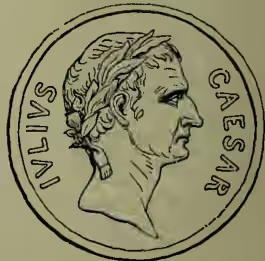
Cæsar now proceeded with his schemes for the settlement of affairs at Rome. During the year 46 B.C. he conferred a benefit on Rome and on the world by the reformation of the calendar, which had been greatly abused by the pontifical college for political purposes. After quelling an insurrection which broke out in Spain, where Pompey's sons, Cneius and Sextus, had collected an army, he received the title of 'Father of his Country,' and also of imperator, was made dictator and praefectus morum for life, and consul for ten years; his person was declared sacred, and even divine; he obtained a body-guard of knights and senators; his statue was placed in the temples; his portrait was struck on coins; the month Quintilis was called Julius in his honour; and on all public occasions he was permitted to wear the triumphal robe. He proposed to make a digest of the whole Roman law for public use, to found libraries for the same purpose, to drain the Pontine Marshes, to enlarge the harbour of Ostia, to dig a canal through the Isthmus of Corinth, and to quell the inroads of the barbarians on the eastern frontiers; but in the midst of these vast designs he was cut off by assassination on the Ides (15th) of March, 44 B.C. Of the sixty aristocrats who were in the conspiracy, many had partaken of Cæsar's generosity, and all of his clemency. A few, like Brutus, out of a weak and formal conscientiousness, based on theory rather than insight, were probably offended by Cæsar's desire to change the form of government into a hereditary monarchy; but the most, like Cassius, were inspired by very ordinary motives.
Cæsar, who was fifty-six years of age when he was murdered, was of a noble and kingly presence, tall of stature, with a countenance which, though pale and thin with thought, was always animated by the light of his black eyes. He was bald-headed (at least in the latter part of his life), wore no beard, and though of a rather delicate constitution naturally, he ultimately attained to the most vigorous health. In the completeness and variety of endowments he has had no equal. Both as general and statesman he takes a foremost place in the annals of the world; and excepting Cicero, he was the greatest orator of his time. As a historian, he has never been surpassed and rarely equalled in simplicity and in the terse directness and dignity of his style. He was, in addition, a mathematician, philologist, jurist, and architect, and always took great pleasure in literary society. The importance of Julius Cæsar in history depends chiefly on the work he did in the transformation of the Roman state from a republic to the rule of a single chief. The republican government of Rome was intended for a city with a limited population of burgesses and dependents. As its rule widened, this form of government proved more and more inadequate to the altered circumstances. Under the new conditions due unity and energy in the administration could be attained only through the rule of a single chief resting ultimately on the military power. During the anarchy of the later republic this was becoming apparent. Cæsar saw it with greater clearness than any of his contemporaries, and he had the genius and energy to bring it almost to realisation. His policy was on the whole the same as that more cautiously pursued by Augustus, to concentrate in his person the chief offices of state, and thus to establish a single rule under the old republican forms. Such a transformation was inevitable; and Cæsar, in the course he followed, simply brought the tendencies of the time to their own proper development. He was a realist statesman who worked towards attainable ends by such means as were available. Yet he showed a clemency and generosity of temper, a humanity and serene superiority to the mean and vulgar passions of the time, that in a moral point of view decidedly raise him above the level of his contemporaries.
Of Cæsar's works the Commentaries on the Gallic and Civil wars alone have been preserved. See Mommsen's Roman History (Eng. trans. 1866), and Drumann's Geschichte Roms; the works of Merivale and Arnold; Histoire de César, by Napoleon III.; Froude's Cæsar; Stoffel, Histoire de Jules César (1888); W. W. Fowler, Julius Cæsar and the Foundation of the Roman Imperial System (New York and London, 1892); Col. T. G. Dodge, Cæsar (in the 'Great Captains' series, Boston, 1893).