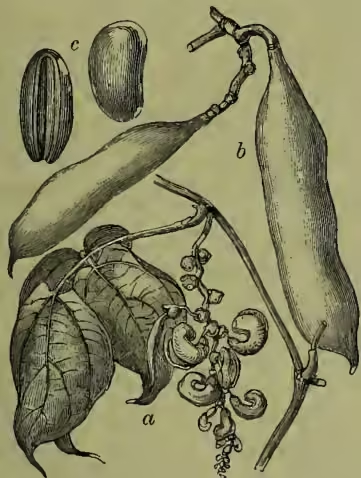
Calabar Bean, or the ordeal bean of Old Calabar, is the seed of Physostigma venenosum, of the order Leguminosæ. It is a climber nearly allied to the scarlet runner (Phaseolus multiflorus), but reaches a height of 50 feet or more, and is perennial, with a slender woody stem. It yields its virtues to alcohol, and imperfectly to water. It is used in the form of an emulsion by the natives of Africa, as an ordeal when persons are suspected of witchcraft; the accused being declared innocent if he can throw off the poison by vomiting. In 1855 the late Sir Robert Christison very nearly fell a victim to his zeal for science in experimenting with some specimens of this bean which had been sent to Edinburgh by some African missionaries, dangerous symptoms having been produced by 12 grains of the kernel which he swallowed. In 1861 Dr T. R. Fraser tried the effects upon himself of doses of 6, 8, and 10 grains. The general symptoms were epigastric uneasiness, great feebleness, dimness of vision, salivation, giddiness, and irregular, feeble, and slow heart's action. About the same time he made the interesting discovery that, when placed on the eyeball, this substance contracts the pupil, and produces near-sightedness; and it is now frequently employed for these purposes in ophthalmic surgery. It has also been administered in tetanus and other nervous diseases. Fraser has also shown that since its action is precisely contrary to that of belladonna or its active alkaloid atropine, the latter can with certainty be administered (even in quantities which would be injurious or fatal under ordinary circumstances) as an antidote to the other. The Calabar bean owes its activity to the presence of a very powerful alkaloid, called Eserin, which, in the form of gelatine discs, each containing th grain of eserin, is much used in ophthalmic operations; and sometimes similarly in solution as a local tonic to strengthen a relaxed power of accommodation. Eserin is used to contract the pupil, as belladonna relaxes it.