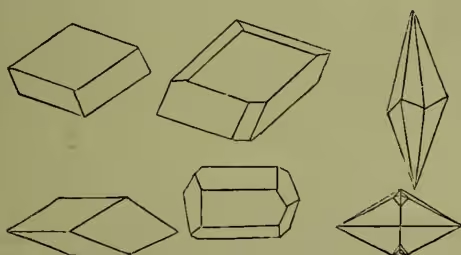
Calcite, CALCAREOUS SPAR, or CALC-SPAR, the name usually given by mineralogists to carbonate of lime, rhombohedral in its crystallisation. It differs from aragonite only in crystallisation (see ARAGONITE). Calcite is one of the commonest minerals. Marble, for example, is composed of small crystalline granules of this mineral. It is abundantly met with in very many rocks as a secondary mineral; that is to say, it is a decomposition-product—the result of the chemical alteration of various rock-constituents, such as the feldspars. Thus it frequently occurs in the cracks, fissures, and vesicles of igneous rocks (see AMYGDALOID). It often completely fills cavities in rocks of various origin; and although it has been prevented by want of space from assuming a crystalline form, is readily divided by the knife and hammer into rhomboids, the primary form of its crystals being a rhomboid, of which the greatest angles are . Its secondary forms are more numerous than those of any other mineral. More than seven hundred have been observed. One of the most common, a rather elongated pyramid, is sometimes called Dog-tooth Spar. Calcite is colourless and transparent, except in consequence of impurities which may be present in it; and when perfectly transparent, it exhibits in a high degree the property of double refraction of light, which was first discovered in it by Bartholinus. The presence of foreign substances frequently renders calcite gray, blue, green, yellow, red, brown, or even black.
The name Iceland Spar has often been given to calcite, at least to the finest colourless and transparent variety, because it is found in Iceland, filling up clefts and cavities in the basalt-rocks of that region. Slate Spar is a lamellar variety, often with a shining, pearly lustre, and a greasy feel, and is found in Wicklow in Ireland, Glen Tilt in Scotland, and Kongsberg in Norway.