Calendering is the term applied to the process of finishing by pressure the surface of linen, cotton, and other textile fabrics, as well as paper. It is usually done by passing the fabric between cylinders pressed together with great force. The familiar domestic processes of starching and ironing afford the simplest illustrations of the object and result of calendering. The patent domestic mangle effects the same object as the flat iron, and somewhat resembles the simpler calendering engines of the manufacturer.
In Beetling (q.v.), the cloth is beaten in a way which produces a supple, leathery finish; but in calendering, the pressure is applied continually across the whole width of the fabric, which stiffens it and gives it a finish more like paper.
Calenders are made with from 3 to 12 cylinders, usually called bowls, but the number of these does not commonly exceed six. There are always one or more of the bowls made of paper or cotton pressed into a solid mass by hydraulic apparatus. These have a hard yet considerably elastic surface, and are not liable to warp like wood. They require to be turned very accurately. The other bowls, where wood is not employed, are of steel, chilled cast-iron, or brass. One or more of the metal cylinders are made so that they can be heated with steam, gas, or hot iron bars.
Printed calicoes, after being starched, are usually smoothed by passing them between bowls or cylinders of hardwood and one of brass under considerable pressure. This is called mangling. What is called the Swiss finish for cotton fabrics is done by a similar process in which greater pressure is employed, but it is termed calendering. In the simplest machine three bowls are used, two of paper or cotton, and one of polished iron. A still higher gloss or glaze is put upon cloth by a friction calender in which the metal roller is driven at a slightly greater speed than the paper ones. Either hot or cold calendering may be employed for these fabrics, which are usually damped previously.
Jute and strong linen cloth are subjected to heavy calendering, the pressure being applied to the cylinders either by levers or hydraulic power. One kind of hydraulic calender for these goods works under a total pressure of eighty-five tons.
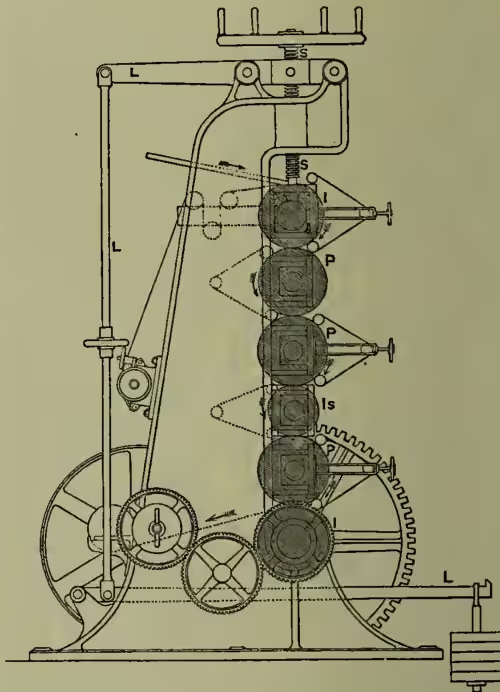
Calenders are now used at most paper-mills for putting a smooth finish, or it may be a high glaze, upon paper. The annexed figure shows one with six bowls. The three bowls, P, P, P, are made of compressed paper or cotton, and the other three, I, I, Is, are of chilled cast-iron. The bowl, Is, is heated with steam, and the care required in using this cylinder is shown by the fact that it must be turned on the inside as well as on the outside to insure a uniform temperature on the surface. This calender is 11 feet high, is driven by a steam-engine of 20 horse-power, and the maximum pressure applied does not exceed 10 tons. As the figure shows, the pressure is regulated by screws, S, and compound levers, L, one of each being attached to each of the two end frames. The arrows show the direction the paper takes over the cylinders.
Some calenders used for the swissing, or ordinary calendering, of calico have the same number of bowls as shown in the figure, but in them the paper and the metal ones are arranged alternately. Such calenders have the same arrangement of screws and compound levers. Machines similar in construction to the one above described, but with all the rollers of iron, and also called calenders, are used for rolling india-rubber into sheets for coats, shoes, &c.