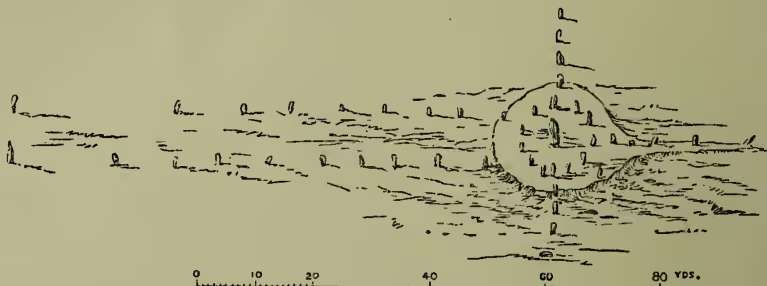
Callernish, a district on the west coast of the island of Lewis, 16 miles from Stornoway, remark- able for its stone circles. There are four at no great distance from one another, but without any visible relation. The principal one, of which the figure gives a bird's-eye view, is of a more than usually elaborate design. Two lines of upright stones run parallel to each other in a northerly direction, while a single line of similar stones is projected from the south, east, and west points, thus giving a cruciform figure to the structure, whose extreme dimensions are 408 by 130 feet. A larger stone than any of the others, being 17 feet high, and 5½ feet broad at the base, occupies the centre of the circle, which circle is 42 feet in diameter. The stones themselves are not columnar or shaped into any form; they are simply broad, flat blocks of gneiss—the all-prevailing rock from the Butt of Lewis to Barra Head. There are 13 stones in the circle, including the centre one, 19 in the avenue, 4 in each of the east and west, and 5 in the south arm. The peat, which in the lapse of centuries had accumulated around the base of the stones to a depth of 5 feet, was removed in 1858, when a chambered cairn was discovered within the circle. See Dr Joseph Anderson's Scotland in Pagan Times (1886).