Camberwell Beauty (Vanessa antiopa), one of the largest and most beautiful of British butterflies, rare in Britain, although it has been found in many parts of the country, but common in the central and southern parts of Europe, and having an extensive range in North America, where there are also two varieties, very close to the typical form. The wings are of a deep purplish-brown colour, with a band of black around the brown, and an outer band or margin of pale yellow, the black band containing a row of large blue spots, the yellow margin dappled with black or brown specks, all the colours rich and velvety. The margin of the wings exhibits tooth-like angularities. The antennae are terminated by a knob. The caterpillar feeds on the willow, elm, and poplar. It is black, with white dots and a row of large red spots down the back, and is rough with soft spines. When Camberwell (now a parliamentary borough in
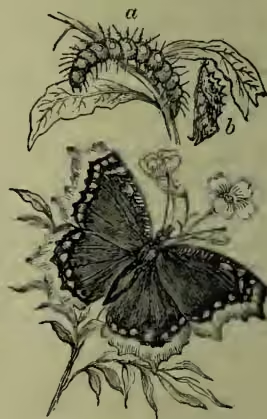
a, larva or caterpillar; b, pupa.
South London) was a rural place, and abounded in willows, this butterfly was sometimes taken there. V. Milberti is a smaller species common in the cooler parts of North America.