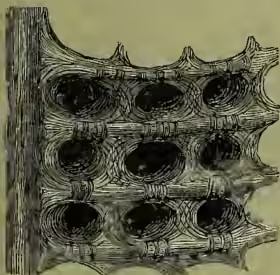
Camel (Lat. camélus; Heb. gámál), a genus of even-toed ruminant Ungulates (Artiodactyla, Ruminantia), and type of a small family—Camelidae or Tylopoda. In this family the dentition is peculiar, for of the three front teeth present in the young only one (the third) generally remains and looks like a canine; the upper lip is hairy and deeply cleft; the neck is very long, though the number of vertebrae remains as usual seven; the feet (with two toes) are not enhoofed, but provided with callous soles. Fig. 1 represents the bones of the lower part of fore-leg, showing the two toes and slightly divided metatarsal bones. The stomach has three compartments, the manyples or psalterium being absent; the placenta is diffuse. The family includes two genera—the Camels proper (Camelus) and the various forms of Alpaca (q.v., Auchenia). The camels are well known for their large size, for their dorsal humps, for their callosities on knees, breast, &c., for the common sole uniting the two toes. The ears are small and rounded; the short tail bears a terminal switch; the hair is tangled and felted; the male may protrude a curious pouch from the skin of the mouth at the reproductive season; the period of gestation is prolonged for eleven to thirteen months; a single young one is born; the diet is wholly vegetarian. Camel's blood has oval corpuscles (see BLOOD).

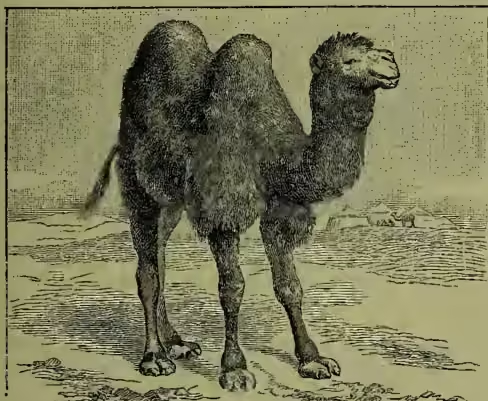
One species (C. dromedarius) is usually spoken of as the dromedary, though the title properly belongs only to a special breed. It has a single hump and a generally reddish-gray colour. This familiar 'ship of the desert' has its home in Arabia, is bred in West Asia and North Africa, and is literally indispensable to the Arabs. There are many breeds, and the dromedary par excellence is the most agile of these. Apart from its use in transit and transport, the flesh is eaten, the milk made into butter and cheese, the hair woven into fabrics of various degrees of fineness, the skin tanned, the 'dung burned as fuel; the soot of the burnt dung was formerly a source of sal-ammoniac. The dromedary is found as far east as India, whence twenty-four were imported into Australia for Burke and Wills's exploration (1860); it has also been introduced into parts of North America, and even into Europe. According to Prejevalsky, wild camels frequent the wastes to the east and north of Lake Lob-Nor in Central Asia. The other camel is technically known as C. bactrianus, and is distinguished by its slightly larger size, two dorsal humps, and somewhat finer brown or reddish hair. This camel is bred in Central Asia, and in its adaptability to domestication, as well as in its natural adaptation to desert life, is a most useful animal. Its frugal diet, its powers of storing water and of going long without a fresh supply, and its great strength, are very familiar facts. The sole uniting the toes, the callosities on chest and joints, the long sheltering eyelashes, the closable nostrils, the capacious water-pouches of the stomach (for the sake of which the Arabs at a pinch are said to sacrifice the camel), the reserve-supply of fat in the humps, the acute senses of sight and smell, are all interesting items in the adaptation of the camel to its life and work. The animal is peculiarly hardy, and can pass the rigours of a Siberian winter without apparent discomfort. Its coat becomes longer in winter. The shaggy undersized camels that drag sleighs over the deep snow of the Kirghiz steppes are very unlike their more southern relations. A camel will eat almost any herbage or green thing it comes across, even dried leafless twigs. The soles of the feet wear into the quick; and Gilmour (in his Mon-golia) tells us that they have often to be patched with leather, fastened by thongs drawn through the callosities. The hair of the camel forms the woof and cotton the warp of the famous Persian camel's-hair cloth. The so-called camel's-hair brushes are made of hairs from the tail of the sable or of some kinds of squirrel. Coarser camel's wool or hair is imported for various purposes.
The Bactrian camel can carry 1000 lb. weight or more, and the dromedary proper can cover 100 miles in a day. The ordinary jog of a camel is about 2½ miles an hour, but this can be kept up for many days with little food and less drink. A swift dromedary may go 10 miles an hour. A thousand or more may journey in a caravan, and the amount of food carried is surprisingly small. The hump must be in good condition before starting. Sir Samuel Baker says an
Arabian camel carrying a load of 400 lb. requires water every third day, or every 90 miles, though they should be watered daily, if possible; but in cold weather, or when not at work, they can remain much longer without any water. If not watered for three days, however, many suffer, unless specially trained. In the stomach-reservoirs a gallon and a half can be stowed away. Like some other frugal animals, the camel enjoys a long life of thirty or forty years. The swinging and jolting gait of the camel renders riding it (on a sort of platform on the hump) a severe ordeal for the uninitiated. The camel's burden is usually disposed on both sides of its back. The Kirghiz yoke camels to a kind of cart; and in Orenburg and elsewhere yokes of four camels may be seen ploughing.
In disposition the camel is peculiarly stolid, not to say stupid. Whether domestication has been too much for it, there can be no doubt that its 'docility' is more the result of habitual nonchal- ance than any outcome of intelligent subservience. It is usually very submissive, except when habitually thwarted or ill-treated, and during the breeding season; but it is often obstinate and vindictive.
Large fossil camels have been dug out from the Tertiary strata of the Siwalik Hills of India, and from the Quaternary deposits of Algeria. Professor Cope has traced a long line of descent from the Miocene Poebrotherium to the modern forms, and primitive forms have been described by Marsh and others from the Eocene strata. The former distribution of the family seems to have been much wider than the natural habitat of the forms now extant. The camel is often mentioned in Scripture, and appears on the sculptures of Assyria. Napoleon used camels for military purposes in Egypt; and a camel corps was organised for service with the British army in the Soudan in 1885. See Leonard, The Camel and its Uses (1894).