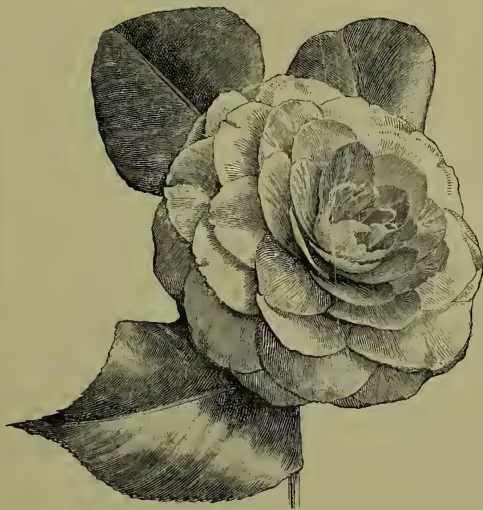
Camellia, a genus of Ternstroemiaceæ (q.v.), named after Kamel or Camellus, a Moravian Jesuit, who in 1639 collected plants in the Philippine Islands. The species are all oriental evergreen shrubs, and have long been cultivated in China and Japan, chiefly on account of the singular beauty of their flowers. The best known and most esteemed of these is C. japonica; in the wild state this has red flowers, recalling those of the wild rose; and in cultivation it yields new florists' varieties from seed, and also furnishes a stock on which to graft them. It was introduced into Europe by Lord Petre in 1739; but double varieties were only brought from China from 1792 onwards: many have also been raised by European florists, and the multitude of beautiful hybrids and varieties is now endless. Camellias may be propagated also by cuttings or layers, as well as by grafting or inarching. The soil suitable is a loose black mould, which may be prepared by mixing a little sand and peat with loam; and they must be watered liberally, yet with caution to avoid excess. The pruning also, which is performed in spring immediately after flowering, requires judgment, since it must be tolerably close, yet avoid extreme severity. In China and Japan the camellia is cultivated in the open air; and in the very similar climate of the Channel Islands this is also possible. In the south of England some of the hardier varieties can be trained on walls in sheltered localities with a little protection in winter; they may also be grown as window-plants, yet for practical purposes of cultivation on any adequate scale, a greenhouse is required. Care, however, must be taken to avoid much heat, else the flower-buds will drop off. From the hardy and beautiful C. reticulata not a few of the varieties now in cultivation are partly derived.—C. oleifera and drupifera are cultivated in China for the sake of the wholesome oil expressed from their seeds, which much resembles olive-oil. The fragrant flowers of C. Sasanqua (Sasanqua Tea) are used for flavouring certain kinds of tea. Like other species, its leaves also afford a kind of tea; in fact the true tea-plant (Thea) is practically a camellia. See TEA.