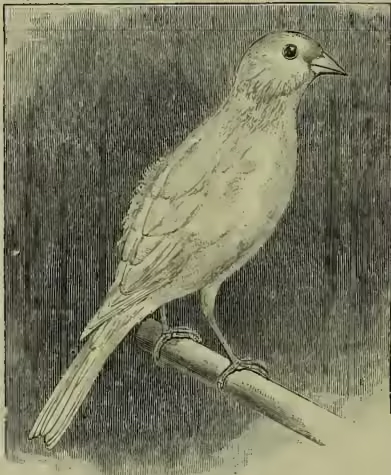
Canary Bird, a beautiful but very common cage-bird, much esteemed for its musical powers. It is one of the family of finches (Fringillidæ), and is Fringilla Canaria of Linnaeus. Some modern ornithologists place it in the genus Carduelis, others in Linota; it is indeed intermediate between these genera, the goldfinches and the linnets. It is found in Madeira, the Canary and Cape Verd Isles; frequents the neighbourhood of human habitations; builds its nest of moss, feathers, hair, &c., in thick, bushy, high shrubs or trees; and produces from two to four broods in a season. In its wild state its plumage is olive-green or greenish-yellow, tinged with brown, and the yellow cage-birds have been produced by selective breeding in domestication. It was brought to Europe in the beginning of the 16th century. It breeds readily in confinement, seems thoroughly reconciled to its cage-life, and if handled when young becomes very tame and fearless. In confinement the canary often breeds three or four times a year, laying from four to six eggs each time. The eggs are pale blue. The male assists the female in building the nest and in feeding the young. Besides canary and millet seed, which are their principal food, canaries are very fond of flowering groundsel and chickweed, a very small supply of which is necessary for their health; and one of their favourite luxuries is sugar. The canary not unfrequently lives 15 or 16 years. It can be taught various notes and airs, and even learn to articulate words. The rearing and training of canaries afford occupation to no small number of persons, particularly in the Tyrol. The canary hybridises readily with some other species of finch, producing 'mules,' some kinds of which are valued as song-birds. There are several species very closely allied to the canary, one of which, the Saffron Finch, a beautiful little bird, a native of Brazil, is sometimes sold in Britain as a song-bird, but its musical powers are very inferior to those of Fringilla Canaria.
Distinct varieties have been produced by scientific selective breeding, and these reproduce their distinctive characteristics, and 'like breeds like' so long as the varieties are not crossed. The hardiest are the Norwich; the largest are Lancashire Copies; the most costly and delicate are Belgians; and Lizards, London Fancies, Yorkshires, Scotch Fancies, and Cinnamons complete the list. By giving sponge-cake and cayenne pepper mixed, instead of seed at the period of moult, the plumage is artificially coloured, becoming very brilliant; and canaries apparently relish this fiery diet and thrive upon it. See CAGE-BIRDS; and works by Blakston (1880), Gedney (1884), Holden (1883), and F. Smith (1876).