Cannon is a general name for large pieces of ordnance or artillery, as distinguished from those which can be held in the hand while being fired. The first cannons were clumsy, wider at the mouth than at the chamber, and made of iron bars hooped together with iron rings, a form of construction very similar to that adopted for many modern guns. The balls fired from them were first stone, afterwards iron. Such a cannon is 'Mons Meg,' at Edinburgh Castle, which is believed to have been made in 1455 for the siege of Threave Castle by James II., who five years later was killed at the siege of Roxburgh by the bursting of a similar cannon, the 'Lion.' Various names for these early guns were bombards, culverins, serpentine, &c. At what exact date cannon were first used is not known (see FIREARMS); but under the name of 'crakys of war,' they were employed by Edward III. against the Scots in 1327, by the French at the siege of Puy Guillaume in 1338, and by Edward III. at Crécy and at Calais in 1346. Bombards of great length and power were employed by Louis XI. during his Flemish campaign in 1477; and as early as 1401 cannon had been cast in bronze at Nuremberg, Augsburg, and Marienburg in West Prussia. They were not cast in iron until the latter half of the 15th century. Probably the largest cannon of the 17th century was the Bijapur cast-iron gun, 'Malick é Meidan,' or 'Lord of the Plain,' made either by Aurungzebe or by the Mahrattas; it was 14 feet long, 28 inches bore, and fired a ball of 1600 lb. weight.
After the great European wars of the 17th century vast improvements were effected in the manufacture and use of cannon, which have, however, been far surpassed by those of recent years. The use of wrought-iron first, and then of steel, in their manufacture has enabled much more powerful guns to be made, thus meeting the demand for such weapons that has been created by the introduction of armour-clad vessels of war. The application of rifling to cannon has made it possible to fire from them elongated projectiles, which are at the same time heavier than the spherical shot suited to the same weapon and are better adapted by their form to penetrate the iron armour. All modern British guns are therefore rifled.
Smooth-bore cannon and Mortars (q.v.) of cast-iron and bronze are, however, still found in the armaments abroad, and some have also been retained in the British service at home for the defence of the flanks and ditches of fortresses, and to cover short avenues of approach at close quarters. For these purposes some smooth-bores are even being converted into breech-loaders. The following is a list of them:
BRONZE—Guns: 12, 9, 6, and 3 pounders. Howitzers: 32, 24, and 12 pounders; and inch diameter of bore. Mortars: and inch.
CAST-IRON—Carronades (q.v.): 32 and 24 pounders. Guns: 8-inch; 63, 32, 24, 18, 12, 9, and 6 pounders. Howitzers: 10 and 8 inch. Mortars: 13, 10, and 8 inch.
In 1864 a few wrought-iron smooth-bore 100 and 150 pounder guns were made for the navy, but they are now obsolete. In order to utilise the cast-iron guns in stock when rifled artillery became necessary, and because the granular nature of the metal was not suited to the process of rifling, many of them were bored out, and a coiled wrought-iron tube inserted. These are called converted guns. A few bronze rifled guns were made in 1870, but only two natures, the 9-pounder and the 7-pounder mountain-gun, for service in India, because it was thought that native artificers could work this metal; but the results were not on the whole considered satisfactory.
All cannon for the British service are now made either of steel or wrought-iron, or a combination of these two metals. The various sizes are very numerous. The following is a list of the principal armour-piercing guns, and their penetration into wrought-iron at a distance of 1000 yards:
| Calibre, inches. | Weight, tons. | Length, feet. | Weight of shell, lb. | Powder charge, lb. | Penetration, inches. |
|---|---|---|---|---|---|
| B.L. M.L. | 17.72 | 35 | 1965 | 450 | 22.8 |
| 16 | 27 | 1684 | 450 | 23.3 | |
| 12.5 | 38 | 805 | 210 | 17.7 | |
| 7 | 4.5 | 112 | 22 | 6.5 | |
| 10 | 32 | 27 | 500 | 21.2 | |
| 8 | 14 | 21 | 210 | 15.6 | |
| 6 | 5 | 17 | 100 | 10.3 | |
| 4 | 1.3 | 10 | 25 | 12 | 5.7 |
The muzzle-loading Howitzers are the 8-inch, 6.6-inch and 6.3-inch. The muzzle-loading field-guns are the 40, 25, 16, 13, 9, and 7 pounders, and the 2.5-inch and 15-pounder jointed guns for mountain service, formed in two parts, and screwed together when in use. Each part forms the load of one mule; and a 25-pounder on a similar plan was made at Elswick to be carried on elephants. The breech-loading field-guns are the 20, 12, and 6 pounders. Quick-firing breech-loading 3, 6, 8, and 36 pounders have been recently introduced, and a 70-pounder has been made. These guns fire from 10 to 15 aimed, or 20 to 30 unaimed shots per minute, as against 2 from an ordinary field-gun. Their introduction marks a distinct epoch in the history of cannon, and they are likely to be so useful for naval purposes, especially against torpedo boats, as to supersede all others of similar power. The rapidity with which they can be worked depends chiefly upon the manner in which the recoil is treated. There are two recoil-presses to each gun, consisting of pistons working in cylinders partly filled with water, which, when the gun is fired, with a gradually increasing resistance bring it to rest. The powerful new breech-loading Howitzers of the siege train are of varying calibre. The 6-inch one throws a lyddite shell (see SHELL) weighing 118 lb., and has a range up to 10,000 yards. It is fired with a high elevation, giving it the useful property of dropping its projectiles into places which cannot be reached by the ordinary gun.
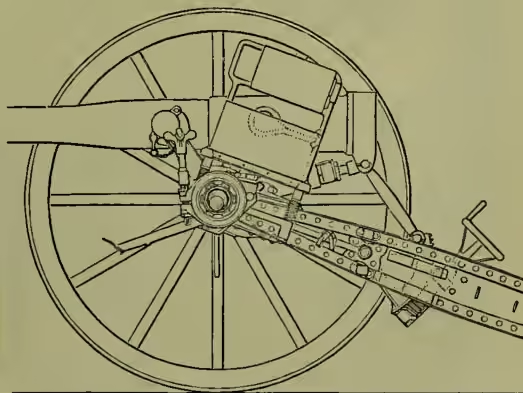
This principle has been applied to a 12-pounder field-gun, as shown in fig. 1; it is an adaptation of the hydraulic buffer used for many years to check the recoil of large cannon, but lately much improved by Mr Vavasour. In his recoil-cylinders the piston-head is in two parts, one of which is rotated by means of rifling. It is perforated with holes, which at first stand wide open, but are gradually closed by the revolving head of the piston as the gun moves backwards, thus equalising the strain.
Until 1888 the largest cannon was the 119-ton
Krupp, made in 1884 for Italy. But in 1888-90 the same house produced a 135-ton gun for Cronstadt. The heaviest guns in use in the British navy are the 111-ton guns of the Benbow (1885) and Sans Pareil. These throw a projectile weighing 1800 lb., with a charge of 900 lb. of brown prismatic powder with a muzzle velocity of 2216 feet per second, so as to penetrate 31.56 inches of iron at a distance of 2000 yards. But of late there has been a reaction in favour of lighter guns, and quick-firers. Wire-wound guns have found favour, and are made both at Elswick and Woolwich. The armament of the Majestic comprises four 12-inch 46-ton Woolwich wire-guns (round each of which is wound 102 miles of wire at a tension of 40 tons to the square inch, under a steel jacket); twelve 6-inch Elswick quick-firing wire-guns; sixteen Elswick 12-pounder quick-firers; and twelve 3-pounder Hotchkiss quick-firers. (See the article NAVY; and for smokeless powder, now so much in use, see GUN-COTTON.)
Range and Accuracy.—Some of the most powerful cannon are sighted for 8700 yards, and at that distance may be relied upon to strike an object 10 feet high. The 12-pounder pattern field-gun is sighted for 6000 yards, and the little 7-pounder mountain-gun for 3185 yards. In battle, however, fire would rarely be opened at a greater distance than 3000 yards owing to atmospheric difficulties and the limited range of human vision. The latter difficulty has to a great extent been surmounted and great accuracy of fire obtained by the use of telescopic sights, the invention (1879) of Lieutenant-colonel L. K. Scott, R.E., and by improvements in rangefinders. The presence of fog, mist, rain, &c. will always, however, interfere with artillery-fire at very long ranges.
Non-service Cannon.—Of the numerous varieties of cannon that have been produced by English manufacturers, but not adopted in the service, the type invented (1859) by the late Sir Joseph Whitworth is by far the most important. It is made of compressed steel, and its characteristic is a spiral, polygonal bore, taking a shot as shown in fig. 2, which is the counterpart of it. No rifling is therefore necessary. This gun has given excellent results, and has been supplied to many foreign powers.
Fig. 2.—Whitworth Forged Shell and Section.
The chief peculiarity of the gun invented (1874-84) by Lieutenant-colonel Hope, V.C., is the mode of igniting the cartridge, which is of abnormal length, and has inside it a little gun charged with a small amount of powder. This latter, on being ignited, starts the projectile, and at the same time fires the large cartridge at a great number of places through holes bored in the small gun at certain calculated distances along it. This device is stated to prevent the great strain to which a gun is subjected when fired, by the sudden expansion of the powder gases before the shot has actually moved, and therefore to enable a larger quantity of powder to be fired with useful effect. This gun has not been favourably received by artillery experts.
In 1883 Mr Mefford of Ohio designed a pneumatic gun to throw a shell charged with dynamite, and the idea was afterwards developed by Lieutenant Zalinski of the United States Artillery. One of these guns, 8 inches in calibre, was fired in 1887 at a vessel 2000 yards off, which its second shell, charged with 55 lb. of nitro-gelatine, completely destroyed. This formidable weapon was 60 feet long, and its barrel, which was not rifled, made of -inch wrought-iron, lined with -inch seamless brass tubing. The air-reservoirs had a capacity of 137 cubic feet. The projectile was made of seamless brass 40 inches long, with a conical cast-iron point. It was exploded by an electric fuse. A special eriser, the Vesuvius, was constructed by the United States government in 1889, to carry three such guns 54 feet long, but it was found impossible to take certain aim on shipboard. For harbour defence pneumatic dynamite guns are invaluable. In 1894 the United States government mounted three at New York and arranged for three at San Francisco, which weigh 40 tons, have a bore of 15 inches, and fire a shell 1000 lb. in weight (half being dynamite) a distance of 2400 yards; or, by adjustment, a shell of 240 lb. a distance of 6000 yards.
Before 1854 cannon were cast in iron, brass, or an alloy called gun-metal or bronze. This alloy, consisting of 90 parts of copper to 10 of tin, was expensive and difficult to work. The tin was often not properly amalgamated, and collected in patches, which, owing to its fusibility, formed holes in the bore. Gun-metal was therefore only used for the smaller natures, and after 1870 was abandoned (see BRONZE).
The heavier cannon were made of cast-iron, and in the United States Rodman's process of casting them hollow round a core filled with water was adopted. The interior of the bore being by this means cooled first, the metal was placed in a state of tension most favourable to resist the shock of discharge. By this process a cannon of 44 tons weight, capable of firing a shot of 9 cwt., was made at a cost of one-fourth that of a steel gun of the same power.
The process of converting cast-iron guns by Sir W. Palliser's method has already been alluded to.
About 1850 Herr Krupp in Germany, and Sir Joseph Whitworth in England, began to make guns wholly of cast-steel, and Lord Armstrong (then Sir William) introduced the system of coiled wrought-iron, which was adopted in 1859 by the Royal Gun Factories at Woolwich Arsenal as the cheapest and most reliable for the manufacture of cannon.
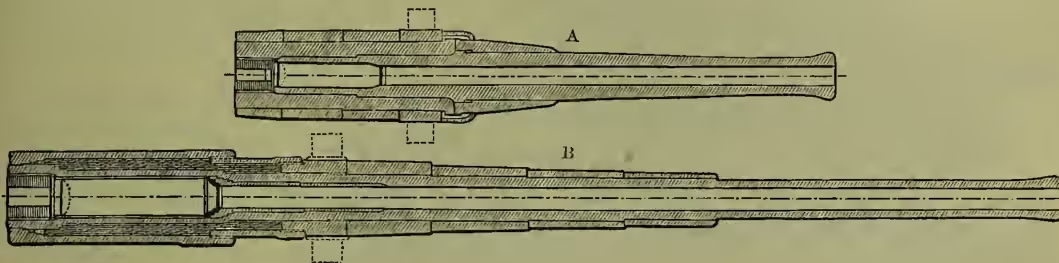
The strains to which a gun is subjected in firing are of two kinds, longitudinal and transverse or circumferential. The fibre of the metal is so disposed in the Armstrong 'built-up' guns as best to resist them. The process of manufacture is as follows: The bore, which must be of hard metal, is a tube of steel toughened and tempered by being plunged when heated into a bath of oil. Wrought-iron bars are then coiled, at red heat, round a mandrel, and welded under the steam-hammers into cylinders of sufficient interior dimensions to just pass over the tube when heated. On cooling they grip it tightly, and are thus most advantageously placed to resist any circumferential strain. They are also finished with interlocking shoulders which resist the longitudinal strain. Other similar coils are shrunk on over them for the larger guns. A solid trunnion-ring is hammered out and shrunk over the coils near the centre of gravity of the gun, and a 'cascable' or breech-loop screwed into the breech. At first many small coils were used, each finished in a lathe before the next was put over it, but Mr Fraser of the Royal Gun Factories introduced the method of shrinking on a few large coils in the rough, and thereby economised the process of manufacture. This Armstrong-Fraser method was long successfully employed. Owing, however, to the cheaper manufacture of steel by improved processes, and to greater facilities in working it, that metal has gradually superseded wrought-iron, and though, when alloyed with manganese, it could be coiled in the same way, it was determined after experiments in 1881 to discard that system of manufacture. Hoops of cast-steel are now cut out of the ingot as discs, then punched and mandrelled out into rings, or the ingot is drawn out under the steam-hammer and trepanned; the latter process being specially adapted to the manufacture of the inner tube of a breech-loading gun, and the former to that of the outer rings. Additional precautions are taken to prevent the hoops slipping over one another. In some cases grooves are cut on the outer surface of one and the inner surface of the other, so as to form annular spaces, which are then filled up with a bronze alloy said to expand on cooling. In others the ends of the hoops are slotted away so as to form alternate projections and intervals which correspond. The outer hoop, expanded by heat, is passed over the inner one, and turned round so as to bring the projections opposite to one another. Long steel wedges are then driven into the intervals to prevent any slipping round. The largest cannon have four layers of hoops round the inner tube from the breech to the trunnions, after which they gradually decrease in number to one at the muzzle. The inner tube, in the most recent patterns, has a thin steel lining extending for about two-thirds of its length from the breech, which, when damaged, can be easily taken out and replaced by a new one, thus practically giving the gun a new life.
Both Lord Armstrong's factory at Elswick and the Royal Gun Factories at Woolwich experimented in 1883-88 with wire guns. The construction is similar to the above, except that the inner tube is at first made thicker at the breech end and then turned down at the part which incloses the powder chamber, and therefore requires to be the stronger. Round this part is then coiled a flat steel wire or riband having a breaking strain of 100 tons to the square inch, and over the wire are shrunk outer hoops of forged steel locked together as above described. Such a gun (fig. 3, B), 9.2 inches calibre, weighing only 19 tons, has been made at Woolwich Arsenal, and when fired with a charge of 330 lb. of powder and a shell of 380 lb. weight, it penetrated 23.2 inches of wrought-iron at 1000 yards. This weapon may be considered the best and newest specimen of heavy cannon.
No heavy gun can be made under fifteen months, and a much longer time is usually required, especially if the steel ingot from which the inner tube is to be made turns out faulty. The following approximate figures in round numbers are of interest:
| Cost of 17.72-inch 100-ton Woolwich gun ..... | £19,500 |
| Turret carriage, and slide..... | 3,850 |
| Cost of one discharge ..... | 35 |
| Cost of 10-inch 32-ton breech-loading gun..... | 6,000 |
| Turret carriage, and gear..... | 1,013 |
| Cost of one round ..... | 12 |
| Cost of 12-pounder field-gun and carriage ..... | 550 |
| Cost of one round..... | 11 shillings. |
It may be noted that the German government subsidises Baron Krupp's establishment at Essen, which supplies it and many foreign nations with cannon, and that the British government, on the other hand, maintains the Royal Gun Factories at Woolwich, and merely gives orders to the Elswick, Whitworth, and other factories for guns, steel forgings, and armour plates, on the same principle that it employs private shipbuilders to supplement the resources of the royal dockyards.
France constructs all her own cannon. As recently as 1877 her field-guns were of bronze, and her heavy ordnance of cast-iron strengthened by wrought-iron or steel hoops. These were superseded by steel guns on De Bange's system. Their construction is very similar to that described above, and rifled breech-loading guns, 74 tons in weight, capable of piercing 24.9 inches of iron at 1000 yards are in the service. Extensive manufacture of modern guns of all kinds is carried on at Creusot (q.v.). The greater part of the artillery used by the Boers in the Transvaal war (1899-1900) was supplied from these foundries.
Russia until 1876 was dependent upon Krupp for rifled guns, and still obtains steel projectiles from his factory; but in that year the Obukhov works commenced the construction of cannon, similar to his, of steel compressed by Whitworth's process. The field-guns from these works rank next in ex- up to 7-inch calibre from the same alloy, has discarded it, and now procures her cannon from Baron Krupp.
The United States have always excelled in casting heavy iron guns on Rodman's system, and a great many are on hand. It is also found impossible to produce the steel required for modern guns in the country, and the South Berlin workshop has therefore been engaged in converting cast-iron smooth-bore guns into rifled weapons by tubing them with steel, and strengthening them with steel jackets and coils. In 1885 such a converted breech-loading gun of 12-inch calibre, fired with 265 lb. of cocoa powder and an 800-lb. shot, gave a muzzle velocity of 1711 feet per second, and a pressure of 14.35 tons. In the same year the steel tube and coils of a 6-inch breech-loading gun of 5 tons were put together at South Berlin, and a 12-inch breech-loading steel wire gun of 53 tons was commenced, the steel cellence to the French, which are considered by artillerists second only to the British. The best known and most effective of their guns is the 12-inch rifle breech-loader of 50 tons. Its penetration into iron at 1000 yards is 22.3 inches. An 8-inch screwed-up gun of 5.5 tons, in four pieces, was designed in 1876 by Captain Kolokolzor, of the Russian Artillery, and did good service at Rustschuk against the Turks in the following year.
Italy has some field-guns of compressed bronze, and others of cast-steel from Krupp's factory, Elswick supplying her naval and coast defence weapons. In 1878 a tube, 50 tons in weight, was cast in iron at Turin by Rodman's process, and afterwards strengthened with three concentric steel rings, making up a total weight of 100 tons. This being procured from the Whitworth foundry. These were soon after in use in the service.
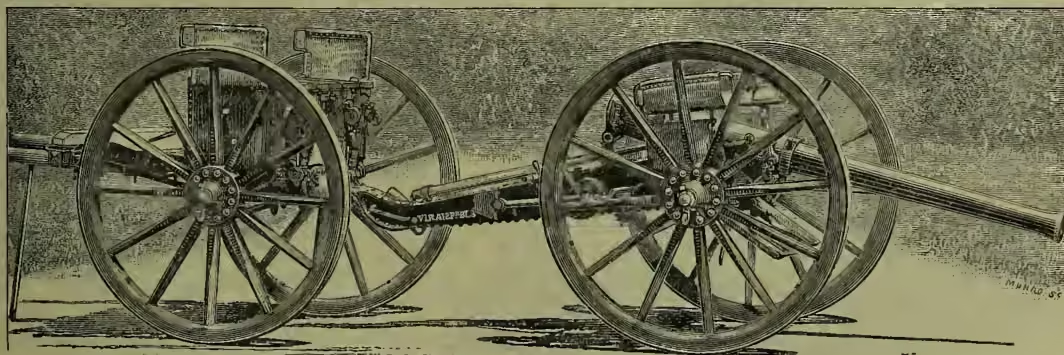
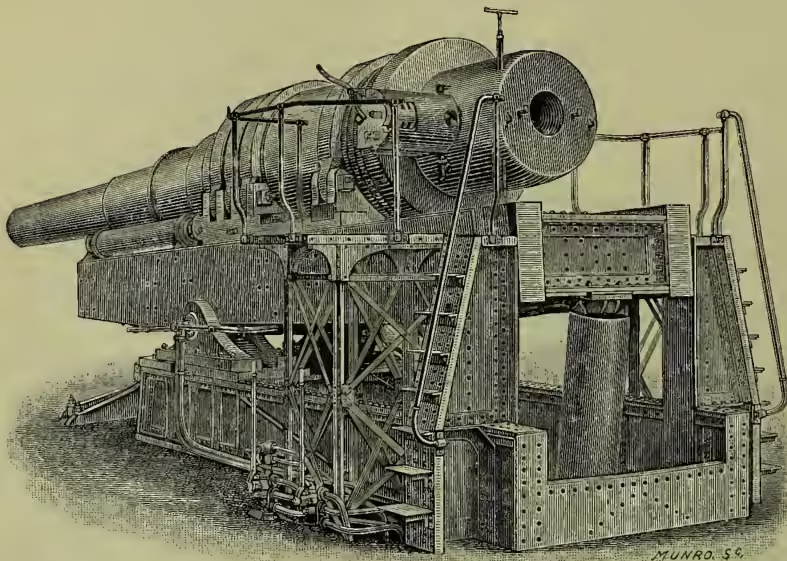
Gun-carriages.—These vary with the nature and use of the cannon. Field-guns, intended to move across country, are mounted as in fig. 4, which shows one fitted with steel limber-boxes. When in action the 'trail' is unhooked from the 'limber,' in which ammunition is carried. This is the weapon which has of late years been supplied to the British Field Artillery. Heavy guns are mounted on carriages working on platforms or on 'mountings' in fortresses, and on slides on board ship. Fig. 5 shows one of the latter class with hydraulic appliances for elevating or depressing the gun by raising or lowering the slide, and for training it to the right or left. Hitherto the first of these movements was effected by elevating gear under the breech of the gun, and the other by mounting the slide on trucks running on racers. Hydraulic power is now used also for raising the heavy projectiles, and for ramming them home, as well as for rotating the turret when a gun is mounted in one. The lighter natures of quick-firing guns are mounted, when in forts or on board ship, on fixed pedestals, and on carriages similar to those for field-guns when intended to accompany troops in the field. The brackets which support the slide of the heavier natures work on trunnions and rotate on a central pivot. Elevation or depression is given by moving the brackets on their trunnions, so that the axis of the gun, and therefore the direction of the recoil, is always parallel to the slide on which it rests.
Except the wheels and shafts of field-gun carriages, steel is the material now used for all the chief parts of these constructions, the smaller fittings being of gun-metal.
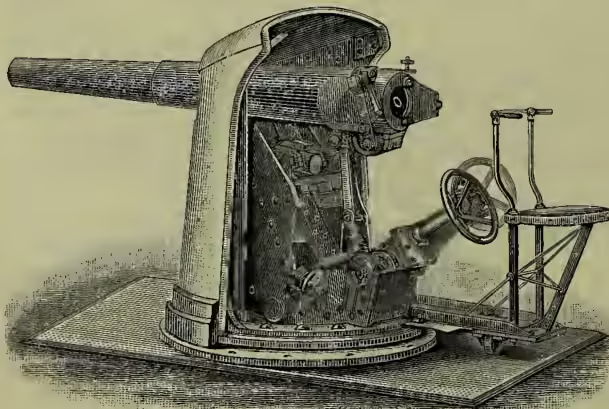
A form of carriage by which the recoil is utilised so as to cause the gun to disappear, will be found described under MONCRIEFF PITS. gun, 17.72-inch calibre, was designed by General Rosset of the Italian army, and with a muzzle velocity of 1480 feet per second, penetrated 23 inches of iron at 1000 yards.
Austria after adopting compressed steel-bronze (Uchatius metal) for her field-guns, and others
Since 1896 the German artillery have been armed with a quick-firing field-gun having a side-wedge breech mechanism of the Krupp type. The calibre is slightly larger than the British 15-pounder and 12-pounder, and the muzzle velocity is somewhat less. It is used for shrapnel as well as highly-explosive shells, their weight being about 15 lb. The carriages and limbers are of a lighter construction than those of the British, so that the field and horse artillery equipments may be practically similar.
The various methods of closing the breech of a gun are described under BREECH-LOADING, the systems of rifling under RIFLE. See also ARMSTRONG, ARTILLERY, CARONADES, CARTRIDGE, ESSEN, GUNNERY, GUNPOWDER, KRUPP, MACHINE GUN, MORTAR, and SHELL.