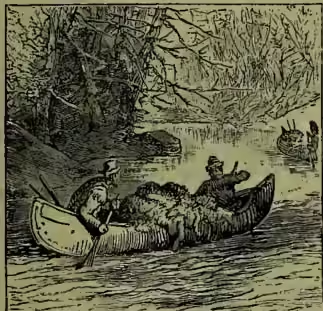
Canoe (from a Caribbean word through the Span. canoa), originally, a light narrow boat, made of the hollowed stem of a tree or of bark, and propelled by paddles. The ancient British and many native canoes are 'dug-outs,' being simply stems of trees hollowed by stone implements, shells, or fire, and then shaped, and often sharpened at either end; canoes hollowed out of the trunks of oaks have been dug up in considerable numbers in the United Kingdom. The Canadian birch-bark canoe is a light, buoyant, frail-looking, but serviceable bark. In building it a skeleton is made of light wood, the casing of birch-bark is put on transversely, with the broadest strips amidships, and sewn together with the fibrous roots of fir-trees, while the seams are dressed with gum. It has no keel, and neither stem nor stern, but runs to a point at each end; and neither nails nor pegs are used in its construction. The outer skin of the 'Canadian' canoes so popular on the Thames is made of alternate strips of light and dark hard-grained woods, inch thick, grooved, bound, and glued together; a layer of broader strips, placed crosswise, forms the inner skin. The timber used is steamed and bent when moist on to a mould the exact size of the proposed canoe. The birch-bark canoes of South America and the native Australian gum-tree bark canoe are made of one piece of bark. Esquimaux canoes are generally of seal or walrus skin stretched over whalebone; some Labrador canoes have a round hole or well in the centre for the occupant, and are light enough to be carried on the head. The canoe of Greenland and Hudson Strait is flat-bottomed and flat-sided. Many of the Polynesian canoes are hollowed out of a single log. Others are of planks cunningly fastened together, and fitted with outriggers. The Malay and Dyak canoes are long and narrow. The largest Fiji canoes are 100 feet long, and the double ones—with deck placed between them—of 70 feet can carry from 40 to 50 persons. Those of the Solomon Islands have a palette-shaped sail made of a mat. The war canoes have often elaborately carved ends. Mr Stanley in his descent of the Congo encountered a war canoe with 40 men rowing on each side, and 10 in the bow, while 8 men guided at the stern with ivory-tipped paddles. Two or three of his own canoes for exploring purposes were of teak, 70 feet long, and very heavy. Others, on the inland African lakes, are made of reeds. See the articles CATAMARAN, PROA, &c.
Modern British canoes have been made of paper, tin, and india-rubber, but they are usually constructed of oak, cedar, or pine. A tin canoe was sailed on the Thames in 1847, and an Esquimaux canoe had been exhibited there prior to that date; but the revival of British canoeing is due to the achievements and lectures (since 1850) of Mr John MacGregor (see the article under that head), the profits of whose lectures and published works on the subject—upwards of £10,000—were wholly devoted to philanthropic institutions. His Rob Roy canoe for navigating eastern waters was 14 feet long, 26 inches wide, with a 7-foot paddle; and its weight, including paddles, masts, and sails, was 72 lb. It was of oak below, decked with cedar, had an apron of white waterproof, and the sails were dyed blue to resist the glare of the sun. But of late years the type of canoe has greatly changed. Messrs Tredwen and Baden-Powell's Pearl and Nautilus canoes have both the head of the boat raised and its shoulder broadened, the modern cruising canoe being on an average 15 feet long, with a 30-inch beam; they are mostly fitted with two larger sails, and, with a metal centre-board and deep rudder, can sail as close to the wind, when tacking, as a yacht. Mr T. H. Holding's Severn canoe (1887), weighing 136-175 lb., has been largely adopted both in England and Scotland. The Royal Canoe Club rules limit the weight of cruising canoes to 200 lb., and the sail area to 75 square feet. A minor improvement of some importance was the invention of the back-board on movable centres, with a deviation which leaves the spine untouched, by means of which the canoeist can lean back at any angle. A speed of 40 miles a day has been covered on lakes and smooth water; racing canoes 20 feet long, and 18 inches broad, attain a speed of 8 miles an hour. Latterly a new mode of sailing has come into use: instead of sitting in the well, the crew sits on the side of the deck, just aft amidships, and thus leans outward to balance the wind pressure, steering the boat by a tiller fitted on deck. The long-voyage equipment for a canoeist must include most of the following articles for boat gear—tent, cooking apparatus, compass, cork seat, painter, air-bed, pistol or revolver, lamp, water-bottle, waterproof sheet, fishing appliances, &c.; and for dress—a pith hat, woven cap, Norfolk jackets, flannel trousers, shirts, and under-vests, cape and hood, sou'-wester, shoes, Macintosh coat, waterproof boots, slippers, and brushes and comb, &c.
The Royal Canoe Club, of which H.R.H. the Prince of Wales is commodore, was founded in 1866, and has now 200 members in different parts of the world. There are some honorary lady members. It is said that only one member of the club has lost his life, and on that occasion his canoe came safely to land with its sails and flags flying: the occupant had fallen out and perished in bog water. Indeed, the modern canoe, in spite of its great sail area, is the safest type of pleasure-boat existing, and will ride out open boats many times its size. Hull, Liverpool, Newcastle, Sunderland, Birmingham, Glasgow, and Leith have all their contingent of canoeists. The British Canoe Association (founded in 1887) has about 70 members, and holds an annual meet. The American Canoe Club numbered some 5000 members in 1888. The Octoroon, 16 feet long and 23 inches broad, crossed from Boulogne to Dover in 11 hours, 19th August 1867; Mr Fowler crossed from Boulogne to Sandgate, standing in an india-rubber twin canoe (the Podoscaphie), in 12 hours, 19th August 1878; and in 1887 a youth named Henderson paddled from Dover to Calais in a very small canoe in 11 hours, having with him neither food nor water.
See MacGregor's A Thousand Miles in the Rob Roy Canoe, and Rob Roy on the Baltie, Jordan, and Zuyder Zee; Baden-Powell's Canoe Travelling (1871); Inwards' Cruise of the Ringleader; R. L. Stevenson's Inland Voyage; Holding's Cruise of the Osprey (1878), and Watery Wanderings (1886); Bishop's Voyage of the Paper Canoe (Boston, 1878); and R. G. Thwaites's Historic Waterways (Chicago, 1888). A list of works is appended to the rules of the R. C. C. The Model Yachtsman and Canoeist is the organ of the sport in England, and the Field contains reports; the American Canoeist represents the American Canoe Association.